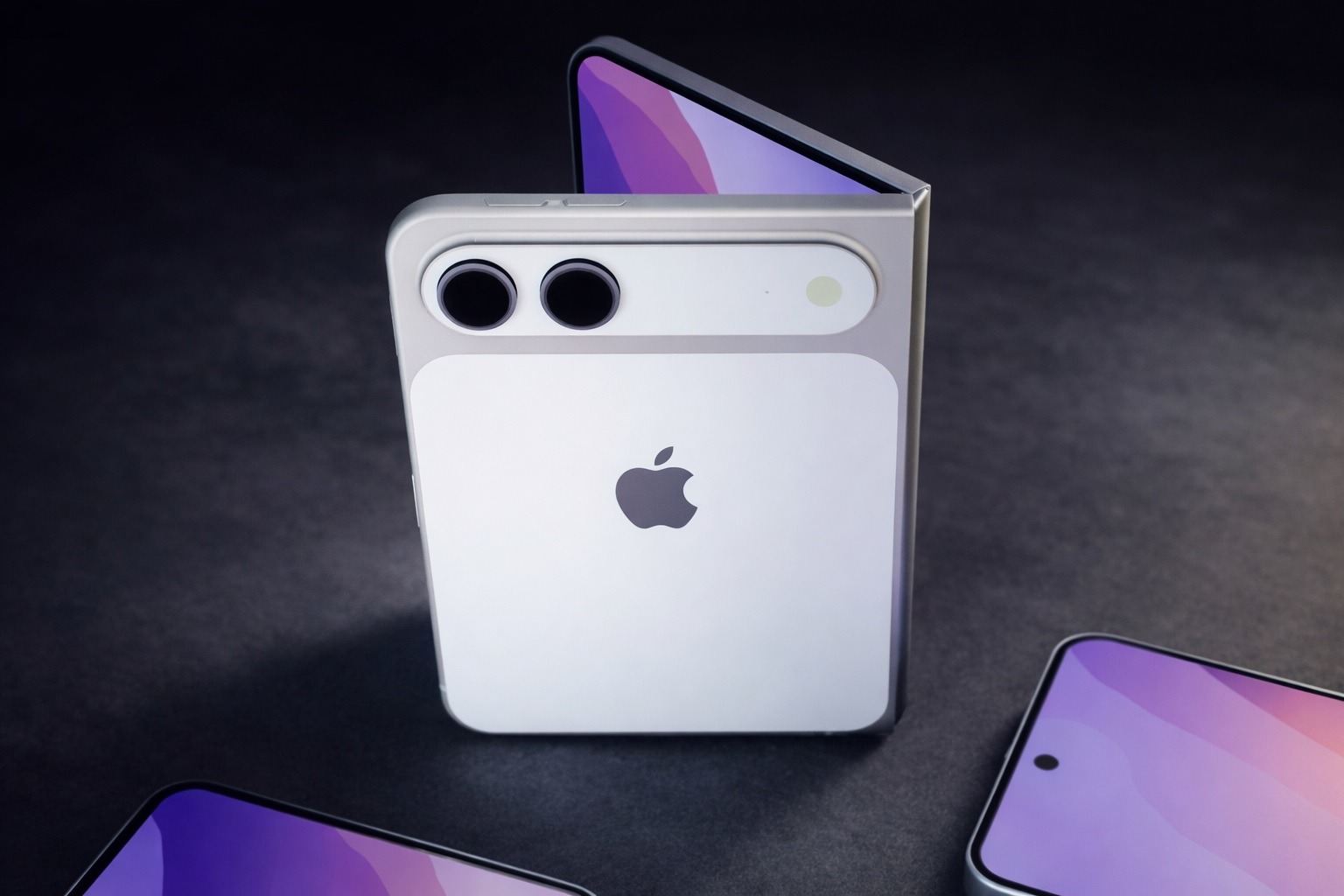

A crease‑less foldable OLED prototype briefly appeared at CES 2026—fueling fresh iPhone Fold speculation. Here’s the latest on Samsung Display’s “R&D concept” panel, Apple’s rumored crease‑free strategy, CoE OLED tech, and what’s next for iPhone launches in 2026.
The crease is finally disappearing — and it’s reigniting iPhone Fold hype
CES 2026 is usually where companies show the future first—and this week, the foldable future briefly looked surprisingly “finished.” Multiple reports say Samsung Display showcased a crease‑less foldable OLED panel at its CES booth, positioned right next to the Galaxy Z Fold 7’s more typical foldable screen for a direct comparison. Then, almost as quickly, it was gone. MacRumors
That short-lived appearance matters because Apple’s long-rumored foldable iPhone—often referred to as the “iPhone Fold”—has been linked repeatedly to Samsung Display as a key supplier. In other words: when Samsung Display flashes a near-invisible-crease foldable panel at CES, the Apple world pays attention. 9to5Mac
What’s new today (Jan 10): the rumor machine is consolidating
Roundups published today continue to converge on a similar narrative: a fall 2026 window is widely expected by many watchers, the device likely uses a book-style fold, and Apple is said to be chasing a foldable experience that feels more like “an iPad you can fold into your pocket” than a tall, narrow Android foldable. India Today
What was actually spotted at CES 2026?
Across Samsung-focused and Apple-focused outlets, the core sighting is consistent:
- Samsung Display showed a new foldable OLED panel in a “crease test” / comparison setup beside an existing foldable screen. SamMobile
- Observers described the crease as practically invisible even from angles where foldable creases usually become obvious.
- The display setup later disappeared from the booth, prompting fresh speculation that it wasn’t meant to be shown publicly.
Samsung Display’s public position, as quoted by multiple outlets, is that this panel was an R&D concept without a fixed commercialization plan.
If it’s an R&D concept, why is everyone linking it to iPhone Fold?
Because Apple’s “why now?” story for foldables has always been simple: Apple wouldn’t ship a foldable iPhone until it could do it without the typical compromises—and the crease has been the most visible compromise in the category.
One 9to5Mac report frames it as Apple rejecting a visible crease and pushing its display partner to build something better—suggesting this “crease-less” moment is a major milestone for the supply chain Apple would rely on. 9to5Mac
Macworld makes the same basic point from a different angle: foldables have to solve two mainstream problems—hinge durability and killing the crease—and this prototype signals meaningful progress on the second.
Meanwhile, MacRumors stresses an important nuance: even if Samsung Display can build a crease-less panel, the specific stack/lamination/materials for Apple’s foldable could still differ, because Apple is rumored to be deeply involved in the structure and requirements.
The “CoE OLED” twist: thinner, brighter, more efficient
Beyond the crease itself, a separate—but related—thread has become a major talking point this week: Apple is reportedly evaluating (or adopting) a Samsung-made OLED approach called CoE (Color Filter on Encapsulation).
According to reporting cited in South Korea’s The Elec, CoE can replace the typical polarizer layer with a color filter approach and other process changes—potentially improving light transmission, saving power, and enabling thinner panels.
MacRumors adds that this CoE approach could debut first in the iPhone Fold and later influence a future “iPhone Air” refresh, emphasizing the “thinner + brighter” upside. MacRumors
Why this matters for the foldable iPhone:
- A foldable’s hinge and layered display stack already fight for space.
- Any meaningful reduction in thickness (without sacrificing brightness or battery life) is a competitive advantage.
- If Apple’s foldable is priced at the very top of the iPhone lineup, the company will want a display story that feels measurably better—not merely “also foldable.” MacRumors
iPhone Fold: the most repeated specs and design expectations as of Jan 10, 2026
Nothing here is confirmed by Apple—but the repeated claims across multiple reports and rumor roundups are starting to cluster.
1) Book-style fold with two screens
The broad consensus remains a Galaxy Z Fold-style “book” fold rather than a clamshell flip. India Today
2) Display sizes around “pocket iPad” territory
Frequently cited ranges:
- Inner display: roughly 7.5–7.8 inches (varies by report)
- Outer display: roughly 5.3–5.5 inches
MacRumors also highlights an important design implication: those dimensions would yield a squatter, wider look when opened, closer to a 4:3-ish tablet feel than the tall, narrow foldables we’ve gotten used to.
3) “Crease‑free” as a defining feature
Across CES coverage and iPhone Fold reporting, the central claim is that Apple is aiming for a near-invisible crease (or “zero crease” in some phrasing). 9to5Mac
4) Premium materials and a serious hinge
Reports and commentary repeatedly point to hinge engineering and reinforcement as key to Apple’s foldable strategy. Macworld specifically mentions a hinge made from ultra-durable metallic glass marketed as LiquidMetal. Macworld
Other reporting also frames hinge durability as a prime focus if Apple wants a mainstream-ready foldable.
5) Price: “Ultra-premium,” potentially around $2,000+
Multiple reports continue to peg the first foldable iPhone as an ultra-premium product—often described as $2,000 or more.
CES 2026 is also a reminder: foldables are escalating fast
Even outside Apple rumors, the broader foldable market has been moving quickly—and at very high price points—heading into 2026. Reuters reported in late 2025 that Samsung unveiled its first multi-folding phone, underscoring both the technical ambition in the category and the reality that top-end foldables can reach prices well north of $2,000.
That context helps explain why Apple would be picky: if the first foldable iPhone arrives at the top of the market, it can’t look like a “first try.”
The other Apple rumors riding alongside iPhone Fold headlines
While the foldable iPhone is getting the attention, it’s not the only iPhone story circulating today.
iPhone 17e timing
A 9to5Mac “Rumor Replay” column this week points to claims that iPhone 17e mass production could begin shortly after CES, suggesting a launch window similar to last year’s late-February timing for the “e” model. 9to5Mac
Longer-term camera talk: 200MP and multispectral ideas
The same roundup notes a Morgan Stanley research note that mentions a potential 200MP iPhone camera direction in 2028, plus chatter around multispectral camera tech being considered.
What to watch next
If you’re tracking iPhone Fold developments from here, the next meaningful “tells” usually come in three forms:
- Supplier clarity – whether more supply-chain reporting links Apple’s foldable to specific display stacks (like CoE) and specific reinforcement/hinge approaches.
- Prototype sightings that persist – the CES panel was reportedly brief and later framed as R&D, but repeated appearances (or leaks from multiple venues) would suggest a shift from concept toward product.
- Apple’s launch cadence clues – several reports now talk about a reshaped iPhone release roadmap in 2026–2027, potentially making room for a foldable launch alongside the Pro lineup.
For now, the most concrete thing we can say is this: CES 2026 made “crease‑less foldables” feel less hypothetical—and that single visual improvement is enough to push iPhone Fold speculation into a new gear.