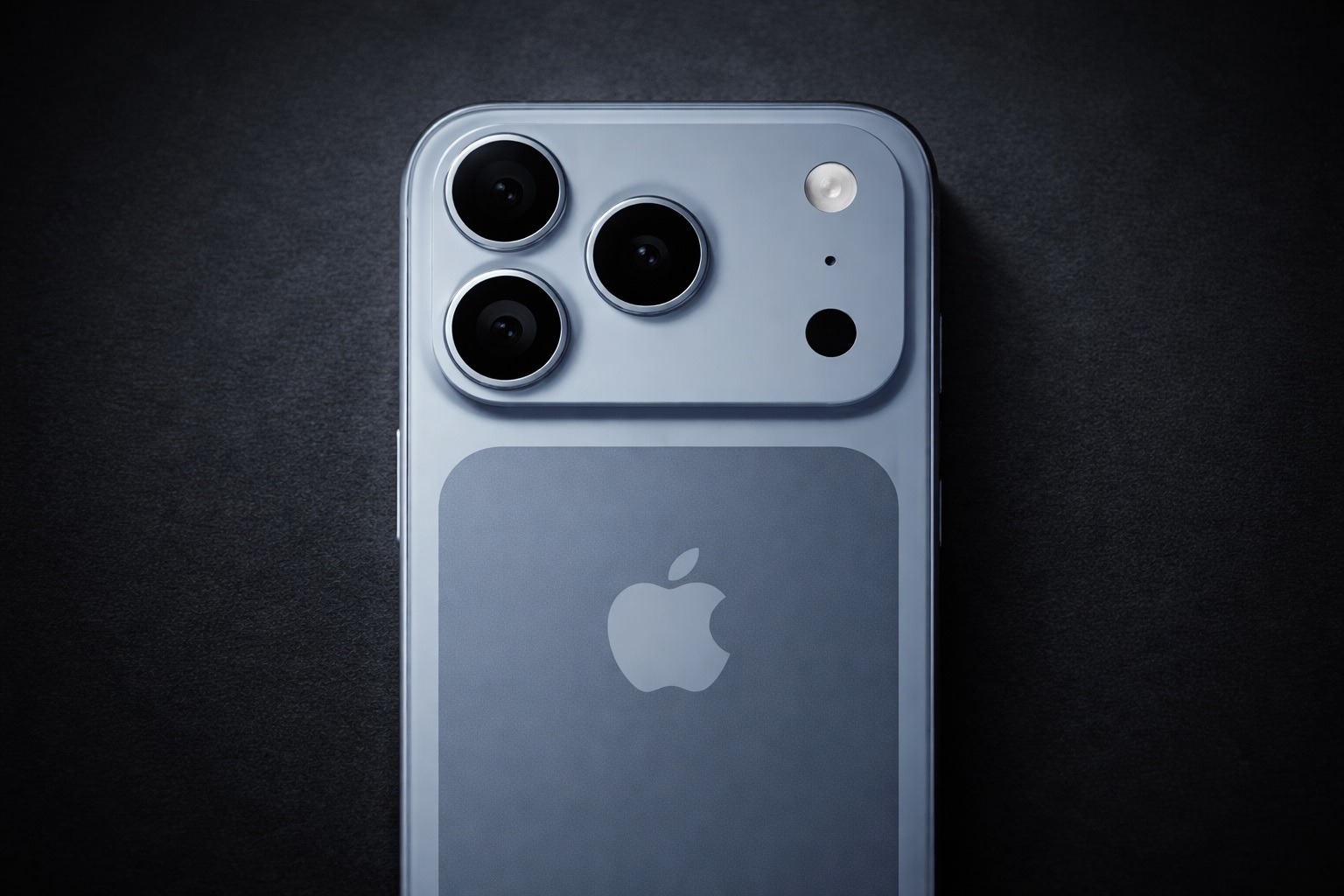

A fresh wave of supply-chain chatter and tipster posts is putting Apple’s 2026 iPhone plans back in the spotlight. Reports circulating on January 14 say the iPhone 18 lineup has already entered early “sample”/prototype stages, with the biggest headline being under-display Face ID testing on iPhone 18 Pro models — a move that could shrink (or even eliminate) the Dynamic Island on premium iPhones.
At the same time, separate reporting continues to point to an unusually busy year for Apple: a lower-cost iPhone 17e expected early, an ambitious foldable iPhone later in the year, and potential shifts in Apple’s traditional September-only iPhone cadence.
What’s being reported today: iPhone 18 and iPhone Air 2 display specs (leak roundup)
Multiple outlets citing Weibo tipster Digital Chat Station say Apple is already sampling display components across four models. While nothing is official, today’s leak converges around a very specific set of panel sizes and features:
Reported iPhone 18 lineup display specs (unofficial)
- iPhone 18: 6.27-inch LTPO OLED, up to 120Hz, with Dynamic Island
- iPhone Air 2: 6.55-inch LTPO OLED, up to 120Hz, with Dynamic Island
- iPhone 18 Pro: 6.27-inch LTPO OLED, up to 120Hz, with under-display Face ID testing
- iPhone 18 Pro Max: 6.86-inch LTPO OLED, up to 120Hz, with under-display Face ID testing
If this holds, one consumer-visible shift could be huge: the leak implies 120Hz LTPO panels across the lineup, not just the Pro tier — a long-requested upgrade for mainstream iPhone buyers.
Under-display Face ID on iPhone 18 Pro: Dynamic Island could shrink — or disappear
The most eye-catching claim is that Apple is testing a new front layout for the iPhone 18 Pro line, pushing Face ID components under the display while leaving the selfie camera as a punch-hole cutout.
Different reports frame the result slightly differently:
- PhoneArena describes the Pro models as having no Dynamic Island, with Face ID sensors moved under the screen and the camera remaining as a punch hole.
- Gadgets360 and Gizmochina suggest a transition phase: a smaller/repositioned cutout area because only part of the Face ID system moves under the display, leaving a smaller visible area for the camera.
That discrepancy matters, because it shows how early this information likely is. Apple can (and often does) test multiple front designs before locking a final “shipping” layout.
Why Apple would do this
Under-display Face ID is a logical next step in Apple’s multi-year move toward more screen and fewer cutouts. On the surface, it’s about aesthetics — but it also creates room for future “all-screen” designs without a notch, pill, or island. PhoneArena
Why it’s hard
Face ID relies on a complex sensor array. Moving those components under an OLED panel introduces new engineering constraints (light transmission, sensor accuracy, display uniformity), which is why this feature has been rumored and delayed across multiple iPhone generations.
That’s also why today’s reporting repeatedly stresses prototype/sample stages — this is exactly when Apple and its suppliers would be validating whether the hardware performs to Apple’s standards.
iPhone Air 2: what the leak suggests — and what we already know from iPhone Air
The iPhone Air 2 appearing in these iPhone 18-era leaks is noteworthy on its own, especially because some chatter has questioned whether Apple would continue the ultra-thin line.
Today’s leak says the iPhone Air 2 is being tested with a 6.55-inch LTPO 120Hz display and Dynamic Island, positioning it as the “thin-and-light” alternative in the lineup. Wccftech
For context: Apple introduced iPhone Air in 2025 as “the thinnest iPhone ever made” at 5.6mm, and Apple lists the iPhone Air’s screen size as 6.55 inches (measured as a standard rectangle). Apple
So, the “Air 2” rumor may not be about a larger display — it may be about refining the formula: durability, battery efficiency, camera upgrades, and whatever Apple learns from generation one’s real-world sales.
The “prototype production” claim: what it actually implies
Several reports today use phrases like “prototype manufacturing phase,” “early prototyping,” and “sample production.” The exact terminology varies, but the implication is similar:
- Apple and suppliers are producing small evaluation runs of key parts (like panels)
- Multiple variants may be in play
- Specs can shift substantially before mass production begins
Wccftech explicitly notes that being in a prototype phase often means Apple could still be testing other variants — and that a different end result is possible if early units don’t meet expectations.
Bigger picture: Apple’s 2026 iPhone roadmap may be changing
Beyond the display leak itself, other reporting frames 2026 as one of Apple’s most complex iPhone years in a while — not just because of new models, but because of how (and when) Apple might launch them.
iPhone 17e: rumored early-2026 launch at $599
Moneycontrol reports the iPhone 17e could arrive “within the next month or two,” positioned as a successor to iPhone 16e and intended to complete the iPhone 17 family — not replace the mainline iPhone. The same report claims:
- A19 chip
- Dynamic Island
- Center Stage front camera
- Slimmer bezels
- MagSafe return
- Starting price around $599
It also says Apple may keep costs down with compromises such as a single rear camera and no ProMotion/always-on features.
iPhone Fold: early testing, premium positioning
A separate report today says Apple’s foldable iPhone has entered early testing and is being treated as a major “industry-level” product rather than a tentative first attempt — including talk of a foldable-focused software experience and a custom Apple chip designed for the form factor. Gizmochina
Moneycontrol adds additional detail on the expected positioning: a book-style foldable, potentially branded iPhone Fold or iPhone Ultra, with a starting price $2,000+, a titanium frame, and displays described as roughly 7.6-inch inner and 5.4-inch outer — plus the possibility Apple uses Touch ID instead of Face ID due to space constraints.
A split launch: fall 2026 for Pro + foldable, spring 2027 for base iPhone 18?
One of the most consequential (and speculative) claims is a potential shift away from Apple’s traditional “everything in September” rollout.
Gizmochina reports that Apple could launch iPhone 18 Pro / Pro Max and a foldable iPhone in late 2026, while the standard iPhone 18 and possibly iPhone 18e might follow in spring 2027.
Moneycontrol similarly says the standard iPhone 18 may be pushed into early 2027, alongside iPhone 18e and potentially an iPhone Air 2.
Notably, this is where today’s rumors collide a bit: the display leak lists an iPhone 18 and iPhone Air 2 in today’s prototyping mix, but the rumored launch timing remains debated across outlets.
Is this all paving the way for a true “all-screen iPhone”?
One reason under-display Face ID keeps resurfacing is the idea that Apple is incrementally stepping toward a full uninterrupted display.
PhoneArena explicitly links the alleged iPhone 18 Pro changes to preparation for a special 2027 “iPhone 20 Pro” timed to the iPhone’s 20th anniversary, claiming it could feature a display with no notches, punch holes, or cutouts. PhoneArena
That’s still firmly in rumor territory — but it does map to a familiar Apple pattern: ship a new approach on Pro models first, refine it, then expand the design language more broadly later.
What to watch next
If you’re tracking the iPhone 18 story, the most important near-term signals will likely be:
- More independent supply-chain corroboration (especially around under-display Face ID)
- Consistency on the front cutout: “smaller island” vs. “no island” is a meaningful distinction PhoneArena
- Launch timing clarity: whether Apple really splits the iPhone 18 cycle into fall + spring drops
- Foldable momentum: whether reports move from “testing” to more concrete production timelines Gizmochina
For now, the safest takeaway from January 14’s leak wave is simple: Apple’s 2026 iPhone pipeline appears active earlier than usual, and multiple reports are aligning around a Pro-only design shift that would finally make the Dynamic Island feel like a transition — not a destination.