
WASHINGTON, Feb 5, 2026, 14:12 (EST)
- Astronomers report that a distant supermassive black hole continues to fuel an increasingly powerful radio jet years after shredding a star
- The jet powered up late and has steadily grown brighter, bucking the typical quick dimming seen after most stellar disruptions
- Scientists say the outburst might reach its peak in late 2026 or sometime in 2027, though they’re still uncertain about the cause
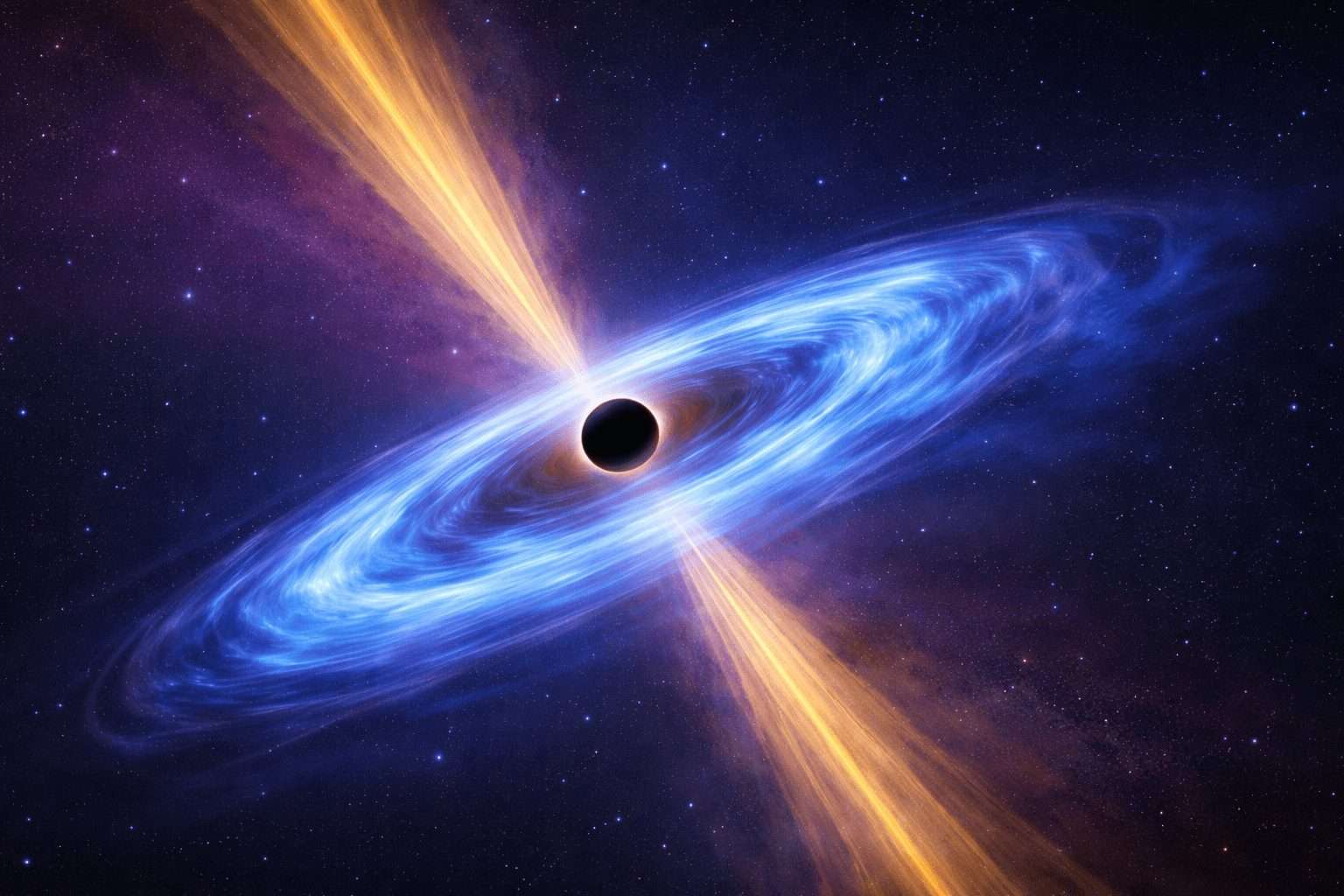
A supermassive black hole located about 665 million light-years away is still blasting an increasingly bright jet into space years after it tore apart a star, astronomers revealed Thursday. This persistent outflow ranks among the most powerful single radio wave events ever recorded, they said.
The timing is key here. The radio jet didn’t appear immediately after the star died; instead, it grew stronger over several years. This defies the usual expectations for such events and suggests that other jets that ignite late might have slipped under the radar.
The researchers are digging into a fundamental puzzle in black hole physics: why only some stellar disruptions launch a narrow, near-light-speed stream of material — known as a “relativistic jet” — while most events don’t. They emphasized that the exact mechanism remains a hot topic in ongoing research.
Radio telescopes in New Mexico and South Africa monitored the source as its brightness surged, with researchers calling the spike in radio luminosity unprecedented. Yvette Cendes, an astrophysicist at the University of Oregon and lead author of the study, noted the source has shown “no sign of stopping.”
At the heart of a galaxy well beyond the Milky Way, the object weighs roughly 5 million times the mass of our sun, researchers reported. The victim? A red dwarf star, only about a tenth the mass of the sun.
The episode is called a tidal disruption event — it happens when a star ventures too near and gravity rips it apart, a process astronomers often dub “spaghettification.” Anything crossing the event horizon — the black hole’s “point of no return” — disappears, but some of the debris heats up and shoots outward instead.
University of Arizona astrophysicist Kate Alexander, a co-author, described the radio light as coming from star material that approached but didn’t fall in—like a “picky baby” refusing food. The team noted the jet started after about a two-year lag and then lasted for several years.
Cendes said scientists still don’t know what sets off the jet initially, but highlighted magnetic fields near the black hole as a probable factor. She noted the rarity of these events implies something out of the ordinary is going on in this system.
Duration is the next big question. According to the researchers, the jet could hit its peak later this year or sometime next year, then gradually fade. It might remain detectable by radio telescopes for ten years or even longer.
The source goes by AT2018hyz, named after its initial optical detection, but Cendes calls it “Jetty McJetface.” She described the event as initially “most boring, garden-variety” before the radio emission unexpectedly took center stage. Phys
The energy scale plays a key role here. Researchers noted the radio outflow matches the power of a gamma-ray burst — those intense, fleeting cosmic explosions — except this one has been growing steadily over years instead of flashing briefly and fading away.
But here’s the twist: the brightening we’re seeing might not reflect a straightforward increase in power. One theory points to geometry — if the jet wasn’t initially aimed at Earth, its signal could have been faint, only becoming noticeable as it expanded or shifted, Discover Magazine reported.
The team intends to continue monitoring AT2018hyz and search for other similar events. If more appear, astronomers might need to reconsider how long they focus their radio telescopes on so-called “finished” stellar disruptions.