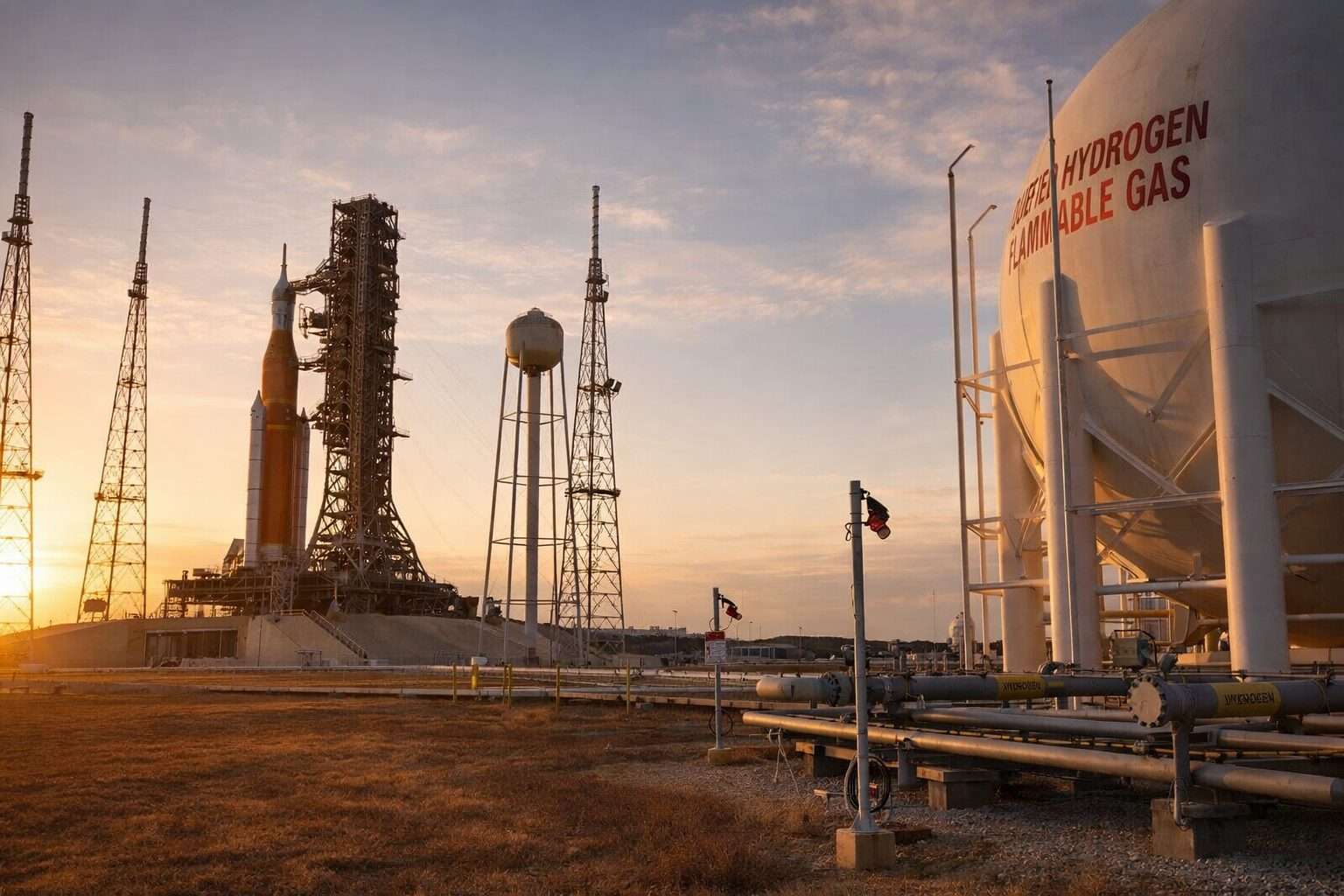

CAPE CANAVERAL, Florida, Feb 20, 2026, 06:03 EST
- NASA finished its second “wet dress rehearsal” fueling test for Artemis II, after hydrogen leaks derailed the initial try.
- How things play out determines if the agency keeps its initial March 6 launch window.
- Engineers sift through test results while the crew moves into pre-flight quarantine, with work on the pad still underway.
NASA managed to refuel its Artemis II moon rocket during a second dress rehearsal late Thursday, overcoming hydrogen leak issues that had derailed the initial try.
NASA refers to the test as a wet dress rehearsal—a full run-through that pumps super-cold propellants into the rocket and goes through the countdown steps. The agency isn’t putting a launch date on the calendar until that fueling test clears, and March 6 is as soon as it might happen.
NASA astronauts Reid Wiseman, Victor Glover, and Christina Koch, joined by Canadian Jeremy Hansen, are set for a 10-day journey around the Moon on Artemis II. No landing is scheduled. If it flies, it’ll mark the first crewed mission toward lunar orbit since Apollo 17 back in 1972.
According to CBS News, NASA teams—along with their contractors—pumped roughly 196,000 gallons of liquid oxygen and 537,000 gallons of liquid hydrogen into the rocket’s core, with another 22,500 gallons going up top for the upper stage. Launch director Charlie Blackwell-Thompson approved the tanking early Thursday, and the outlet noted sensors picked up no leaks above allowable thresholds.
The rehearsal went through a pair of terminal countdowns, each halting at T-minus 33 seconds before stepping back to T-minus 10 minutes, then stopping again at T-minus 29 seconds, according to a NASA live blog. NASA reported the test finished up at 10:16 p.m. Eastern.
On Feb. 3, the initial attempt wrapped up ahead of schedule when a liquid hydrogen leak showed up at the tail service mast umbilical interface—basically, where the ground line feeds propellant into the rocket. NASA called off the countdown at T-minus 5 minutes 15 seconds and started draining the tanks.
NASA said hydrogen gas levels stayed within safe bounds this time, boosting engineers’ confidence in the new seals on the fuel interface. Crews dealt with a brief loss of ground comms early in the fuel loading, switching over to backups before normal channels came back, according to the agency. Data review is ongoing. The Artemis II astronauts head into a roughly two-week quarantine in Houston late Feb. 20, just as technicians begin setting up pad platforms to service and recheck the flight termination system—the safety setup designed to destroy any off-course rocket.
Hydrogen leaks have dogged NASA going back to the shuttle days, and Administrator Jared Isaacman is pushing for a revamp of the fuel line hookups from pad to rocket before Artemis III flies. “We will not launch unless we are ready and the safety of our astronauts will remain the highest priority,” Isaacman posted last week on X. AP News
Hydrogen isn’t easy to handle—leak-prone, demanding storage at almost minus 423 degrees Fahrenheit. That’s rough on seals and fittings. On X, Isaacman said NASA “should not be surprised there are challenges” with Artemis II as the mission heads toward launch. Live Science
With China setting its sights on landing astronauts on the Moon by 2030, NASA’s Artemis program has gained urgency, reshaping the old lunar rivalry into something new. The agency has brought in commercial players for the mission’s next phase—SpaceX was tapped in 2021 to build the Artemis III lunar lander.
NASA has scheduled a briefing for 11 a.m. on Feb. 20, where senior officials like Lori Glaze and John Honeycutt, the Artemis II mission management chair, are expected to speak.