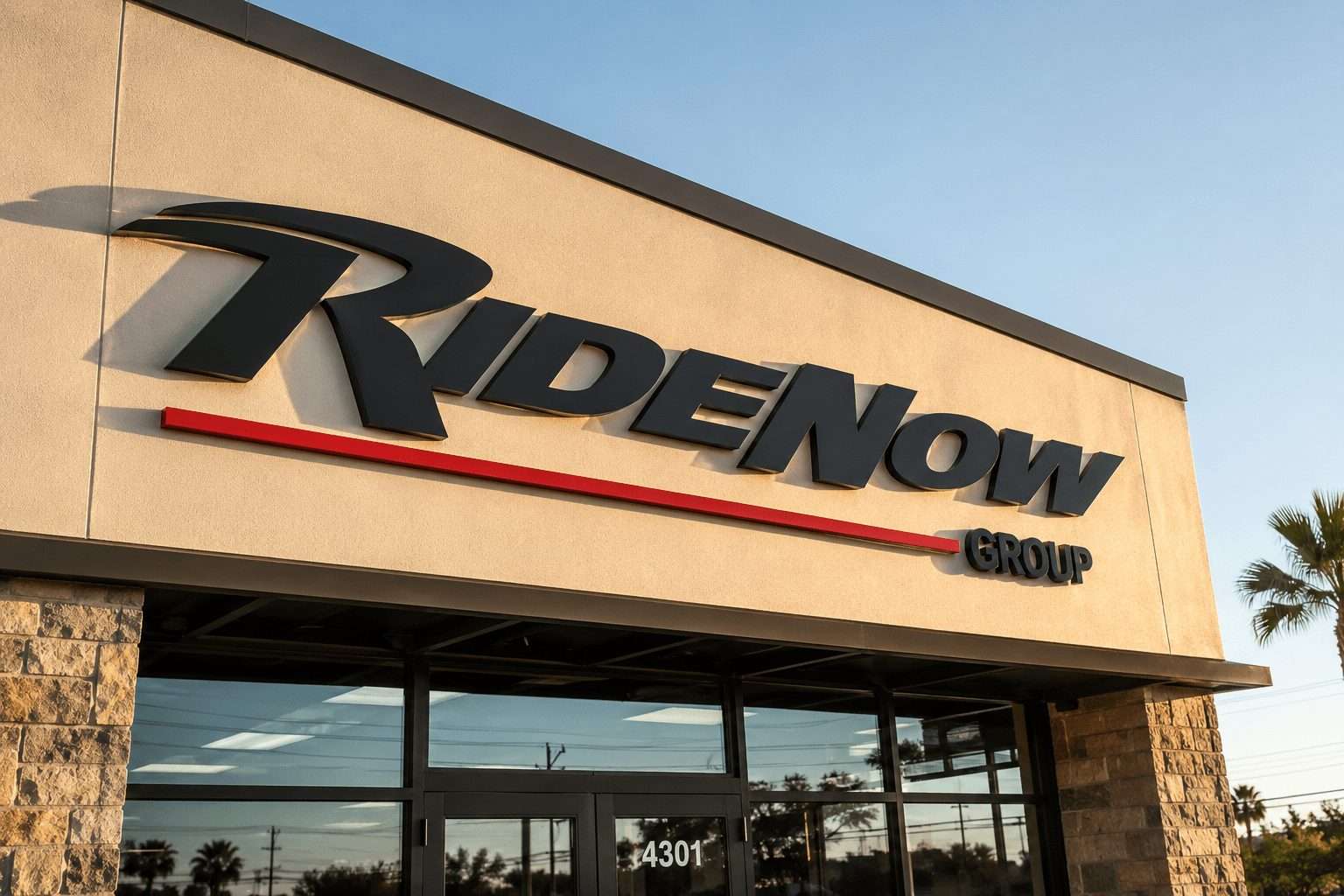

NEW YORK, May 24, 2026, 16:04 (EDT)
- RideNow closed at $7.81 Friday, slipping 1.01% in the session and down 1.26% for the week.
- U.S. stock markets are closed Monday for Memorial Day. Regular trading resumes Tuesday.
- Investors are looking at higher first-quarter sales, but also bigger inventory, tighter cash, and refinancing deadlines.
RideNow Group shares, which trade on Nasdaq, finished the last session before the U.S. holiday at $7.81, down 1.01% on Friday. The stock lost 1.26% over the past week. Investors looked past the latest dip, watching a fresh credit agreement meant to help fill dealerships for the riding season. For comparison, the S&P 500 added 0.37% and the Nasdaq Composite was up 0.19%.
Market trading stops now with the balance-sheet step still working through. Nasdaq’s 2026 holiday calendar puts Memorial Day, May 25, down as a full close, so RideNow is out of regular session trading until Tuesday.
The company announced May 18 it got another $35 million in floorplan financing, a type of dealer credit line for inventory ahead of sales. The new funding from Wells Fargo brings the total to $135 million: $115 million for new inventory with Polaris, Indian and Suzuki, plus $20 million for used vehicles.
RideNow chairman, CEO and president Michael Quartieri said the bigger floorplan will help the company hold the “right product mix to meet customer demand” at locations across the U.S. Next, investors will watch to see if more inventory gives sales a boost or just locks up more cash. PR Newswire
RideNow’s Q1 numbers were mixed. Revenue climbed 6.4% to $260.4 million. Same-store powersports sales were up 13.1%. The net loss shrank to $4.3 million versus $9.7 million last year. Adjusted EBITDA rose, too, hitting $9.3 million from $7.0 million.
Quartieri said after the results that management stuck to an “unrelenting focus on execution” and called the quarter proof RideNow is on the “right trajectory.” This follows the company’s name change from RumbleOn and a clearer return to the powersports dealership model. PR Newswire
RideNow’s 10-Q showed net cash used in operations jumped to $27.6 million in the first quarter as inventory went up, from $6.9 million a year ago. Total net debt was $474.3 million at March 31, rising from $426.0 million at Dec. 31. The cash line looked messier.
RideNow doesn’t make vehicles like Polaris or Harley-Davidson. It’s a retailer, so it relies on suppliers, buyers, and available dealer financing. BRP, Polaris, Harley-Davidson, Yamaha, and Kawasaki all showed up as main suppliers in its 2025 annual report. The report also said U.S. powersports retail is still a very fragmented market.
Big powersports brands kept some sway. Polaris shares rose 2.4% to end Friday at $67.83. Harley-Davidson added 2.3%, closing at $23.73. RideNow’s update is more specific, saying it can now finance more vehicles and sell them without losing control over working capital.
There’s a risk the larger inventory line won’t turn into better cash flow. RideNow has flagged that inventory, OEM allocations, tariffs, demand and financing capacity could all weigh on results. Its credit agreement says RideNow has to begin refinancing before Sept. 30 and finish by Nov. 30, but it was in compliance with covenants as of March 31.
Tuesday brings the first price check for the week. Investors will be watching to see if the $35 million facility signals momentum, or if it just points to RideNow’s ongoing struggles with debt, inventory turns and demand for discretionary vehicles. The company’s next shareholder event is the virtual annual meeting on June 4.