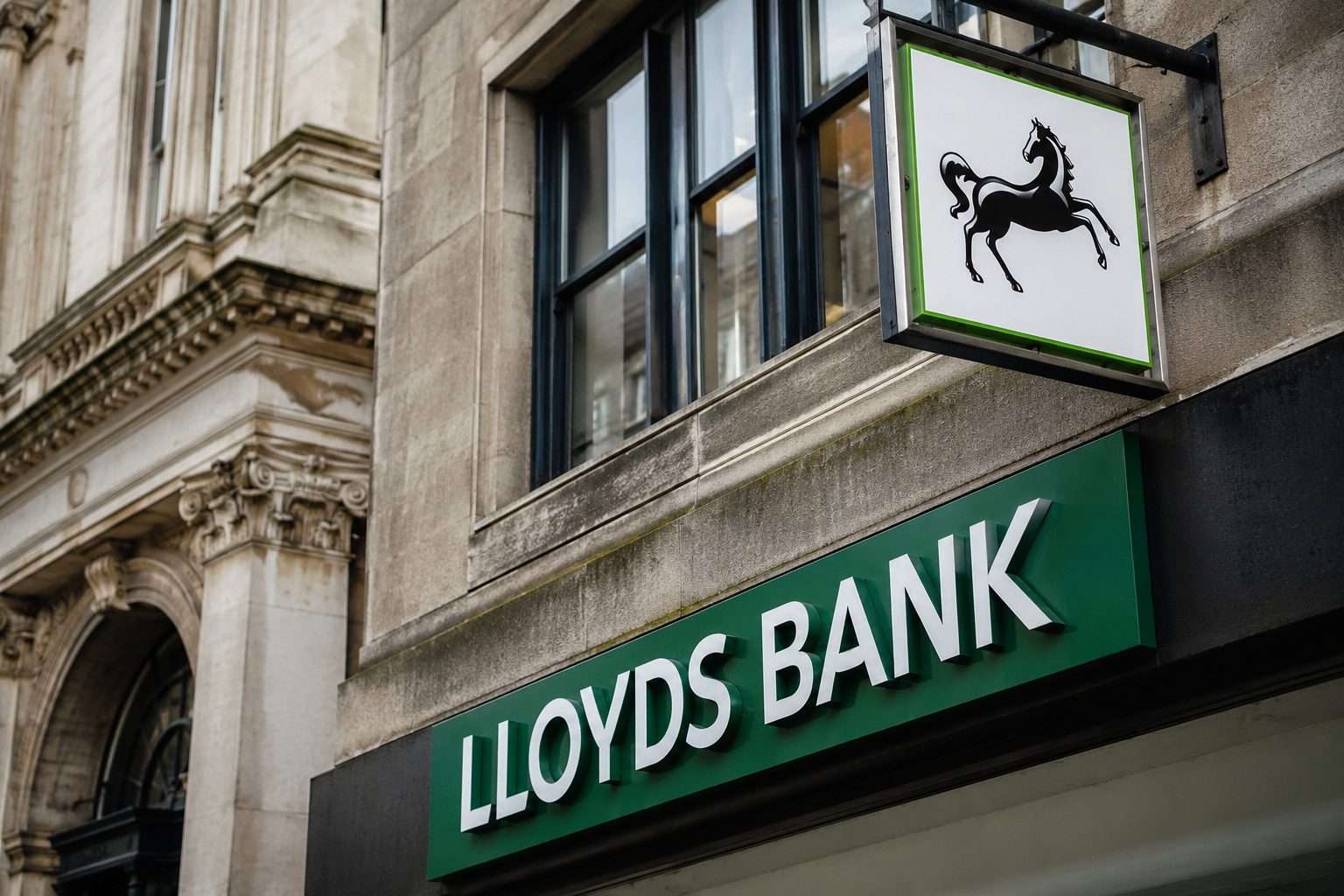

London, June 6, 2026, 15:04 BST
Lloyds Banking Group shares ended the week under pressure, closing at 99.16 pence on Friday, down 1.33% on the day and about 2.7% below the previous Friday’s close, with London trading shut for the weekend. The stock traded as high as 101.05p during the session but finished at the low, a weak close for a bank still running a large capital-return programme.
That matters now because Lloyds is one of the cleanest listed bets on the UK consumer, mortgages and small business credit. The share price is being pulled between two stories: a bank still buying back stock and earning more from lending, and a bank facing questions over digital outages, branch closures and old conduct costs.
The wider market gave only limited help. The FTSE 100 rose 0.07% on Friday, while the FTSE 250 fell 1%; both ended the week lower, Reuters reported. Paul Dales, chief UK economist at Capital Economics, said the latest evidence supported his view that “weakness of the labour market” could stop second-round inflation pressure, a key point for lenders because rate expectations feed directly into bank margins. Reuters
Lloyds kept buying its own stock. A filing showed the group bought 5 million ordinary shares on June 5 through Goldman Sachs at a volume-weighted average price of 100.0735p and plans to cancel them. A buyback means a company uses cash to purchase its own shares; cancellation cuts the share count, which can lift earnings per share if profit holds up.
The latest buyback sits inside a programme of up to 1.75 billion pounds announced with 2025 results, Lloyds says. The bank’s board also lifted the 2025 total dividend to 3.65p a share, up 15%, and said it expects to pay capital down toward a common equity tier 1 ratio — a core bank capital buffer — of about 13% by end-2026.
The earnings backdrop is still supportive. Lloyds reported first-quarter statutory profit before tax of 2.0 billion pounds and underlying net interest income of 3.6 billion pounds, up 8% year on year; net interest income is the difference between what a bank earns on loans and what it pays on deposits. Chief Executive Charlie Nunn said the group was “confident in our delivery for the year ahead,” and the bank guided for more than 14.9 billion pounds of underlying net interest income in 2026. Investegate
Peers were not much shelter. Google Finance showed Barclays down 1.17% and NatWest down 1.10% alongside Lloyds on Friday, keeping the pressure broadly within UK banking rather than on Lloyds alone.
Still, Lloyds had operational noise to deal with. The Guardian reported that thousands of customers were unable to make payments or send money after an IT glitch hit Lloyds, Halifax, Bank of Scotland, Scottish Widows and MBNA services on Wednesday. The paper said the outage followed a March incident in which a software defect exposed personal data of nearly 500,000 customers.
Branch access is another live issue. Lloyds plans to shut almost 150 outlets by March 2027, the Guardian reported on Saturday, as UK banks push more customers toward mobile and online channels. The same report cited Which? figures showing 6,795 UK branch closures since January 2015, or 69% of branches open at the start of that year.
But the risk case is not just about apps and branches. Lloyds has said there are still uncertainties around UK motor finance redress, including customer response rates, operating costs and possible litigation, even after it assessed final FCA rules and said no change to its provision was required. A worse outcome there, or a sharper UK credit slowdown, would cut against the buyback story.
The week ahead has no scheduled Lloyds results, so trading may be driven by UK macro data, rate expectations and any follow-up on service reliability. The next hard company catalyst is July 30, when Lloyds is due to publish half-year results and a strategy update.