
Dubai, May 11, 2026, 19:15 GST
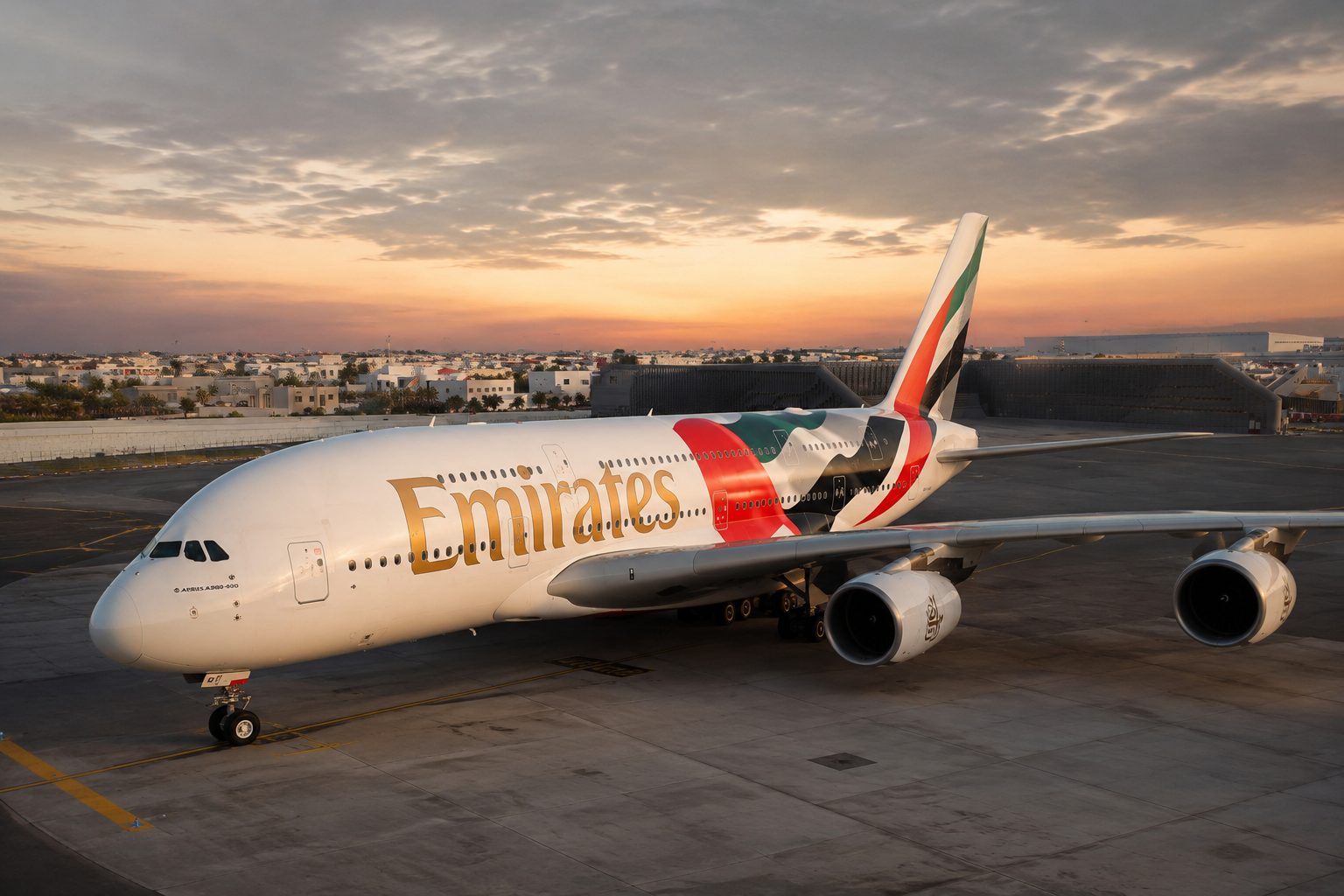
- Emirates has covered its Airbus A380 A6-EVG in a giant UAE flag as part of the “This Flag Will Always Fly” campaign.
- The aircraft has flown routes to both New York and Brisbane so far, and additional A380 destinations are on the horizon.
- The move comes on the heels of record annual results at Emirates Group and recent disruptions in Gulf aviation.
Emirates has draped a massive UAE flag along the fuselage of its Airbus A380, with aircraft A6-EVG now standing out as the Dubai airline’s boldest display of national branding to date.
The special livery splashes the flag’s colors in a three-dimensional pattern along both sides of the world’s biggest passenger jet. According to the airline, it’s part of the “This Flag Will Always Fly” campaign, connected to Sheikh Mohammed bin Rashid Al Maktoum’s call for citizens and residents to raise the flag in a show of unity. TravelWires
Timing is key here. After weeks of Gulf air travel chaos, Emirates is pushing an image of confidence and business as usual. On May 4, the airline reported 96% of its global network was back online, but weekly frequencies are still running at just 75% of their pre-disruption levels.
The announcement lands just days after Emirates Group posted pre-tax profit of 24.4 billion dirhams, or $6.6 billion, for the year ended March 31. Although the company described its final month as “disruptive and challenging,” it cited robust demand, healthy cash reserves, and fuel hedging measures as support. Emirates
Sheikh Ahmed bin Saeed Al Maktoum, who serves as chairman and chief executive of Emirates airline and Group, framed the new livery as an answer to Sheikh Mohammed’s call and called it “a tribute to the UAE’s unity and strength.” “There is no greater stage for our flag than in the skies,” he said. Emirates
The A380’s touched down in both New York and Brisbane so far, with Emirates eyeing additional stops for the jet as part of its expanding A380 schedule. Next up, the airline is gearing up to roll out the same flag-themed livery on a Boeing 777, which serves as its other key widebody workhorse.
This isn’t about new routes, better seats, or different fares. It’s a branding play—though in Gulf aviation, that can actually matter. Emirates, Qatar Airways, and Etihad Airways have been fighting for long-haul transfer passengers through their respective hubs, and the latest disruption cut into capacity at all three.
Emirates isn’t new to special liveries. Back in 2017, the airline rolled out a custom look on its 100th A380, celebrating the Year of Zayed; later, it decorated jets with Expo 2020 Dubai branding. This latest flagship continues that approach—turning a widebody into a flying ad for a milestone event.
The drawbacks are obvious. A fresh paint job won’t boost seat numbers, cut fuel bills, or shield timetables if airspace snarls come back. Emirates is still running short of its pre-disruption capacity, and getting back to full strength depends on reliable regional air corridors.
Right now, the jet sends a clear signal at big airports: Emirates is here, making itself seen, doubling down on the flag that’s been on its tail for years. The business challenge isn’t as straightforward—restoring routes, filling seats, and boosting capacity, all while regional uncertainty still lingers.