
London, June 15, 2026, 11:57 BST.
- IQE shares rose sharply after a multi-year indium phosphide epiwafer deal with Tower Semiconductor.
- The agreement includes first-year minimum purchase commitments and settles prior IP litigation.
- The next test is whether the Tower deal and wider AI photonics demand show up in H2 order conversion and guidance.
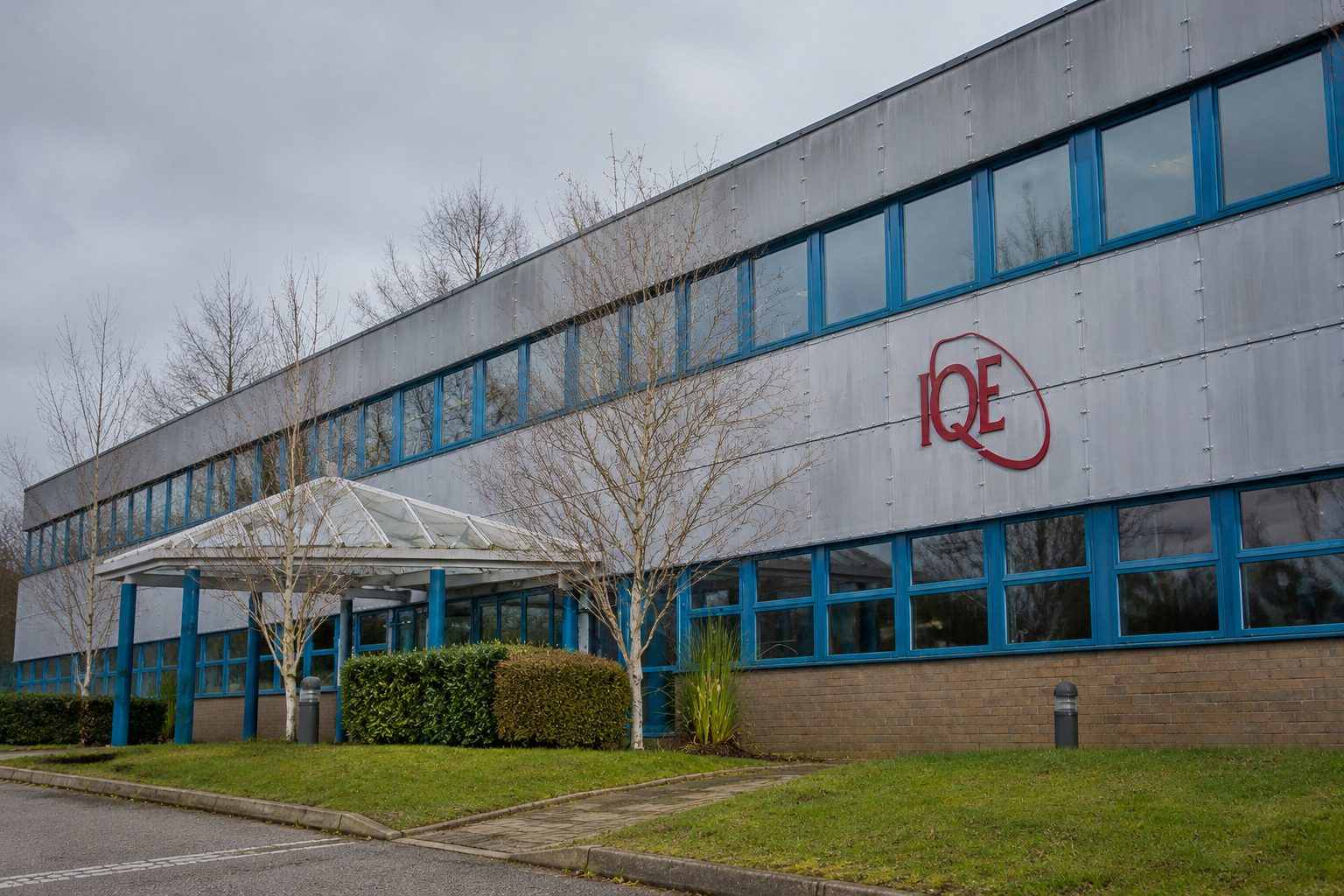
IQE plc surged in London on Monday after the Cardiff-based semiconductor materials supplier announced a multi-year agreement to supply indium phosphide, or InP, epiwafers to Tower Semiconductor for optical connectivity products used in AI-driven data centres. InP is a compound semiconductor material used in high-speed photonics, while an epiwafer is a wafer with engineered semiconductor layers grown on it for chip manufacturing. IQE shares jumped 17% to 53.90p in Monday morning trading, according to Alliance News, and Hargreaves Lansdown later showed the stock at 54.70p to sell and 55.00p to buy, up 8.55p, or 18.49%, with a previous close of 46.25p.
The move matters because the deal gives investors something more concrete than general AI enthusiasm. IQE and Tower said the wafers will be used in Tower’s silicon photonics platforms for next-generation optical technologies, including 200Gbs-per-lane pluggable transceivers, prototype 400Gb-per-lane modulators and optical circuit switches for data centres. The agreement includes a minimum purchase commitment from Tower in the first year, a reciprocal supply commitment from IQE, and minimum volume commitments after that. Tower will also grant IQE a broad, worldwide, royalty-free licence for porous silicon patents, ending litigation between the companies.
That is why the shares rose. Stocks usually move higher when investors believe future revenue, margins or risk levels have improved; they fall when expected earnings weaken, dilution rises or uncertainty increases. In IQE’s case, Monday’s announcement touches two of those levers at once: possible revenue visibility in AI infrastructure and removal of an intellectual-property dispute. IQE Chief Executive Jutta Meier said the agreement “reinforces IQE’s position within Tier 1 global hyperscale cloud and AI infrastructure markets.” IQE
The bull case is that IQE is finally getting operating leverage from markets investors already want exposure to: AI data centres, photonics, aerospace and defence. Tower itself said in May it had signed silicon photonics contracts for $1.3 billion of 2027 revenue and had received $290 million in customer prepayments for capacity reservations, which makes Tower a more meaningful partner for IQE than a routine customer win. IQE’s own 2025 results also pointed to photonics as the healthier side of the business, with photonics revenue rising 15% to £57.1 million even as group revenue fell 17.6% to £97.3 million.
The bear case is that IQE remains a volatile AIM-listed turnaround stock, not a clean earnings compounder yet. In 2025, adjusted EBITDA — earnings before interest, tax, depreciation and amortisation, a rough measure of operating profit before major accounting charges — fell 60% to £3.2 million, and wireless revenue dropped 40% to £40.1 million. Reuters also reported after the results that supply shortages and Chinese export restrictions had pushed up prices for materials such as indium phosphide and gallium, while prior softness in mobile handset demand weighed on the company. Those are real risks if today’s AI-linked optimism does not convert into profitable volume.
After the rally, IQE looks attractive only for investors comfortable with high risk and sharp price swings. The Tower deal improves the story, and the litigation settlement removes an overhang, but the stock has already repriced hard. Deutsche Bank recently restarted coverage with a buy rating and 60p target, while the latest market price is now much closer to that level than it was a few weeks ago. The next major catalyst is the June 30 AGM, followed by evidence in the September half-year update that Tower, MACOM-linked supply agreements and InP demand are feeding into order book visibility, cash generation and the company’s 2026 target for more than 20% revenue growth.