
New York, May 29, 2026, 15:01 (EDT)
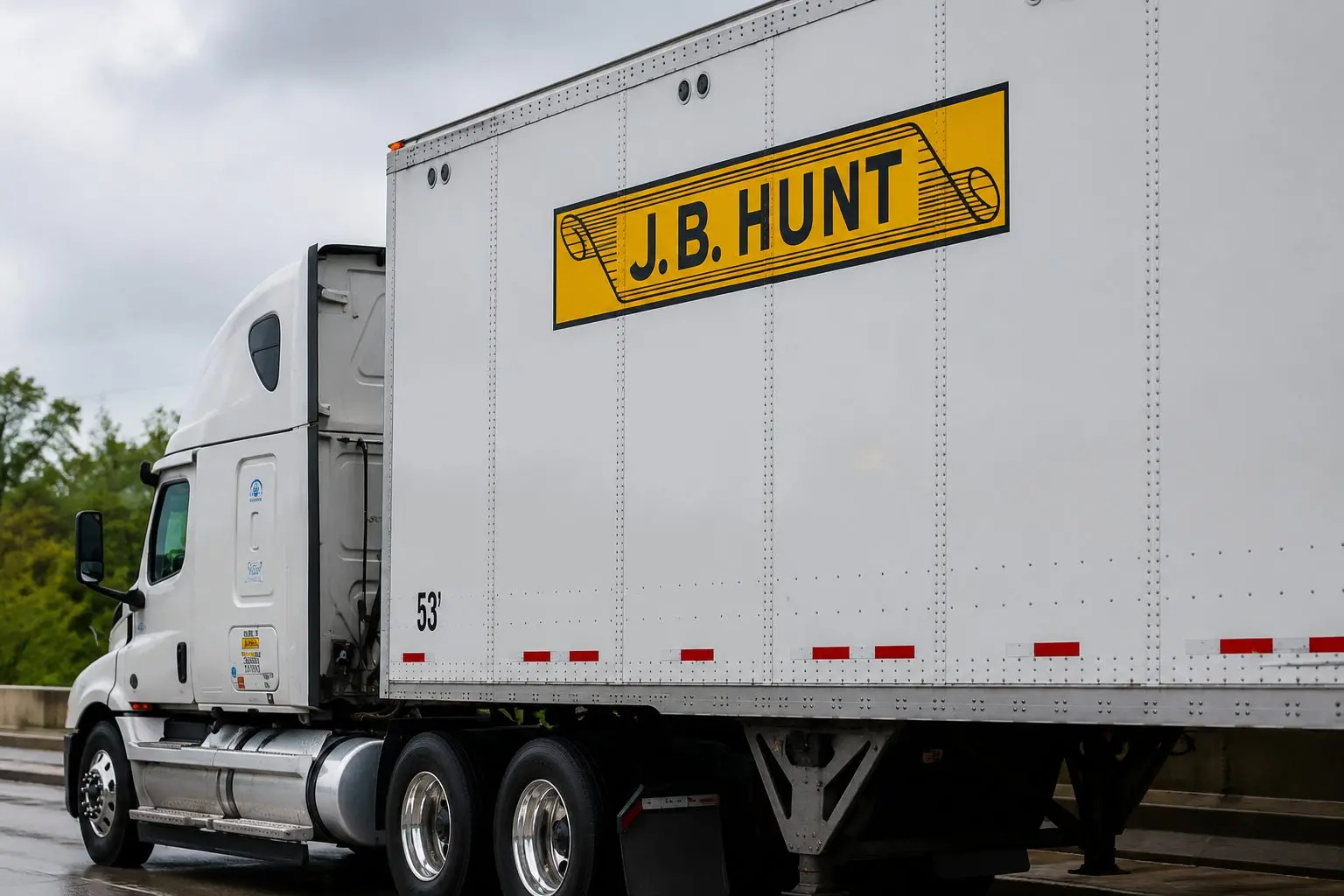
J.B. Hunt Transport Services shares traded higher Friday afternoon, moving the trucking and logistics stock near its 52-week high. Investors are still betting on better freight pricing and improved margins.
J.B. Hunt shares climbed 1.1% to $275.38 on Nasdaq, up $2.86 after swinging from $269.68 to $276.85. The rally puts the trucking company’s market cap around $26.2 billion.
The rally is playing out in a week cut short by the holiday. The stock finished at $258.77 on May 22 before the Memorial Day pause. It then moved to $267.63 Tuesday, $270.87 Wednesday and $272.52 Thursday, per Investing.com. At Friday’s latest price, shares were up roughly 6.4% from the prior Friday’s close.
U.S. markets were open for trading Friday. Nasdaq’s 2026 schedule shows markets shut for Memorial Day on May 25. Usual hours on regular weekdays run 9:30 a.m. to 4:00 p.m. Eastern.
Wall Street kept up its push higher on Friday. All the major indexes added to the rally, with the S&P 500 set for gains for the week and the month. “We certainly haven’t seen the last of AI optimism,” Melissa Brown, head of investment decision research at SimCorp, told Reuters. Reuters
Freight stocks picked up too, with sector names backing the move instead of this being only about J.B. Hunt. C.H. Robinson added around 1.7%, Old Dominion Freight Line climbed 1.3%, and Knight-Swift was up 1.0% lately.
J.B. Hunt’s numbers kept investors in the stock. The company posted Q1 revenue of $3.06 billion and operating income of $207.0 million. Diluted EPS rose to $1.49, up from $1.17 a year ago. CEO Shelley Simpson called the operating environment “dynamic.” J.B. Hunt
J.B. Hunt’s intermodal unit stays in focus, pulling in $1.50 billion in Q1 revenue. The company said loads on the eastern network went up 7% as more customers shifted freight off the highways and onto rail-connected service.
Pricing is still on the table. Chief Financial Officer Brad Delco told Distribution Strategy Group the “industry needs margin recovery” and improved returns to make reinvestment work. Distribution Strategy Group
The trade still carries risk. J.B. Hunt’s Integrated Capacity Solutions, which connects shippers and outside carriers, saw its first-quarter operating loss deepen to $4.7 million from $2.7 million. Gross margin dropped to 12.0% from 15.3% as purchased transportation costs went up. Purchased transportation is what J.B. Hunt pays third-party rail and truck carriers to move freight.
The stock isn’t factoring in much of a delay for freight to bounce back. Stronger rates and steady volumes would clear the way for more gains. But if demand slips or costs tied to outside carriers stay elevated, Friday’s pop could be shaky.