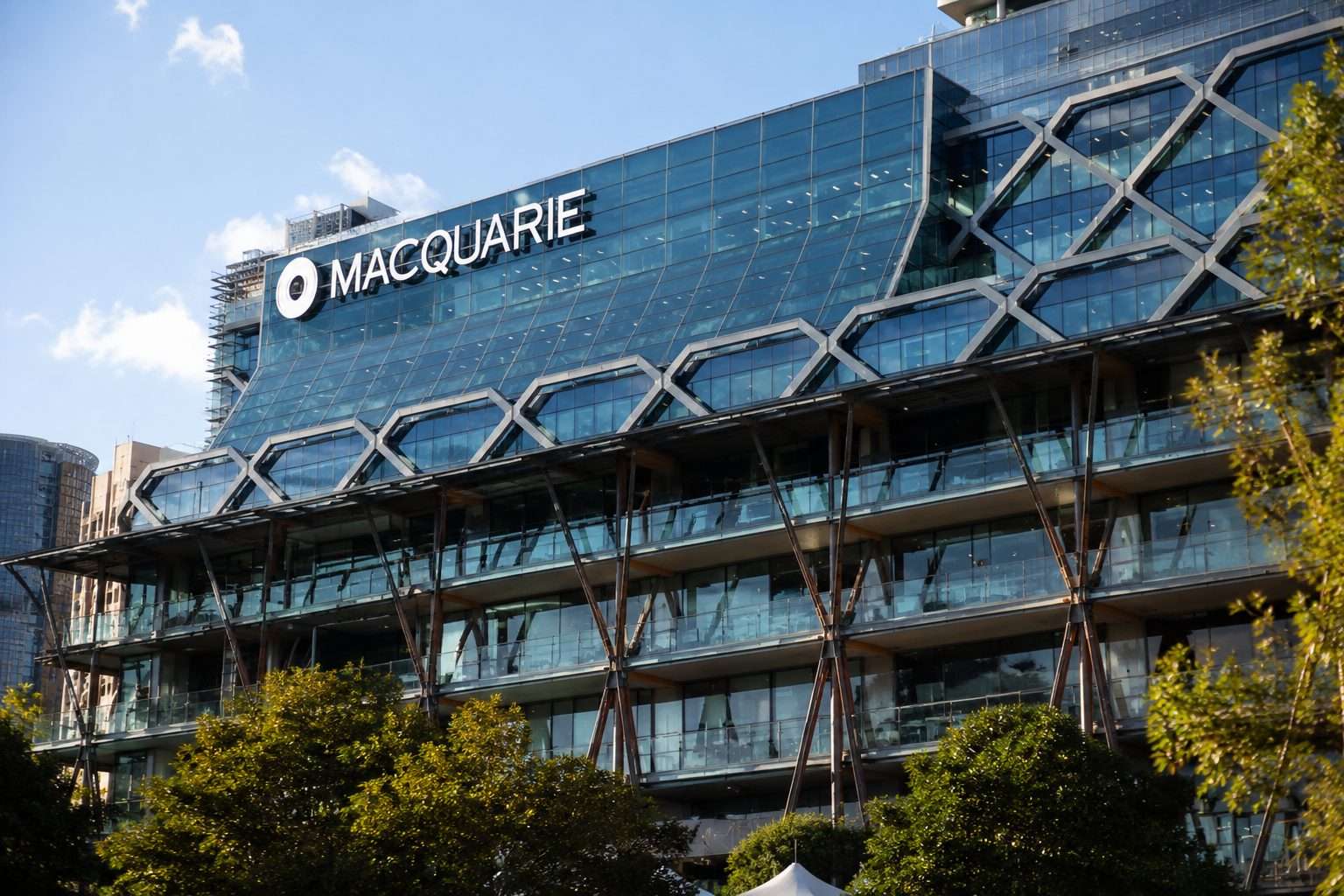

May 10, 2026, Sydney — 23:04 AEST.
Macquarie Group Ltd. booked a full-year profit of A$4.85 billion, up 30%, marking its second-best year ever. Strong gains from commodity trading and asset sales helped the Australian firm surpass expectations. Profit for the six months ended March 31 surged 93% over the previous half, hitting a record A$3.19 billion.
It’s the same question again for investors: what portion of Macquarie’s earnings will stick, and how much was just a product of market chaos? The profit outpaced a Visible Alpha consensus of A$4.39 billion, Reuters noted, with the boost coming largely from increased oil and gas trading tied to the Middle East conflict.
No trades for Macquarie shares Sunday night in Sydney, as the ASX was shut. On Friday, the stock finished at A$239.23, a 1.09% drop for the day—it had reached as high as A$249.49 during Friday’s session, per Macquarie’s investor page and market figures from Reuters.
Chief Executive Shemara Wikramanayake pointed to the group’s “specialist expertise” as key to steering through the current environment and spotting growth. Net operating income climbed 13% to A$19.48 billion. Expenses moved up by 5%, giving the bank more operating leverage. Return on equity increased to 14.0%, up from 11.2%. Macquarie
Commodities and Global Markets pulled in the strongest numbers, with net profit contribution up 49% to A$4.22 billion. Macquarie credited the jump to a few things: unloading its OnStream meters platform, a pickup in client hedging activity—trades aimed at cushioning price volatility—and bigger gains from inventory management and trading in gas, power and oil.
“Supply is constrained, prices rise”—that’s how Macquarie’s chair Glenn Stevens summed up the U.S.-Iran war’s impact on policymakers. Simon Wright, head of Commodities and Global Markets, told Reuters that trading desks can benefit from volatility, but added, “prolonged volatility” tends to put clients off. Reuters
The bank maintained strict controls on private credit—direct lending that bypasses public bond markets. According to Reuters, Macquarie lifted its exposure in the space by 5%, reaching A$27.3 billion. That increase lagged last year’s pace. CEO Wikramanayake cited a deliberate move to steer clear of concentration risk.
Macquarie’s Australian banking business is still edging into turf dominated by heavyweight mortgage players Commonwealth Bank of Australia and Westpac. On its earnings call, Macquarie reported home loan balances hit A$181 billion—good for a 7% share of the market—while deposits climbed to A$215 billion, or 6.5%. Yet, according to Canstar data from earlier this year, both CBA and Westpac continue to command a much bigger slice in mortgages.
CLSA’s Ed Henning called it a “large beat” and pointed to a positive outlook, according to the Australian Financial Review. But the optimism comes after a sharp rally in the shares: Reuters Breakingviews noted Macquarie is now trading at roughly 2.5 times forward book value—a lofty multiple that hinges on continued strong returns. Afr
There’s a catch: some of the standout numbers might not stick around. Reuters Breakingviews pointed out that the OnStream sale won’t be repeated, and those strong trading gains tied to conflict or market chaos could slip away if commodity markets settle down. Macquarie highlighted interest rates, inflation, geopolitics, tax, and regulatory changes as key risks to its short-term picture.
The board signed off on a final dividend of A$4.20 per share, bumping Macquarie’s full-year payout up to A$7.00. After snapping up A$1.01 billion of its own shares, Macquarie has wrapped up its on-market buyback, citing robust business momentum and market settings as reasons not to continue with additional repurchases under the scheme.
Weak demand isn’t the main concern at this point. The question is whether Macquarie can sustain its earnings pace after the lift from recent asset sales fades and volatility dies down. CEO Wikramanayake described the group as “well-positioned” heading into the medium term, pointing to its mix of income sources, cautious balance sheet, and approach to risk. Macquarie