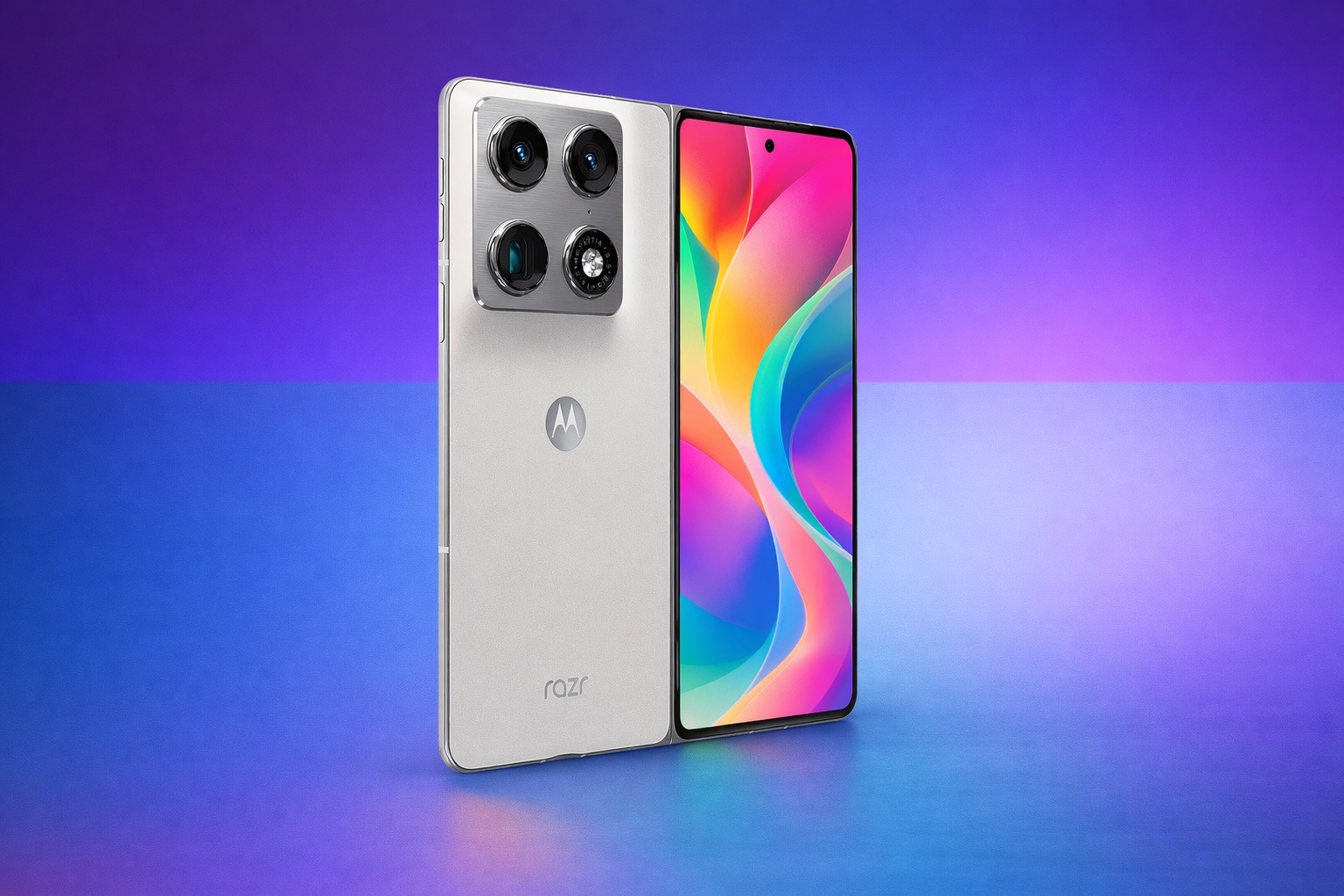
Motorola has unveiled the Razr Fold—its first book-style foldable phone—set for a summer 2026 launch in North America, alongside the new Qira cross-device AI platform, a “Signature” premium handset, and fresh Moto Things accessories.
LAS VEGAS — January 7, 2026 — Motorola is finally stepping into the big-screen foldable arena it’s been circling for years. After refining flip-style Razr phones for more than half a decade, the company used CES-week announcements in Las Vegas to introduce the Motorola Razr Fold, a book-style foldable designed to compete directly with Samsung’s Galaxy Z Fold line and Google’s Pixel Fold family. 1
But the Razr Fold wasn’t the only headline. Motorola and parent company Lenovo also showcased a broader “ecosystem play” that blends hardware, accessories, and AI: a unified assistant platform called Qira, a concept Project Maxwell “AI pendant,” a new ultra-premium phone line dubbed motorola signature, and a set of “Moto Things” accessories that range from a Bose-tuned speaker to a tracking tag with an attention-grabbing battery claim. 1
Quick takeaways: what Motorola announced today
- Razr Fold: 6.6-inch outer screen + 8.1-inch 2K LTPO inner display, triple 50MP cameras, stylus support, launching in North America this summer. Price is still unknown. 2
- Qira AI: A cross-device AI platform intended to span Lenovo PCs and Motorola phones, with a “shared knowledge base” and a mix of on-device and cloud capabilities. 3
- motorola signature: A new premium smartphone line starting in select European countries at €999, with Snapdragon 8 Gen 5, four 50MP cameras, and seven years of OS/security updates. 4
- Razr FIFA World Cup 26 Edition: Launching February 12 in the U.S. (Verizon / Total Wireless + unlocked via Motorola) for $699.99, and in Canada for $999.99. 5
- Moto Things: New Moto Watch, Moto Pen Ultra, Moto Tag 2, and Moto Sound Flow speaker (with Sound by Bose). 6
Motorola Razr Fold: the first book-style foldable from the Razr brand
Motorola’s Razr Fold is its first “book-style” foldable—meaning it opens like a book into a tablet-ish screen, rather than flipping shut like the classic clamshell Razr. In other words, this is Motorola’s direct bid for the category where Samsung’s Galaxy Z Fold series has been the default reference point in the U.S. 1
Razr Fold specs (confirmed so far)
Motorola and early hands-on reports point to a set of headline specs that put the Razr Fold squarely in premium foldable territory:
- Outer display: 6.6 inches (cover screen) 2
- Inner display: 8.1 inches, 2K LTPO panel 2
- Rear cameras: Three 50MP sensors (main + ultrawide/macro + 3x periscope telephoto) 3
- Selfie cameras:32MP on the cover side + 20MP on the inner screen 2
- Stylus: Works with the new Moto Pen Ultra 2
- Video: Dolby Vision recording support is cited in official materials and hands-ons 3
- AI features (on-device): Motorola calls out “Catch me up” and “Next Move” as productivity-focused features 3
Motorola also leans hard into design and materials. The Razr Fold ships in Pantone Blackened Blue and Pantone Lily White, and multiple reports describe a woven vegan leather finish—very on-brand for a company that has leaned into color and texture as a differentiator. 1
Hands-on impressions: thinner, softer, and more style-forward
With the Razr Fold, Motorola appears to be aiming at two gaps in the premium foldable market: style and (potentially) price.
Early hands-on impressions describe a device that feels familiar if you’ve used Samsung or Google’s book-style foldables, but with a noticeably more tactile, “softer” aesthetic—especially the textured blue-black finish. Reviewers also noted Motorola carried over some of its smart clamshell tricks, like showing a clock and calendar on the outer screen in a “tent mode” posture. 2
One important asterisk: Motorola has framed this as an early look at the device, and several publications emphasize that the company is not sharing full specifications yet. 2
The big unanswered question: Razr Fold price
If there’s one storyline dominating Razr Fold coverage today, it’s what Motorola didn’t say: pricing.
The Verge’s hands-on report is blunt: Motorola spokespeople wouldn’t provide even a hint, and the publication frames price as the defining question for whether the Razr Fold becomes the “more affordable foldable” many buyers want—or simply another high-end luxury device. 2
Wired echoes the same theme, noting Motorola is holding back key details (including price) and will share more in the coming months ahead of a summer launch. 1
What we can say, based on today’s information: Motorola wants the Razr Fold to be taken seriously as a flagship-class foldable (big screens, triple 50MP cameras, stylus support), but it’s leaving room to shape the narrative later—especially around price, chipset, and final hardware specs. 2
Qira: Lenovo and Motorola’s unified AI platform (and why it matters)
Motorola’s hardware push is tightly tied to a bigger CES-week theme: AI that follows you across devices.
What Motorola says Qira is
In Motorola’s own briefing, Qira is positioned as a single AI experience that spans the Lenovo + Motorola ecosystem—unifying products and features such as moto ai, Lenovo AI Now, and more under “one name, interface, and wake word,” with a shared knowledge base that carries context across devices. 3
Motorola also highlights partnerships with major industry players—including Microsoft 365 and Copilot, Perplexity, Google, and chip partners like Qualcomm and Intel—as part of building “trusted experiences” across on-device AI capabilities. 3
What today’s reporting adds
Reuters reports that Lenovo’s CES announcements included Qira as “a personal AI system” designed to work across Lenovo and Motorola devices, even in the background, and says Lenovo expects it to offer services from partners such as Expedia. 7
The Verge’s deeper look adds important nuance: Lenovo describes Qira as modular, mixing local on-device models with cloud-based models, “anchored” by Microsoft and OpenAI infrastructure accessed through Azure, and integrated with tools like Notion and Perplexity. 8
The Verge also says Lenovo is trying to avoid the pitfalls of “always-watching” features, emphasizing opt-in memory, persistent indicators, and clear user controls—a direct nod to privacy backlash that has hit other AI features in the PC space. 8
Lenovo’s Nvidia tie-up: the infrastructure story behind the AI push
While Motorola’s Razr Fold is the headline gadget, Lenovo’s broader AI ambitions form the backdrop. Reuters reports Lenovo is teaming with Nvidia to help AI cloud providers bring data centers online faster—reducing deployment time to “weeks”—as part of a program Lenovo calls an “AI Cloud Gigafactory with NVIDIA.” 7
For Motorola, the takeaway is clear: the Razr Fold isn’t being launched in isolation. It’s arriving as Lenovo positions itself as a bigger AI player across infrastructure, devices, and assistants—with Qira designed as the glue. 7
Project Maxwell: an “AI pendant” concept designed to be hands-free
Motorola also previewed Project Maxwell, described as an “AI perceptive companion” proof of concept—essentially an always-available wearable that can collect scenario data (what you see and hear) and offer real-time help. Motorola even suggests conference use cases like listening to a keynote and drafting a social post. 3
Wired’s coverage characterizes Maxwell as a “weird AI pendant” with a camera and microphone; it’s explicitly a concept with no firm promise of becoming a commercial product. 1
motorola signature: a new premium phone line, starting in Europe at €999
Alongside the foldable reveal, Motorola introduced motorola signature, a new “ultra-premium franchise” with a focus on design, service, and long-term updates. 3
Motorola’s own specs list reads like a direct attempt to meet flagship expectations:
- Snapdragon 8 Gen 5 (3nm) 4
- Four 50MP rear cameras (Motorola calls it the first ultrathin smartphone in its class to do so) 3
- 5200mAh silicon-carbon battery, 90W TurboPower charging, and 50W wireless charging 4
- 6.8-inch Extreme AMOLED display, 165Hz, with peak brightness listed as up to 6200 nits 4
- Up to seven Android OS upgrades and up to seven years of security updates 4
- Extras positioned as “luxury,” including on-demand white-glove assistance (available later in 2026, according to Motorola) 4
Availability: Motorola says the Signature will arrive in select countries across Europe starting at €999, then expand to regions including the Middle East, Africa, Latin America, and Asia-Pacific. 4
Wired reports Motorola’s “Signature” devices won’t be sold in the U.S. 1
Razr FIFA World Cup 26 Edition: the special edition phone coming February 12
Motorola is also leaning into sports partnerships. The company says it’s the Official Smartphone Partner of the FIFA World Cup 2026, and it’s shipping a themed Razr device as part of its “Collections by Motorola” series. 5
Key details (confirmed by Motorola):
- U.S. availability: February 12, with Verizon as the exclusive North American carrier partner (also sold via Total Wireless); unlocked models on motorola.com the same day; later expanding to Amazon. 5
- Price:$699.99 MSRP for the U.S. unlocked model (carrier pricing may vary). 5
- Canada: February 12 at motorola.ca for $999.99 MSRP. 5
The device includes World Cup-themed styling, plus FIFA wallpapers, a ringtone, and a watermark feature for photos, according to Motorola. 5
Moto Things: speaker, watch, stylus, and tracking tag (with prices and dates)
Motorola’s ecosystem expansion isn’t just about phones. The company also introduced four accessories under its Moto Things umbrella. 6
Moto Sound Flow speaker: “Sound by Bose,” Wi‑Fi streaming, and UWB tricks
Motorola calls the Moto Sound Flow its first portable speaker, featuring Sound by Bose, built-in support for streaming platforms over Wi‑Fi, plus Bluetooth 5 for on-the-go listening. 6
It also adds a twist: Ultra-Wideband (UWB), used to detect proximity and hand off calls or music from your phone to the speaker, plus “Dynamic Stereo,” “Quick Switch,” and “RoomShift” features for multi-speaker setups. 6
Moto Watch: 13-day battery life and Polar-powered wellness tracking
Motorola’s new Moto Watch features a 47mm round face, health tracking powered by a partnership with Polar, and up to 13 days of battery life (with a shorter figure for always-on display users). 6
Motorola says the watch will roll out broadly, including North America, and specifically notes a U.S. on-sale date:
- Starting price: €99 (and a €149 “premium pack” with two straps in Europe) 6
- U.S. availability: January 22 via motorola.com (Pantone Volcanic Ash color) 6
Moto Pen Ultra: stylus support for Razr Fold and Signature
The Moto Pen Ultra is built to work with the new Razr Fold and motorola signature, with features like an ultra-fine tip, pressure sensitivity, tilt detection, and palm rejection. Motorola also layers in AI-assisted features such as “Sketch to Image” and sharing tools. 6
Motorola says it launches this spring in select regions and arrives in North America in the coming months. 6
Moto Tag 2: UWB + Find Hub compatibility, with a 500+ day battery claim
Finally, the Moto Tag 2 adds UWB and Bluetooth Channel Sounding, and Motorola says it’s compatible with the Google Find Hub network—along with a standout figure: more than 500 days of battery life. 6
Why the Razr Fold launch matters right now
Motorola is entering a foldable market that’s heating up again—both in product variety and in the underlying display tech.
At CES, Samsung Display showcased a crease-free foldable OLED concept panel, and suggested it could influence future foldables across the industry. 9
Meanwhile, Samsung has also shown off a TriFold concept that expands into a 10-inch tablet, underscoring how quickly the category is evolving beyond the “standard” book-style fold. 1
Against that backdrop, Motorola’s pitch is straightforward: bring its design DNA and software polish from flip Razrs into a bigger foldable—with stylus support and AI features—then use ecosystem devices (watch, tag, speaker) and Qira to make the whole lineup stickier. 3
What to expect next: release windows and dates (confirmed)
Here are the timeframes Motorola has publicly attached to today’s announcements:
- Razr Fold: North America, summer 2026 2
- Razr FIFA World Cup 26 Edition:February 12, 2026 (U.S. + Canada) 5
- Moto Watch (U.S.):January 22, 2026 6
- Moto Sound Flow / Moto Tag 2: rolling out in select regions in the coming weeks; North America timing for Tag 2 still TBD 6
- Moto Pen Ultra: this spring in select regions; North America in coming months 6
- Qira: more functionality “later this year,” with rollout details varying by device and platform in reporting 3