CAPE CANAVERAL, Fla., Jan 18, 2026, 04:38 (EST)
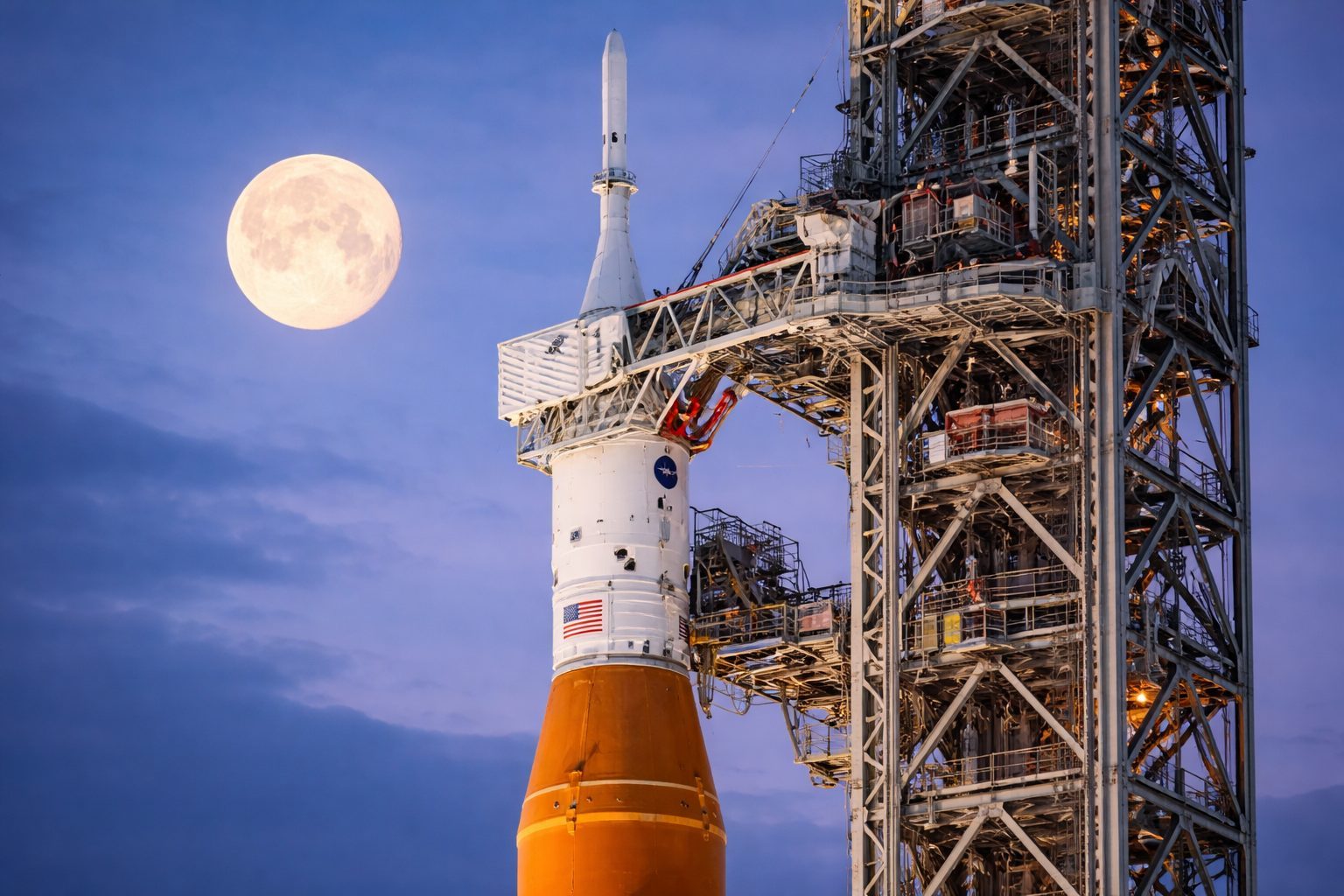
- NASA’s Artemis II Space Launch System rocket and Orion capsule arrived at Launch Pad 39B after a slow 4-mile rollout
- A “wet dress rehearsal” fueling test is targeted by Feb. 2 ahead of a potential February launch attempt
- NASA has backup launch windows in March and April if February slips
NASA’s Artemis II Space Launch System rocket reached its launch pad at Kennedy Space Center in Florida late on Saturday, closing out a slow 4-mile (6-km) trip from the Vehicle Assembly Building and pushing the mission into its final test stretch. The stack arrived at Pad 39B at 6:42 p.m. EST after a nearly 12-hour journey that topped out at 0.82 mph (1.3 kph), NASA said. 1
The move matters because the program is now inside the part that tends to break schedules: pad ops, fueling work, and the kind of last-minute fixes that do not show up until a rocket is standing outside in the weather. NASA is trying to keep Artemis II on track as a near-term crewed deep-space flight, while also juggling other launches and range activity.
Artemis II is slated to carry commander Reid Wiseman, pilot Victor Glover and mission specialist Christina Koch, along with Canadian Space Agency astronaut Jeremy Hansen, on a roughly 10-day loop around the moon and back, after an uncrewed Artemis I test flight in 2022. NASA has launch windows Feb. 6–11, March 3–11 and April 1–6, but the schedule hinges on a “wet dress” fueling rehearsal and may also be shaped by preparations for Crew-12 to the International Space Station. “Wet dress is really the driver,” Artemis launch director Charlie Blackwell-Thompson said, while Wiseman called the rollout a show of “teamwork” and “global cooperation.” 2
In a pre-rollout briefing, NASA officials described the wet dress rehearsal as a full loading of super-cold propellants and a countdown run to a planned stop at T-minus 29 seconds. Mission management chair John Honeycutt said, “We’re going to fly when we’re ready,” adding: “I got one job, and it’s the safe return of Reid, Victor, Christina, and Jeremy.” 3
The risk is straightforward: the rehearsal can turn up leaks, valve issues, ground-system glitches or other problems that force extra work and chew up the narrow February window. Even if the rocket behaves, the schedule still has to fit around weather and the practical limits of staffing and hardware at a busy launch site.
The crew has tried to keep the moment small, at least in what they pack. Wiseman told reporters he plans to bring a blank piece of paper and a pen and pencil, saying he wants “to write some thoughts” without “preconceived notions,” while Glover said he will take his Bible and family keepsakes. Sky News also pointed to a tightening lunar race with China and said delays in SpaceX’s Starship — the vehicle NASA plans to use to ferry astronauts from lunar orbit down to the surface — have pushed a U.S. landing goal to 2028, while China aims for a 2030 landing. 4
NASA Administrator Jared Isaacman has cast Artemis II as a near-term proof point for the broader moon-to-Mars plan. “Artemis II will be a momentous step forward for human spaceflight,” Isaacman said in a NASA release, as the agency positions the mission as a step toward a lasting lunar presence and, eventually, crewed Mars flights. 5