
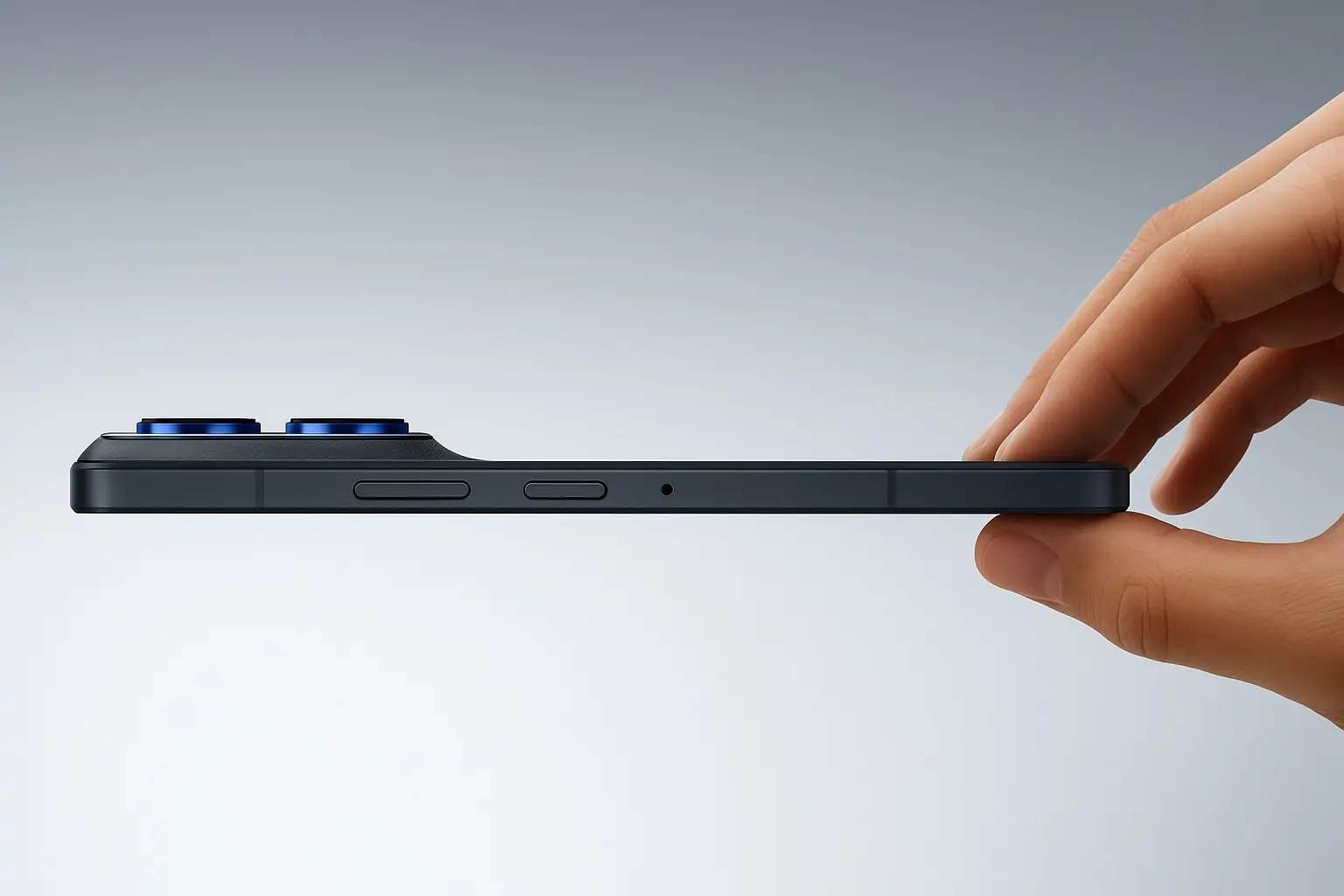
- Slim Design: Motorola’s new Moto X70 Air (globally expected as the Motorola Edge 70) is under 6mm thin (5.99mm) and weighs just 159g, putting it in the same ultra-slim league as Apple’s 5.6mm iPhone Air and Samsung’s 5.8mm Galaxy S25 Edge [1].
- Surprisingly Large Battery: Despite its svelte profile, the X70 Air packs a 4,800 mAh battery, a capacity far larger than the iPhone Air’s 3,149 mAh or the Galaxy S25 Edge’s 3,900 mAh cells [2]. This means Motorola’s device promises significantly better battery life than its ultra-thin rivals, addressing a common drawback of slim phones [3] [4].
- Mid-Range Power: The phone runs on Qualcomm’s Snapdragon 7 Gen 4 chipset (a solid mid-range processor) paired with up to 12GB RAM and 512GB of storage [5] [6]. While not a top-tier chip, it’s power-efficient and is backed by features like a 3D vapor chamber cooling system for steady performance [7] [8].
- Big Display & Cameras: It features a 6.7-inch pOLED display with a sharp 1220×2712 resolution and smooth 120Hz refresh rate [9]. The camera setup is ambitious – a triple 50MP rear camera array (primary lens with OIS, plus ultra-wide and another sensor) and even a 50MP front camera for high-res selfies [10]. Motorola is aiming for flagship-level photography in a mid-range device, with natural color tuning, even if it doesn’t match the sheer megapixel count of Samsung’s 200MP flagship sensor [11] [12].
- No Compromise Features: Unusually for a phone this thin, the X70 Air is IP68/IP69 rated for water and dust resistance [13] – meaning it can survive splashes and even high-pressure water jets. It also supports 68W fast wired charging (and 15W wireless charging), far outpacing the Galaxy S25 Edge’s 25W charging limit [14] [15]. Motorola even offers bold design choices with Pantone-certified colors (e.g. Bronze Green, Lily Pad green, Gadget Gray) and matching accents on the camera rings [16] [17], bringing a flash of style to the ultra-thin category.
- Launch & Pricing: The Moto X70 Air goes on sale in China on October 31, 2025, and Motorola has teased a November 5 launch in Europe for the global version (likely branded as Edge 70) [18]. No official price is announced yet, but European retailer leaks list the top 12GB/512GB model around €709–€802 (approximately ₹73,000–₹82,600) [19]. That’s expected to undercut the premium price tags of the iPhone Air and Galaxy S25 Edge, making Motorola’s offering relatively more affordable [20]. (U.S. availability remains uncertain – analysts note Motorola seems focused on its Razr series in North America for now [21].)
Ultra-Thin Phones: A Growing Trend
“Thin phones are in, and Motorola doesn’t want to miss out,” observed The Verge’s Dominic Preston, as brands across the industry race to shave down device thickness [22]. In 2025, ultra-slim smartphones have become a hot trend following the era of foldables. Apple wowed with the iPhone Air at just 5.6 mm thick, and Samsung impressed tech watchers with its Galaxy S25 Edge at 5.8 mm [23]. These devices proved that high-end phones could go on a serious diet – but they also had to sacrifice battery capacity to achieve those razor-thin profiles [24] [25].
That’s where Motorola saw an opportunity. The company’s new Moto X70 Air is explicitly positioned to challenge those slim flagships without the usual compromises. PhoneArena, a mobile tech outlet, even quipped that the X70 Air’s spec sheet is “likely to make both Apple and Samsung jealous of Motorola’s engineering feat” [26]. The key reason? Motorola managed to combine an ultra-thin body with a much bigger battery, aiming to solve the battery life problem that plagues other slim phones [27]. In short, Motorola is jumping into the ultra-thin phone war not just for bragging rights on thickness, but to one-up Apple and Samsung on everyday longevity.
Motorola Moto X70 Air: Slim Frame, Giant Battery
The Moto X70 Air (launched in China this month) measures just about 5.99 mm in thickness and 159 g in weight [28], living up to the “Air” name with a featherlight feel. For context, it’s virtually as slim as the iPhone Air and S25 Edge, yet Motorola somehow fit a 4,800 mAh battery inside – a huge leap in battery size for this class of device [29]. This battery is roughly 30% larger than the one in Samsung’s Galaxy S25 Edge (which has a 3,900 mAh battery) and over 50% larger than what Apple’s iPhone Air offers (around 3,149 mAh) [30]. Tech experts note this as a potential game-changer: users of ultra-thin phones typically had to carry a charger or battery pack, but the X70 Air might finally break that trade-off by delivering all-day power in a super-slim package [31].
Motorola also equipped the phone with 68W fast charging, so even when that big battery runs low, a quick top-up will be much faster than on its Apple or Samsung counterparts [32]. (For comparison, Apple’s iPhone Air is estimated to top out around 25W charging, and Samsung’s S25 Edge is capped at 25W as well [33].) Wireless charging is supported at 15W, which is convenient for a mid-range device. Impressively, the X70 Air carries an IP68/IP69 rating, meaning it’s not only protected against dust and standard water immersion, but can even withstand high-pressure water jets [34] – a level of durability even some thicker phones struggle to achieve. This suggests Motorola didn’t skimp on build quality or seals, despite chasing extreme thinness.
All these feats make the X70 Air stand out in a category that usually demands compromises. As Android Authority noted, Motorola’s engineering is “intriguing,” proving that “thin doesn’t have to mean fragile” or under-powered [35]. With the X70 Air, Motorola is effectively saying you can have your cake and eat it too: an ultra-sleek phone that doesn’t die by dinnertime.
Mid-Range Core with Premium Touches
Under the hood, the Moto X70 Air is not aiming to be a performance beast like an iPhone Pro or Galaxy Ultra – and that’s intentional. It runs on the Snapdragon 7 Gen 4 chip, a newly announced mid-range SoC. “Motorola’s leaning on a Snapdragon 7 Gen 4… not the flagship Snapdragon 8 Elite or the A19 Pro found in Samsung and Apple’s respective rivals,” 9to5Google explained, noting this device isn’t trying to go toe-to-toe on raw CPU/GPU power [36]. In day-to-day use, though, the Snapdragon 7 Gen 4 should be more than capable for most users, and it brings efficiency benefits that help that big battery last even longer. Motorola pairs the chip with up to 12 GB of LPDDR5X RAM and up to 512 GB of fast UFS 3.1 storage [37] – specifications on par with many premium phones. The device runs Android 16 out of the box, with Motorola’s near-stock MyUX interface providing a clean software experience and some handy extras (like Moto gestures and a new AI assistant, according to official listings) [38].
On the front, you get a gorgeous 6.7-inch pOLED display. It offers a crisp 1.5K resolution (2712×1220 pixels) and a fluid 120Hz refresh rate for smooth scrolling [39]. Motorola claims up to 4,500 nits peak brightness, which would make it one of the brightest screens on any phone – useful for visibility in sunlight. The panel supports HDR10+ and is TÜV/SGS-certified for eye comfort, indicating reduced blue light emissions [40]. In short, the X70 Air’s screen isn’t cutting any corners; it’s as immersive and vibrant as you’d expect from a high-end device.
Despite the mid-tier chipset, other components feel quite premium. The camera system is a highlight: on the back are three 50-megapixel cameras [41]. The primary lens has Optical Image Stabilization (OIS) for steadier shots and likely uses a high-quality Samsung sensor. There’s also an ultrawide lens (with a 120° field of view, according to leaks) [42], and a third shooter that is reportedly for either macro or depth sensing. Having all rear cameras at 50MP is unusual and suggests Motorola is aiming for consistent image quality across zoom levels. For selfies, the X70 Air boasts a 50MP front camera, far higher resolution than typical front cameras [43]. This could make it great for detailed selfies or high-res video calls (and a potential favorite for content creators who use the front camera often). While a megapixel count isn’t everything, Motorola’s approach seems to prioritize clarity and color consistency. In fact, Motorola tends to favor natural color tuning in its camera software, which should appeal to users who dislike over-saturated or overly processed shots [44]. It may not beat Samsung’s 200MP sensor on pure resolution, but in real-world usage the X70 Air’s camera trio is poised to deliver reliable, high-quality photos [45].
Bold Design and Colorful Flair
A big part of the Edge 70/X70 Air’s appeal is that it doesn’t look like any other phone on the market. Motorola has leaned into its partnership with the Pantone Color Institute to offer the device in three striking colors: a deep Pantone Bronze Green, a lighter Lily Pad Green, and a classic Gadget Gray, all with a matte finish [46] [47]. Each color option has unique accent tones – for instance, one model pairs a teal body with bright orange camera ring accents, creating a stylish contrast [48]. These colorful touches extend even to a new customizable “AI” button on the side (painted in the accent color) and a fabric-textured back panel for a better grip, as leaked renders suggest [49] [50]. This is a refreshing change in a realm where Apple and Samsung have mostly stuck to muted, neutral hues for their ultra-thin models.
The X70 Air’s build also shows thoughtful detailing. The camera module on the rear is a neat square housing the three lenses and flash, with each lens surrounded by a metallic ring that matches the Pantone accent color [51]. It’s a small design flourish that gives the phone a bit of personality. Overall, the phone’s aesthetic is clean and modern – Motorola didn’t overload it with logos or gimmicks. Observers are already calling the design “stunning” for how well it blends fun color choices with a premium, minimalist shape [52]. In an ultra-thin device, every millimeter counts for engineering, yet Motorola still managed to deliver a visually striking product that stands out from the crowd of ultra-thin slabs.
Global Release Plans and Competition
Motorola officially unveiled the Moto X70 Air in China in mid-October, with sales there set to begin on October 31, 2025 [53]. The Chinese launch will likely confirm final pricing in yuan, but Motorola has kept that under wraps for now. International tech fans won’t have to wait long, though: Motorola’s European arm is already teasing a November 5 launch event in London, where the same device will debut globally as the Motorola Edge 70 [54]. The company is expected to reveal Euro pricing and availability details at that event.
Leaked retailer listings in the EU hint at a price in the range of €709 to €802 for the maxed-out configuration (12GB RAM, 512GB storage) of the Edge 70 [55]. If accurate, that positions it well below the cost of Apple’s and Samsung’s slim flagships – the iPhone Air and S25 Edge are both premium devices likely priced nearer to €1,000+. Motorola appears to be targeting a more value-conscious segment of the market: folks who want the trendy thin design and solid specs, but don’t want to pay luxury-brand prices. CNET notes that the X70 Air is expected to “cost a good deal less” than Samsung’s and Apple’s ultra-thin offerings [56]. This could attract a wider audience to the ultra-thin category, including many who admired the iPhone Air’s look but balked at its battery trade-offs or steep price.
As for the United States, there’s no official word yet. Motorola has not announced a US release for the Edge 70, and some analysts are skeptical if it will come at all. The company has been prioritizing its foldable Razr series in North America (as well as mid-range Moto G models), and ultra-thin devices are a tougher sell in a market that often prioritizes battery size over slimness. “No word yet on a US release,” noted 9to5Google, even cautioning fans that they “wouldn’t get [their] hopes up” for an American launch at this point [57]. If the Edge 70 stays absent from US shelves, Motorola’s ultra-thin challenger will primarily duke it out with the iPhone Air and Galaxy S25 Edge in Europe and Asia, where those devices are available and the appetite for sleek design is high.
Meanwhile, competition in the ultra-thin arena continues to heat up. Aside from Apple and Samsung, other manufacturers are also exploring record-thin designs. For example, Tecno recently introduced the Tecno Pova Slim, a budget-friendly phone just 5.95mm thick, and Honor is rumored to be developing ultra-thin models in its Magic series [58]. These entries underscore that the “phone diet” trend spans both high-end and mid-range markets. Motorola’s Edge 70 will need to differentiate itself not only with thinness, but with overall user experience – battery life, camera quality, and price-to-performance ratio – to stand out in this niche.
Early impressions from tech experts are optimistic. By combining an impossibly slender build with features that users actually care about (like battery endurance and fast charging), Motorola’s Edge 70 could “win some shoppers over” from the pricier iPhone and Galaxy, as 9to5Google suggested [59]. It represents a design philosophy shift: instead of thin phones being gimmicky showpieces with major compromises, they might become practical daily drivers. RBC Ukraine, reporting on the launch, commented that Motorola specifically set out to solve the battery issue of slim phones by “combining a thin body and a decent-sized battery” in the Edge 70 [60]. If Motorola delivers on that promise, the X70 Air/Edge 70 may very well prove that super-slim phones can be more than just tech demos.
Outlook
Motorola’s Moto X70 Air is more than just another Android phone launch – it’s a statement that the ultra-thin form factor can evolve without sacrificing usability. The device enters the fray with bold claims, and on paper it indeed one-ups its direct competitors in critical areas like battery capacity and charging speed. Android Authority called it “one of the most intriguing mid-range phones of the year,” praising the mix of sleek design and thoughtful engineering [61]. By leveraging a mid-range chipset, Motorola also aims to keep the price reasonable, potentially undercutting Apple and Samsung by hundreds of dollars [62].
The coming weeks will tell how the Edge 70 is received once reviewers and consumers get their hands on it. Will that 4,800 mAh battery truly deliver all-day battery life in such a thin device? Can the cameras hold their own against more expensive phones? And has Motorola managed to avoid the durability issues that sometimes plague ultra-thin gadgets? If the answers are positive, the Edge 70 could become the poster child for the new wave of ultra-thin yet practical smartphones. As it stands, Motorola has successfully grabbed headlines by addressing a key pain point of its rivals. In the words of one industry observer, Motorola’s entry shows that “thin doesn’t have to mean fragile” or underpowered anymore [63] – a welcome message for consumers who want pocket-friendly phones in both size and price.
Motorola’s bold bet to join the “Air” club is about to be put to the test in the real world. If it succeeds, expect the thin-phone trend to accelerate even further, with every manufacturer trying to pack bigger batteries into slimmer frames. For now, the Moto X70 Air/Edge 70 is leading by example, proving that sometimes you can have it both ways: an ultra-thin phone that doesn’t compromise on the features that matter most [64].
Sources: Motorola/Lenovo official announcements; CNET [65]; The Verge [66] [67]; PhoneArena [68]; 9to5Google [69] [70]; Android Authority [71] [72]; Indian Express [73]; RBC Ukraine [74]; Gadgets360 [75] [76].

References
1. www.theverge.com, 2. www.androidauthority.com, 3. www.rbc.ua, 4. www.rbc.ua, 5. www.gadgets360.com, 6. www.androidauthority.com, 7. www.androidauthority.com, 8. 9to5google.com, 9. www.androidauthority.com, 10. www.androidauthority.com, 11. www.androidauthority.com, 12. www.androidauthority.com, 13. www.androidauthority.com, 14. www.androidauthority.com, 15. www.rbc.ua, 16. www.androidauthority.com, 17. 9to5google.com, 18. www.gadgets360.com, 19. indianexpress.com, 20. www.theverge.com, 21. 9to5google.com, 22. www.theverge.com, 23. www.rbc.ua, 24. www.rbc.ua, 25. www.rbc.ua, 26. bsky.app, 27. www.rbc.ua, 28. www.theverge.com, 29. www.theverge.com, 30. www.androidauthority.com, 31. www.rbc.ua, 32. www.androidauthority.com, 33. www.rbc.ua, 34. www.androidauthority.com, 35. www.androidauthority.com, 36. 9to5google.com, 37. www.androidauthority.com, 38. www.androidauthority.com, 39. www.androidauthority.com, 40. www.androidauthority.com, 41. www.androidauthority.com, 42. www.rbc.ua, 43. www.gadgets360.com, 44. www.androidauthority.com, 45. www.androidauthority.com, 46. www.gadgets360.com, 47. www.androidauthority.com, 48. 9to5google.com, 49. www.notebookcheck.net, 50. www.notebookcheck.net, 51. www.notebookcheck.net, 52. 9to5google.com, 53. www.gadgets360.com, 54. www.gadgets360.com, 55. indianexpress.com, 56. www.theverge.com, 57. 9to5google.com, 58. indianexpress.com, 59. 9to5google.com, 60. www.rbc.ua, 61. www.androidauthority.com, 62. www.androidauthority.com, 63. www.androidauthority.com, 64. www.androidauthority.com, 65. startupnews.fyi, 66. www.theverge.com, 67. www.theverge.com, 68. bsky.app, 69. 9to5google.com, 70. 9to5google.com, 71. www.androidauthority.com, 72. www.androidauthority.com, 73. indianexpress.com, 74. www.rbc.ua, 75. www.gadgets360.com, 76. www.gadgets360.com
