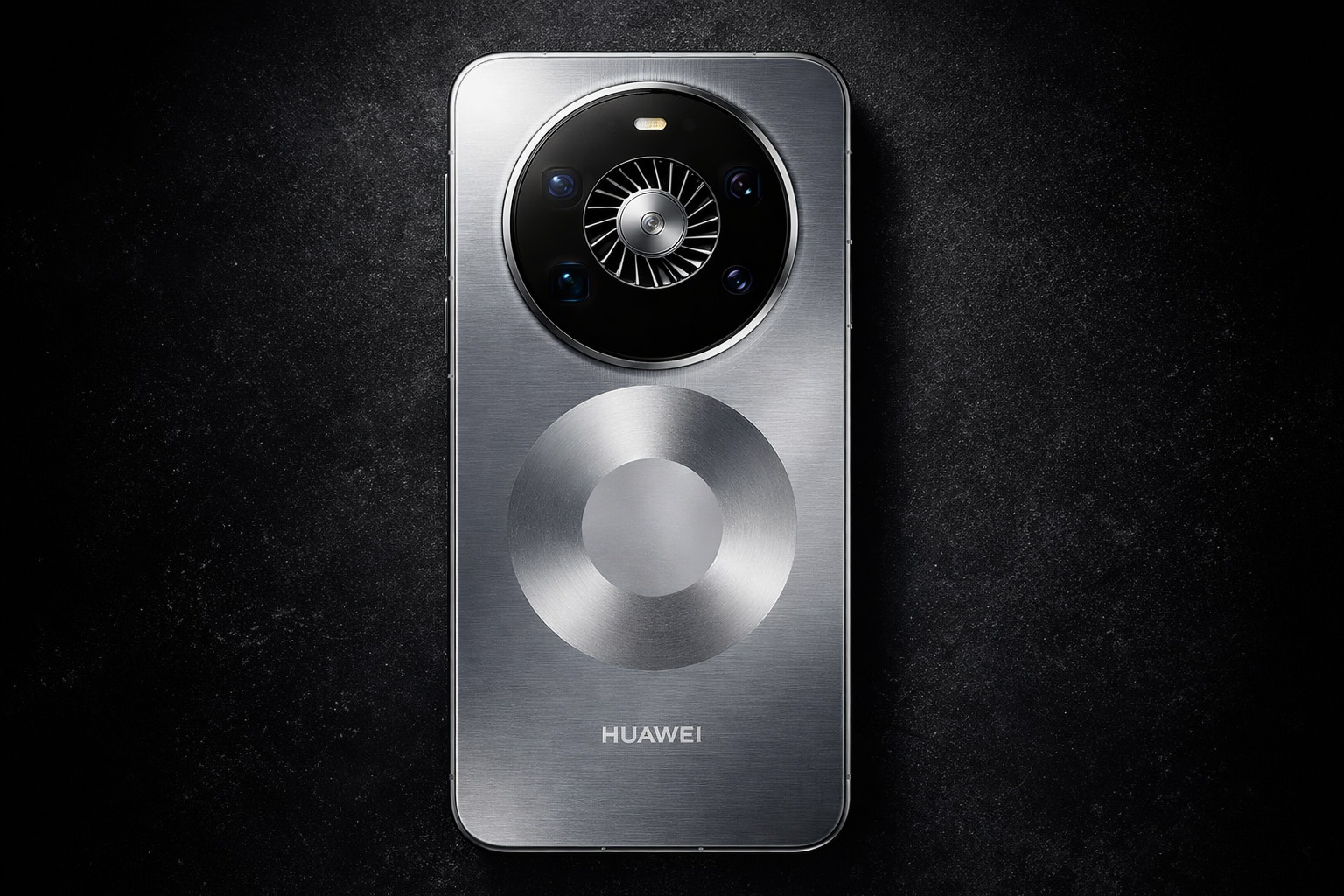
A new wave of reports circulating on Dec. 30 claims Huawei may be preparing a performance-focused Mate 80 GTS variant that borrows a feature usually reserved for gaming phones: active cooling. The twist is where that fan might live. Instead of a side vent or a visible cutout, leaked “concept” images suggest Huawei could place a tiny turbofan inside the circular camera module, using the empty center of the ring as a functional cooling element. [1]
While none of this is official, multiple outlets are now repeating the same core idea: a micro fan integrated into (or around) the camera bump, reportedly to keep the chipset from throttling under sustained gaming and heavy workloads. [2]
Today’s leak: a “fan in the camera ring” concept image goes viral
The most eye-catching part of today’s reporting is a side-by-side design image showing a standard Mate-style circular camera ring and a second version with what looks like fan blades placed in the center of that ring. Hong Kong outlet MobileMagazine describes the image as speculative, but says it aligns with earlier ideas about putting an active cooling component into the camera module area—potentially giving the GTS model a distinct look compared with other Mate 80 variants. [3]
Huawei Central, which amplified the same concept on Dec. 29, explicitly calls the image “speculative” and “probably AI-generated,” stressing it’s not confirmation the feature exists. Still, the report notes the approach makes use of a recognizable Mate design trait: a round camera ring with a vacant inner circle, which could theoretically house a micro fan. [4]
Chinese tech coverage from Antutu on Tencent News echoes the same visual: a guessed render showing a fan “integrated in the center of the rear camera module,” positioning the Mate 80 GTS as a higher-performance edition. [5]
Sohu’s CNMO syndication repeats that description and adds that reports are inconsistent on the fan’s exact placement (center vs. lower section), suggesting the final design—if real—may still be in flux. [6]
Why would Huawei put a fan inside the camera module?
Active cooling isn’t a new idea in smartphones, but it’s unusual in mainstream flagships because a fan introduces trade-offs: space, noise, durability, dust/water sealing, and power draw.
So why the camera ring?
1) It’s one of the few “thick” zones on a modern phone
A fan needs physical volume—something thin phones rarely have. A camera bump is already a “permitted” bulge, so relocating cooling hardware there could avoid making the entire chassis thicker.
2) It can create a dedicated airflow path
If Huawei can route air through ducts around the camera area (instead of directly into the phone’s main cavity), it could reduce heat more efficiently during heavy tasks—without leaving obvious side vents.
3) It turns design into function
Huawei’s circular camera ring is a brand signature. A “fan ring” would be both practical and visually distinctive, potentially helping Huawei market the GTS as a performance flagship rather than just another premium variant.
This isn’t coming out of nowhere: Huawei patents and earlier leaks point to the same direction
Today’s “camera-fan” rumor has roots in earlier reporting and patent chatter.
A Huawei patent describing fan + ducts in a round camera bump
Huawei Central previously reported on a Huawei patent showing a layered round camera bump that includes a built-in fan and internal air ducts, plus integrated inlets/outlets—suggesting airflow could be pushed from the sides rather than the top. [7]
NotebookCheck also covered that same theme, describing a patent for a Mate-style round camera hump composed of multiple layers, one resembling a grille for an active spinning fan, and noting an internal air duct concept. [8]
A separate report: miniaturized fan + water resistance goal
Gizmochina reported (Aug. 2025) that Huawei was working on a miniaturized cooling fan and air duct for the Mate 80 line, allegedly placed in the lower half of the circular camera module, with an air duct along the side—while aiming to keep the phone water resistant by isolating the airflow path. [9]
In other words: the “fan in/near the camera ring” idea has been repeated enough—across months and outlets—that it resembles a persistent engineering direction, even if the final product details remain uncertain.
The big question: why didn’t the Mate 80 launch with this already?
One reason today’s rumor is gaining traction is that earlier reports suggested Huawei wanted a fan-equipped Mate 80 variant—but didn’t ship it.
Huawei Central reported in November that tipster commentary blamed the missing “built-in fan tech” on the difficulty of putting a fan inside a thin, tightly packed smartphone, plus the extra power requirements that could affect battery life. [10]
A Dec. 24 report from Huawei Central adds another wrinkle: Huawei allegedly canceled the fan upgrade for the main lineup due to complex design and high cost, implying the feature might be reserved for a separate model instead. [11]
That backdrop makes the Mate 80 GTS story plausible in concept: if Huawei couldn’t justify the fan for the whole flagship range, a dedicated performance “special edition” could be the easiest place to bring it back.
Rumored Mate 80 GTS specs: Kirin 9030 Pro, 7,000mAh+ battery, and a “turbo fan”
Here’s what multiple reports are claiming today—again, all unconfirmed:
- Chipset: Kirin 9030 Pro (often described as a stronger version for the GTS) [12]
- Battery: 7,000mAh+ capacity (with some reports pairing the big battery with the added power draw of the fan) [13]
- Cooling: a micro fan described as “turbo” or “turbofan,” intended to reduce throttling and maintain sustained performance [14]
- Positioning: a high-performance / gaming-oriented Mate model (the “GTS” naming is commonly interpreted that way in the leaks) [15]
- Timing: March 2026 is repeatedly mentioned; other reports widen it to “H1 2026” [16]
Huawei Central’s earlier reporting also suggested additional “special edition” features, including 3D facial recognition, a 16:10 wide-screen panel, and 20GB RAM—but those details currently appear in fewer sources than the fan and battery claims. [17]
Why cooling matters more now: Kirin 9030 and sustained performance
Huawei’s rumored push toward active cooling also matches a broader reality: modern flagship chips can run into thermal limits quickly during gaming, AI workloads, or extended high-resolution video recording.
Earlier this month, Reuters cited TechInsights saying Huawei’s Mate 80 series is powered by the Kirin 9030, manufactured by China’s SMIC using an improved “N+3” version of 7nm—still behind leading-edge 5nm-class processes from the top global foundries. [18]
That context doesn’t prove Huawei “needs” a fan—plenty of phones manage thermals without one—but it helps explain why a company might explore more aggressive cooling to squeeze out sustained performance, not just peak benchmarks.
The reality check: what would a camera-module fan need to solve?
If Huawei truly ships a fan-equipped Mate 80 GTS, the engineering story won’t just be “there’s a fan.” It will be whether Huawei can deliver:
- Water and dust resistance without obvious open vents (a recurring concern in active cooling designs) [19]
- Low noise during real-world gaming and camera use
- Long-term reliability (moving parts inside a phone are always a risk)
- Battery efficiency, since the fan draws power and needs smart triggering logic [20]
- A believable airflow path, because a fan without proper ducting is mostly cosmetic
Interestingly, some reports explicitly say online leaks disagree on the fan’s placement (center vs. lower section) and whether it uses a patented ducting layout—suggesting the design could still be in active experimentation. [21]
What to watch next
If you’re tracking the Mate 80 GTS story, the next “real” signals likely won’t be another render. Instead, look for:
- More consistent, independent leaks that agree on the fan’s position and venting approach
- Regulatory or supply-chain hints (battery suppliers, thermal component sourcing, or accessory ecosystems)
- Hands-on photos showing a physical grille/duct structure (not a clean concept render)
- Huawei trademark and launch-event patterns lining up with an H1 2026 release window [22]
For now, what we can say confidently is this: on Dec. 30, multiple outlets are converging on the same headline concept—a Mate 80 GTS that uses the camera ring as a home for an active cooling fan—and it’s consistent with prior patent talk and earlier cooling-rumor coverage. Everything else remains rumor until Huawei speaks. [23]

References
1. www.mobilemagazinehk.com, 2. www.mobilemagazinehk.com, 3. www.mobilemagazinehk.com, 4. www.huaweicentral.com, 5. news.qq.com, 6. m.sohu.com, 7. www.huaweicentral.com, 8. www.notebookcheck.net, 9. www.gizmochina.com, 10. www.huaweicentral.com, 11. www.huaweicentral.com, 12. news.qq.com, 13. news.qq.com, 14. www.huaweicentral.com, 15. news.qq.com, 16. news.qq.com, 17. www.huaweicentral.com, 18. www.reuters.com, 19. www.gizmochina.com, 20. www.huaweicentral.com, 21. news.qq.com, 22. www.huaweicentral.com, 23. www.mobilemagazinehk.com