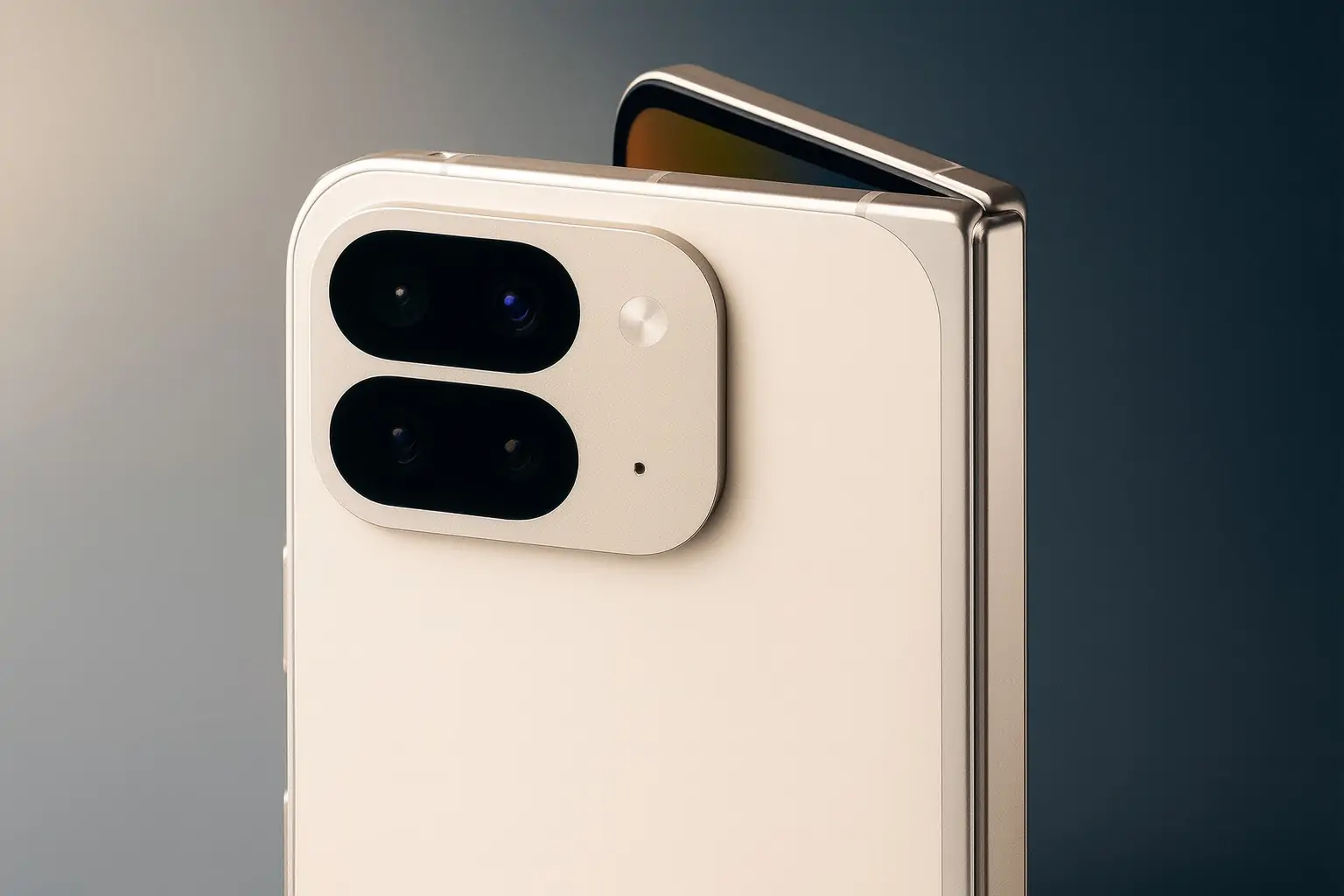
- Launch & Specs: Announced Aug 20, 2025 (with Pixel 10 series) and released Oct 9, the Pixel 10 Pro Fold is Google’s third-generation foldable phone Wikipedia. It packs high-end hardware: a custom Tensor G5 chip, 16 GB RAM, and up to 1 TB storage. It features a 6.4‑inch exterior OLED (up to 3000 nits, 60–120 Hz) and a record-breaking 8.0‑inch “Super Actua Flex” internal OLED (LTPO, 1–120 Hz, 3000 nits) Blog. The triple rear camera system gains a new 48 MP main sensor, plus ultra-wide and 5× telephoto lenses. Google touts 20× Super Res Zoom, a macro mode, and a “Rear Camera Selfie” mode for the big screen 1 .
- Battery & Charging: This phone has Google’s biggest battery ever (rated for 30+ hours of use) Blog. It supports fast charging (50% in ~30 min with 45W wired) and – new to Pixel – Qi2 magnetic wireless charging (PixelSnap), allowing it to attach MagSafe-style accessories and chargers even when unfolded Blog 2 .
- Gearless Hinge & Durability: Google engineered an all-new “gearless” hinge (no mechanical gears) to improve reliability and free up space Blog Blog. The phone’s frame is aerospace-grade aluminum, and Google claims this makes it “twice as durable” as last year’s Pixel 9 Pro Fold Blog. Critically, the Pixel 10 Pro Fold is the first foldable phone ever with an official IP68 dust/water resistance rating – Google’s blog says it “even has an IP68 rating — a first for a foldable device” Blog Blog. In other words, it should resist immersion in water and “dust-tight” particles, unlike earlier Pixel Folds.
- AI & Software: Like other Pixel 10 models, it runs Android 16 with Material 3 theming Wikipedia and Google’s latest AI features. The Tensor G5 chip enables new tools (Gemini Live, Magic Cue, etc.) and computational photography (Instant View preview, Add Me modes, etc.) Blog 3 .
- Breaking News – Durability Test: Within weeks of launch (Oct 2025), a famous stress‐test by YouTuber Zack “JerryRigEverything” Nelson revealed alarming results. During an extreme bend test, the Pixel 10 Pro Fold snapped at a known weak spot (the “antenna line” on the hinge) and caught fire. Nelson filmed the battery expanding, smoking, and emitting enough heat to set off his fire alarm Theverge. He exclaimed that in 10 years of phone durability videos “I have never had a smartphone explode before… The Pixel 10 Pro Fold is the first phone to go up in smoke.” Theverge. Likewise, NotebookCheck observes “the Pixel 10 Pro Fold goes up in flames” in the same spot as its predecessors Notebookcheck, and bluntly calls it “the weakest foldable [Nelson] has ever encountered” Notebookcheck. (For comparison, Samsung’s much thinner Galaxy Z Fold 7 survived the same bend test unscathed 4 .)
- Dust and Hinge Issues: The durability test also challenged the phone’s dust resistance. Nelson threw sand on the folded device: the outer screen remained undamaged, but sand jammed the hinge. He reported “sickening crunches” as gritty particles got stuck and the hinge ground noisily Theverge Androidcentral. Android Central similarly notes that while the display is “dust-proof,” the gearless hinge still didn’t handle sand well – particles crunched inside it Androidcentral. In short, real-world tests found that Google’s claimed IP68 sealing didn’t fully protect the hinge from dust intrusion 5 .
- Expert Reactions: Teardown experts caution that Nelson’s fire was driven by the extreme nature of the test. iFixit’s battery specialist Elizabeth Chamberlain told The Verge that a punctured lithium-ion cell can always go into thermal runaway if cut open under load Theverge. She emphasized “we don’t think this is necessarily a sign that something is wrong with the Pixel 10 Pro Fold design” Theverge, noting that Zack probably didn’t drain the battery (new phones ship ~60% charged) before bending it. (iFixit advises keeping battery charge below 25% when doing these tests Theverge.) Still, this incident isn’t Google’s only battery scare: earlier in 2025 the company issued updates to fix overheating in the Pixel 6A and performance issues in the Pixel 4A 6 .
- Outlook: Google has not publicly responded to the bend-test fiasco beyond the iFixit comments Theverge. The Pixel 10 Pro Fold remains on sale starting at about $1,799 (256 GB) and $2,149 (1 TB) in the US. As one reviewer quipped, you might avoid an “unfolded Pixel 10 Pro Fold in your pocket” after seeing this test Wccftech. For now, Google stands by its specs – a massive foldable screen, long battery, AI smarts, and the promise of toughness. But critics note that Google “simply does not learn from its mistakes” Notebookcheck unless it fixes the same hinge flaw that doomed its earlier foldables. Users eager for a big-screen Pixel will appreciate the advanced features, but others will watch closely to see if Google reinforces that notoriously vulnerable antenna line in future models.
Sources: Authoritative tech coverage and official Google announcements have been used throughout Blog Theverge Androidcentral Notebookcheck Blog. The durability quotes come from JerryRigEverything’s test video and expert commentary in The Verge and others Theverge Theverge Notebookcheck. Google’s own blog details the gearless hinge, IP68 rating, and hardware improvements Blog 7 .
MY PIXEL 10 PRO FOLD EXPLODED -- CAUGHT LIVE ON CAMERA!