

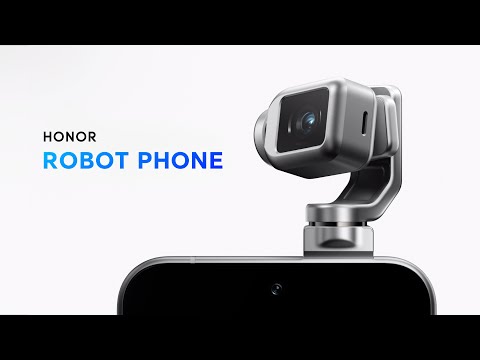
- Honor teases a “Robot Phone” concept: a smartphone with a fold-out, gimbal-mounted camera arm that can swivel in any direction under its own power [1] [2].
- The camera “eye” shows personality: In a CGI teaser video, the single lens pops up and moves with the “infantile curiosity of a puppy”, tilting and even giggling like a tiny robot companion [3] [4].
- Billed as an AI “emotional companion”: Honor says this AI-powered device is more than a phone – it’s a “new species of AI device” meant to “enrich users’ lives with love, joy, and wisdom” by sensing and adapting autonomously [5] [6].
- Part of Honor’s big AI push: The Robot Phone is a milestone in Honor’s “Alpha Plan” strategy, as the company invests $10 billion in AI over five years and aims to lead in AI-driven gadgets [7] [8].
- Full reveal in 2026: The concept was a surprise “one more thing” at Honor’s Magic 8 phone launch and will be fully unveiled at Mobile World Congress 2026 in Barcelona [9] [10].
A Smartphone Camera That Comes Alive
Smartphone maker Honor (formerly a sub-brand of Huawei) has stunned tech watchers by teasing a device it calls the “Robot Phone.” Unlike any handset on the market, this concept phone features a single camera on a mechanical arm that folds out from the back [11] [12]. Once deployed, the camera can rotate freely to face any direction, essentially giving the phone a swiveling “eye.” In Honor’s CGI teaser video, the camera even moves on its own – peeking around, tilting like a curious pet, and emitting little giggles of wonder [13]. The effect is deliberately whimsical, making the gadget feel less like a slab of electronics and more like a pocket-sized robot sidekick. Tech blog Droid-Life quipped that the device appears to have its own “WALL-E-like robot personality,” comparing it to the lovable Pixar robot [14]. Honor seems to be hinting that future phones could behave more like living companions than inert tools.
This motorized, gimbal-mounted camera isn’t just a party trick—it could enable new photography capabilities. Because the lens can physically reposition itself, the Robot Phone can theoretically track subjects or scenes autonomously and stabilize shots in ways fixed cameras cannot. One promo scene even shows the phone lying flat on a table while its camera periscopes up to film the surroundings [15]. Another imagines the phone gazing up at the night sky in “astonished wonderment” to capture a shooting star [16]. Honor is clearly emphasizing creative use cases: hands-free vlogging, video calls where the “eye” follows the user, astrophotography with automatic tracking of stars, and more. “We’re assuming this thing won’t actually ooh and aah at things… but given it’s said to fuse multi-modal intelligence and advanced robotics, who knows,” Droid-Life joked of the concept’s animated behavior [17]. Indeed, the company claims the Robot Phone will have enough AI smarts to frame shots and even “soothe” a crying baby by recognizing emotion – tasks far beyond a normal camera [18].
Part Phone, Part Pet: An “Emotional Companion”
Honor is explicitly marketing the Robot Phone as something beyond a typical smartphone. In a press release, the company described the device as an “emotional companion” rather than just a gadget. “With the Robot Phone, Honor envisions the future phone as more than just a tool… It becomes an emotional companion that senses, adapts, and evolves autonomously like a robot, enriching its users’ lives with love, joy, and wisdom,” the company said [19]. In other words, Honor sees this concept as a new category of consumer AI – a device that could interact with humans in a more personal, lifelike way. The Robot Phone even carries an alpha symbol (∝) on its back instead of the usual Honor logo [20]. That symbol not only hints at the device’s code name in development, but also resembles Sony’s Alpha camera logo – an intentional nod to advanced photography, and possibly to Honor’s overarching “Alpha Plan” vision [21].
Industry observers have noted that Honor’s Robot Phone teaser also cheekily references its rivals. The video’s opening frames flash the word “iPhone” before morphing into “AiPhone”, signaling that Honor’s next-gen phone will be defined by AI [22]. Visually, the Robot Phone prototype bears a “passing resemblance” to Apple’s iPhone 17 Pro in shape and style [23] – a design trend increasingly common among Chinese manufacturers. Honor may be playfully asserting that while everyone is busy comparing specs with the latest iPhone, it’s pursuing something more radical. As one report put it, Honor is “going all in” on this bold concept to “redefine future human-machine interaction and coexistence” [24] [25]. By integrating an AI “brain” with a robotic body (albeit a tiny one that lives in your phone), Honor hopes to bridge the gap between user and AI in daily life [26].
Pushing Boundaries in Honor’s “Alpha Plan”
The Robot Phone is part of Honor’s newly announced Alpha Plan, a long-term strategy to become a leader in AI-driven consumer tech [27] [28]. Earlier this year, the Shenzhen-based company – which spun out from Huawei in 2020 – pledged $10 billion for AI development over five years as it expands beyond smartphones into an “AI device ecosystem” [29] [30]. Honor’s CEO, James Li, has spoken about transforming Honor from a handset maker into an “AI ecosystem company”, developing AI-powered PCs, tablets, wearables, and more [31]. The new Robot Phone concept is a “significant milestone” in this plan [32]. It represents what Honor calls a “new species of AI device” – not just a phone with smart features, but a fundamentally new form factor built around AI, robotics, and advanced imaging [33]. By showcasing a phone that can quite literally move, see, and react on its own, Honor is making a statement that the next era of mobile devices will be defined by autonomy and personality as much as by raw specs.
Analysts note that this is an ambitious move for Honor. The global smartphone market is fiercely competitive and has seen stagnating innovation in recent years, as most phones look and act alike. Features like pop-up selfie cameras and flipping lenses (remember the Asus Zenfone 6 in 2019?) have come and gone [34], and foldable screens are now the big trend. With the Robot Phone, Honor is trying something entirely different to stand out – essentially fusing a smartphone with a robotic camera on a 3-axis gimbal. “The concept is neat, though the logistics of a compact gimbal tightly folded into a phone present challenges,” observed 9to5Google, noting that this is still just a demo for now [35]. Indeed, cramming motors, hinges and an AI module into a phone raises questions about durability (moving parts can break), battery life, and real-world utility. Will a phone that swivels its “eye” around be practical, or is it more of a sci-fi gimmick? These are the questions Honor will have to answer when the Robot Phone moves from concept to reality.
From Teaser to Reality: Coming in 2026
For now, the Robot Phone remains an early concept – shown only in CGI renders and a teaser video, without any live demo of hardware. Honor hasn’t announced a price, specs, or even a formal product name beyond the “Robot Phone” moniker. The company is using the coming months to build anticipation. More details are promised at the Mobile World Congress (MWC) in Barcelona in late February 2026, where Honor says it will reveal the device fully [36]. That timing suggests the Robot Phone could launch sometime next year if development stays on track. It’s worth noting that companies often tease concept devices that never actually ship, or that undergo significant changes before release. However, Honor “seems confident in its arrival,” according to 9to5Google’s Andrew Romero [37], implying that this is more than just a wild idea on paper.
The teaser itself was unveiled as a surprise “One More Thing” at the end of Honor’s launch event for its new Magic 8 series smartphones in Beijing [38]. That event primarily showcased the Magic 8 and Magic 8 Pro – conventional flagship phones that boast cutting-edge AI software features and high-end cameras. By tacking the Robot Phone preview onto the event, Honor captured headlines well beyond the usual China tech press. The gambit appears to be paying off in terms of buzz: tech enthusiasts worldwide are now talking about Honor as the company with the crazy phone that might come to life in your pocket. It’s a bold image for a brand that, until recently, was best known for mid-range Android phones and Huawei hand-me-down designs.
Whether the Robot Phone will live up to the hype (and not just live in our imaginations) remains to be seen. But it undeniably underscores a trend in consumer electronics: the blending of AI and robotics into everyday devices. From robot vacuum cleaners with arms to smart home assistants with personalities, the line between gadget and robot is blurring. Honor is betting that even our personal phones could evolve into helpful little robots that go beyond swiping and tapping – perhaps even offering a friendly wiggle or comforting gaze when we need it. As the company itself proclaims, this device is “set to redefine” how we interact with technology [39]. Come 2026, we’ll find out if the world is ready for a smartphone that winks, wiggles, and wants to be our friend. Stay tuned – your next phone might just blink back at you [40].
Sources: Honor press release [41]; The Verge [42] [43]; Droid-Life [44]; 9to5Google [45] [46]; Engadget/Yahoo News [47]; MeriStation/Diario AS [48].
References
1. www.theverge.com, 2. www.theverge.com, 3. 9to5google.com, 4. www.theverge.com, 5. www.theverge.com, 6. www.prnewswire.com, 7. startupnews.fyi, 8. www.prnewswire.com, 9. www.theverge.com, 10. 9to5google.com, 11. www.theverge.com, 12. www.theverge.com, 13. 9to5google.com, 14. www.droid-life.com, 15. www.theverge.com, 16. www.theverge.com, 17. www.droid-life.com, 18. www.theverge.com, 19. www.theverge.com, 20. www.theverge.com, 21. 9to5google.com, 22. 9to5google.com, 23. 9to5google.com, 24. 9to5google.com, 25. www.prnewswire.com, 26. 9to5google.com, 27. en.as.com, 28. www.prnewswire.com, 29. startupnews.fyi, 30. evertiq.com, 31. evertiq.com, 32. www.prnewswire.com, 33. www.prnewswire.com, 34. www.theverge.com, 35. 9to5google.com, 36. 9to5google.com, 37. 9to5google.com, 38. www.theverge.com, 39. www.prnewswire.com, 40. www.theverge.com, 41. www.prnewswire.com, 42. www.theverge.com, 43. www.theverge.com, 44. www.droid-life.com, 45. 9to5google.com, 46. 9to5google.com, 47. startupnews.fyi, 48. en.as.com
