Motorola’s Moto G Power (2026) launches Jan. 8 for $299 with rugged durability and a 5,200mAh battery—here’s how it compares to the $180 Moto G Play (2026).
Motorola’s budget-friendly Moto G lineup is heading into 2026 with a very specific message: you don’t need to spend flagship money to get a big screen, long battery life, and—yes—a 3.5mm headphone jack. After Motorola’s North America announcement of the Moto G Power (2026) this week, early coverage has focused on two themes: the phone’s durability upgrades and the surprisingly “old-school” choices that still make sense in 2026, like wired audio. [1]
At the same time, shoppers are already asking the obvious question: if the Moto G Play (2026) can be found around $180, what exactly do you get by spending closer to $300 on the Moto G Power (2026)—and is it worth it?
Below is what the latest reports and official details say as of Dec. 19, 2025, including the key differences, what’s new, and one important spec that’s causing real confusion.
Moto G Power (2026): Motorola’s “tougher” budget phone lands in January
Motorola officially announced the moto g power – 2026 on December 16, 2025, positioning it as a value phone built around four pillars: a brighter big display, durability, battery life, and an upgraded camera system. [2]
Price and release date
- US price:$299.99 MSRP
- On sale (US):January 8, 2026
- Where to buy (US, unlocked): Motorola, Amazon, Best Buy; plus Verizon on Jan. 8 and additional carriers “in the coming months” [3]
- Canada price:$449.99 MSRP, also starting January 8 [4]
The headline upgrades: durability + a more modern “Power” spec sheet
According to Motorola’s announcement, the Moto G Power (2026) features:
- 6.8-inch FHD+ 120Hz display with a high brightness mode listed up to 1,000 nits [5]
- IP68/IP69 water/dust protection and MIL-STD-810H testing, plus Corning Gorilla Glass 7i [6]
- 5,200mAh battery marketed as “two days of power,” with 30W TurboPower wired charging [7]
- 50MP main camera with OIS, 8MP ultrawide/macro, and a 32MP front camera [8]
- MediaTek Dimensity 6300 and Android 16 out of the box [9]
This is also being framed as a durability story: Motorola explicitly calls out drop and environmental testing, and multiple outlets highlight the combination of IP68/IP69 + Gorilla Glass 7i as unusual in this price bracket. [10]
The headphone jack angle: Motorola is doubling down on “useful nostalgia”
One of the most widely shared takeaways has nothing to do with megapixels: the Moto G Power (2026) keeps a headphone jack, and The Verge leaned into the fact that you can still buy a new phone with one in 2026. [11]
That matters for more people than it sounds like:
- wired earbuds still work with no pairing, no charging, and no latency
- the jack is still the simplest way to plug into older car stereos, classroom AV systems, and inexpensive speakers
- in the budget segment, it’s also a quiet way to save money—because not everyone wants to buy wireless earbuds immediately
And Motorola isn’t treating it like an afterthought in the way many brands do—it’s becoming part of the Moto G identity again. [12]
The wireless charging confusion: does Moto G Power (2026) have it or not?
Here’s the messy part of the story right now: wireless charging is being reported inconsistently, depending on the outlet.
- PhoneArena’s comparison piece says the Moto G Power (2026) adds 15W wireless charging and calls it a standout upgrade. [13]
- PCMag’s early write-up (via a Muck Rack listing) said there was “no word yet” on whether wireless charging is included. [14]
- 9to5Google reports the opposite: it states wireless charging has been removed compared to recent generations. [15]
- A Tom’s Guide overview echoes that point, saying the 2026 model loses wireless charging and focuses on 30W wired instead. [16]
Motorola’s own announcement emphasizes 30W TurboPower but does not highlight wireless charging as a feature. [17]
Practical takeaway (as of Dec. 19): If wireless charging is a must-have, assume it’s unlikely on the Moto G Power (2026) until retail listings and full reviews confirm otherwise—because multiple reports explicitly say it’s missing. [18]
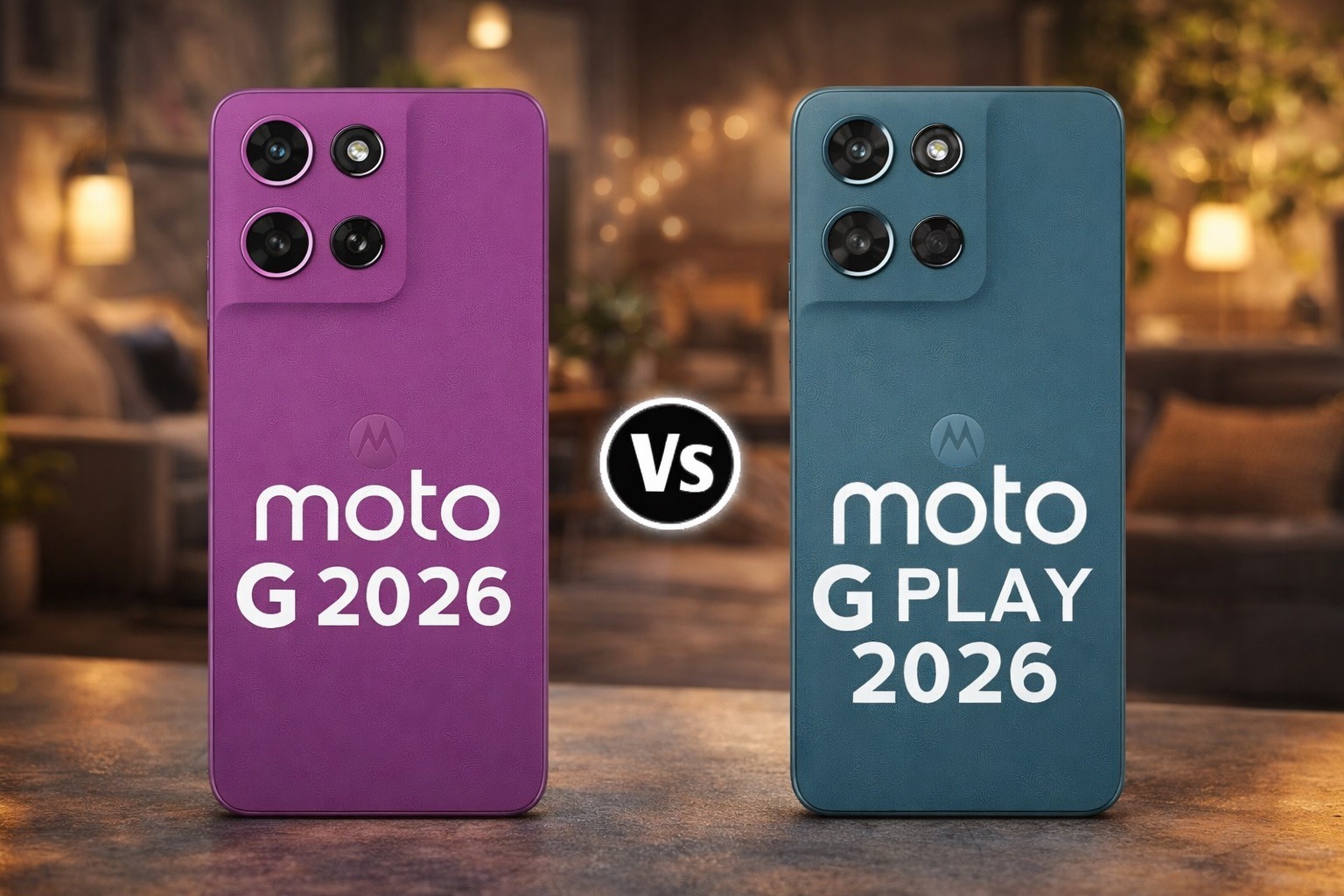
Moto G Play (2026): the $180 alternative that’s “good enough” for basics
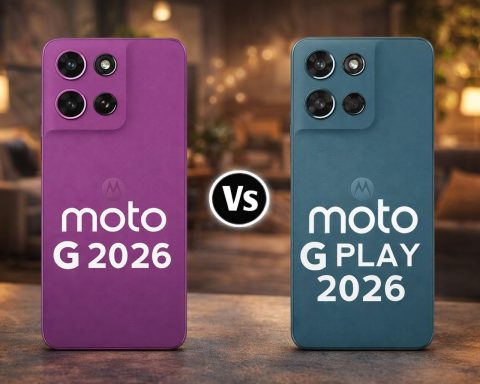
The Moto G Play (2026) sits at the other end of the value spectrum. PhoneArena’s comparison frames it as a surprisingly decent ultra-budget phone—especially for battery life and everyday tasks—while acknowledging the compromises you’d expect under $200. [19]
From recent hands-on/review coverage and spec summaries, the core picture looks like this:
- Price: around $179–$180
- Display:6.7-inch LCD with 120Hz, but at HD+ (720p) resolution [20]
- Chipset:MediaTek Dimensity 6300
- Memory/storage: generally 4GB RAM / 64GB storage with microSD expansion [21]
- Cameras: a simpler setup (commonly described as a single 32MP rear camera) and an 8MP selfie camera [22]
- Battery:5,200mAh, with 18W wired charging [23]
In other words: the Play is built to be a reliable screen-and-battery phone—great for streaming, messaging, rideshare, a teenager’s first phone, or a backup device—without pretending to be anything else. [24]
Moto G Power (2026) vs Moto G Play (2026): the differences that actually matter
If you’re deciding between the two, most of the real-world difference comes down to four areas:
1) Screen sharpness (biggest day-to-day difference)
- Moto G Play (2026): 6.7″ HD+ (720p)
- Moto G Power (2026): 6.8″ FHD+ (1080p) [25]
This is the kind of upgrade you notice constantly—text crispness, video clarity, and how “expensive” the phone feels.
2) Cameras (Power is meaningfully more versatile)
- Play: simpler single-camera approach
- Power: 50MP main with OIS + 8MP ultrawide/macro, plus 32MP selfie [26]
Even if you’re not a camera nerd, an ultrawide and stabilized main camera can be the difference between “fine” and “frustrating” in low light or moving shots.
3) Durability and water resistance
Motorola’s marketing for the Power (2026) is clearly durability-led with MIL-STD-810H testing and IP68/IP69 ratings. [27]
PhoneArena also highlights Gorilla Glass 7i on the Power vs Gorilla Glass 3 on the Play. [28]
If you’re buying for someone who drops phones (or works outdoors), this alone can justify the price gap.
4) Charging and performance headroom
- Power (2026) is consistently listed with 30W wired charging, while the Play stays around 18W. [29]
- Both share the same chipset family, but the Power is positioned with more RAM in most coverage, which typically means smoother multitasking over time. [30]
Which one should you buy?
Buy the Moto G Play (2026) if…
- you want the lowest price possible (around $180)
- you mainly stream video, text, browse, and use social apps
- you’re buying a backup phone or something for light use [31]
Buy the Moto G Power (2026) if…
- you keep phones for multiple years and hate “budget lag”
- you care about screen sharpness (1080p) and better cameras
- you need durability: IP68/IP69 + MIL-STD-810H
- you want a budget phone that feels closer to midrange—without jumping to $400+ [32]
What to watch next (between now and Jan. 8)
Because the Moto G Power (2026) doesn’t hit shelves until January 8, the next wave of coverage will likely focus on:
- real battery testing (does it beat other Moto G models?)
- confirmation of the wireless charging situation
- camera performance beyond the spec sheet [33]
For now, the story is simple: Motorola is making a strong case that “budget” can still mean durable, practical, and fun—and that a headphone jack is still a feature worth shipping in 2026. [34]
References
1. motorolanews.com, 2. motorolanews.com, 3. motorolanews.com, 4. motorolanews.com, 5. motorolanews.com, 6. motorolanews.com, 7. motorolanews.com, 8. motorolanews.com, 9. motorolanews.com, 10. motorolanews.com, 11. www.theverge.com, 12. www.theverge.com, 13. www.phonearena.com, 14. muckrack.com, 15. 9to5google.com, 16. www.tomsguide.com, 17. motorolanews.com, 18. 9to5google.com, 19. www.phonearena.com, 20. www.phonearena.com, 21. www.phonearena.com, 22. www.phonearena.com, 23. www.phonearena.com, 24. www.phonearena.com, 25. www.phonearena.com, 26. www.phonearena.com, 27. motorolanews.com, 28. www.phonearena.com, 29. motorolanews.com, 30. motorolanews.com, 31. www.phonearena.com, 32. motorolanews.com, 33. motorolanews.com, 34. www.theverge.com