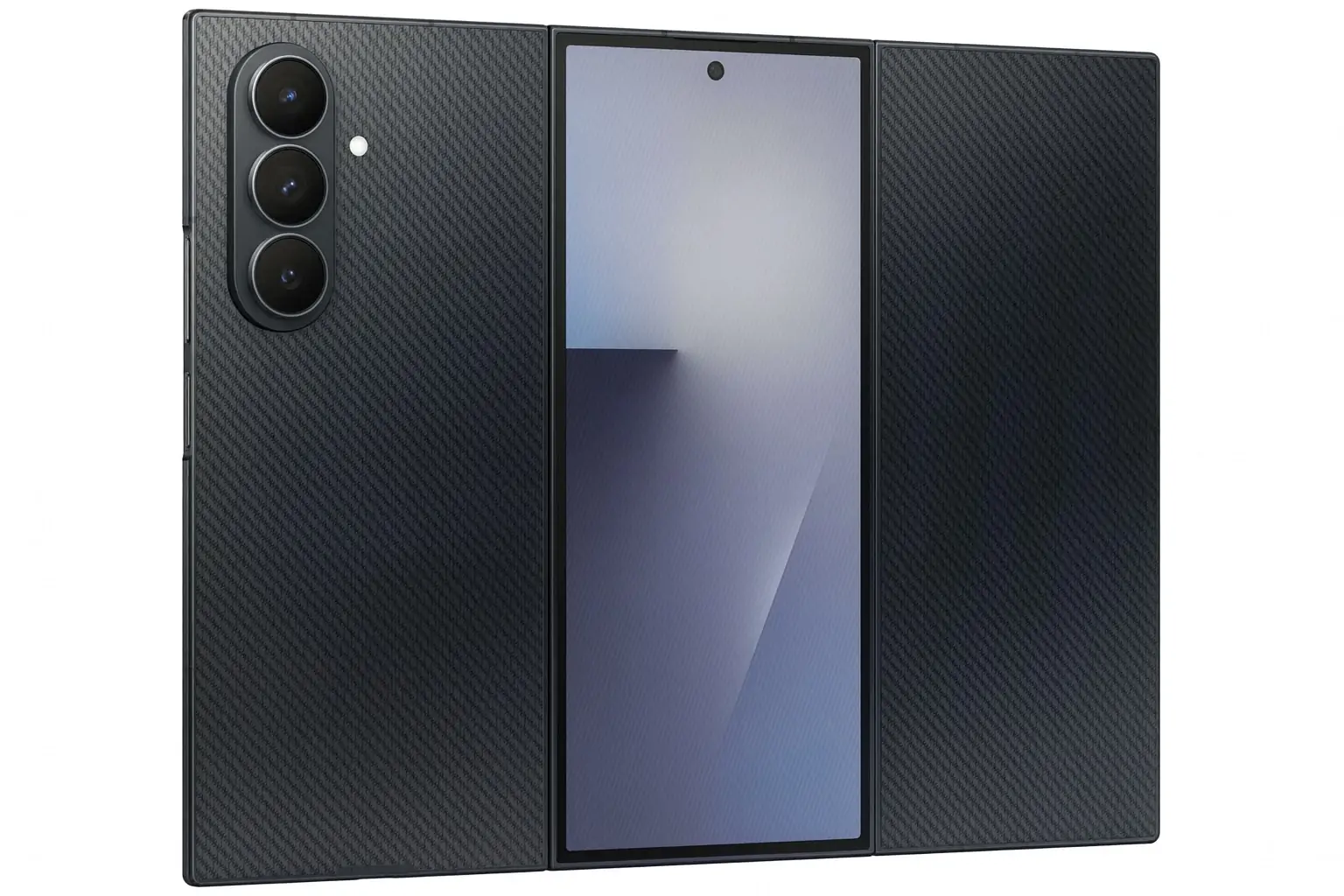
Samsung’s most radical phone in years is almost here. The Galaxy Z TriFold, a device that folds not once but twice to reveal a 10‑inch tablet‑style display, goes on sale in South Korea on December 12 – and today we’re getting a wave of fresh details, from benchmark leaks and missing features to new component partners. 1
Here’s a complete look at Samsung’s first tri‑fold phone – including price, release date, specs, today’s news (Dec 8, 2025), and what it means for Apple’s long‑rumored foldable iPhone. 2
Galaxy Z TriFold at a glance
- Form factor: Tri‑fold “G‑fold” design with two inward‑folding hinges 3
- Main display: 10.0‑inch Dynamic AMOLED 2X, 2160 × 1584, 1–120 Hz, up to 1,600 nits 4
- Cover display: 6.5‑inch FHD+ (21:9), up to 120 Hz, up to 2,600 nits 5
- Chipset: Snapdragon 8 Elite Mobile Platform for Galaxy (3 nm) 6
- Memory & storage: 16 GB RAM; 512 GB or 1 TB storage 6
- Cameras:
- Rear: 200 MP wide + 12 MP ultra‑wide + 10 MP 3x telephoto
- Front: 10 MP selfie on cover display + 10 MP selfie on main display 5
- Battery: 5,600 mAh (three‑cell design), 45 W wired fast charging, 15 W wireless, Wireless PowerShare 6
- OS & software: Android 16 with One UI 8, Galaxy AI features, Gemini integration for some markets 6
- Durability: IP48 water resistance, titanium hinge housing, Gorilla Glass Ceramic 2 front, ceramic‑glass fiber back 6
- Weight & size: 309 g; just 3.9–4.2 mm thin when unfolded, ~12.9 mm folded 7
- Price: KRW 3,590,400 (≈ $2,450–$2,500) for 512 GB model in Korea 1
- Colors: Crafted Black only (for now) 6
A phone that becomes a 10‑inch tablet
Samsung has been teasing flexible form factors for years, but the Galaxy Z TriFold is the first consumer device where the company goes all‑in on a tri‑panel design. When folded, it behaves like a regular slab phone with a 6.5‑inch display; open both hinges and it becomes a 10‑inch tablet‑like screen with a 4:3 aspect ratio. 5
The TriFold uses two differently sized “Armor FlexHinges” connected by a dual‑rail structure. This allows both outer panels to fold inward, protecting the flexible display when the device is closed – a different approach from Huawei’s Mate XT, which can fold outward and is currently sold mainly in China. 8
Materials are very flagship‑leaning:
- Titanium is used for the hinge housing.
- An Advanced Armor Aluminum frame reinforces the structure.
- The back combines ceramic‑glass fiber‑reinforced polymer to keep things rigid yet light. 6
At 309 g, it’s undeniably hefty, but early hands‑on impressions suggest the weight distribution is surprisingly well‑balanced, and the 12.9 mm folded thickness is only a bit more than Samsung’s own Z Fold 7. 9
Displays and multitasking: three phones’ worth of screen
The display experience is the real reason this device exists:
- Main screen: 10.0‑inch Dynamic AMOLED 2X
- QXGA+ (2160 × 1584), 269 ppi
- 1–120 Hz adaptive refresh rate
- Up to 1,600 nits peak brightness 4
- Cover screen: 6.5‑inch FHD+
- 21:9 aspect ratio
- Up to 120 Hz
- Up to 2,600 nits brightness (great for outdoor use) 5
Samsung’s software pitch centers around productivity and multi‑window use. On the 10‑inch canvas, you can:
- Run three full apps side‑by‑side, plus a fourth in a floating pop‑up. 9
- Use standalone Samsung DeX directly on the device, turning the TriFold into a tiny laptop replacement with resizable app windows and multiple virtual desktops. 6
- Combine this with Galaxy AI features and Google’s Gemini Live assistant on supported markets for summarisation, translation, and on‑device generative tools. 6
In other words, this is meant to be phone + tablet + mini‑PC in one device for people who live inside multiple apps at once.
Hardware, performance – and today’s “disappointing” benchmark leak
Under the hood, the Galaxy Z TriFold ships with a Snapdragon 8 Elite Mobile Platform for Galaxy, paired with 16 GB of RAM and 512 GB or 1 TB of storage depending on configuration. 6
On paper, that’s top‑tier hardware. But today’s big performance story (Dec 8) is an early Geekbench 6 leak:
- Single‑core score: 2,853
- Multi‑core score: 8,501
According to analysis published this morning, those numbers are roughly 10% below Qualcomm’s own baseline figures for the Snapdragon 8 Elite, raising questions about thermal limits and Samsung’s tuning on this unique form factor. 10
It’s worth stressing a few caveats:
- Benchmarks may come from pre‑release software.
- Samsung has to manage heat across three panels, which may lead to more conservative power limits.
- For most users, these scores are still firmly in “flagship‑fast” territory. 10
We’ll need full reviews – not just synthetic numbers – to know whether performance is noticeably constrained in real‑world gaming and heavy multitasking.
New today: Goodix confirms it powers TriFold’s touch and fingerprint
Another important December 8 update is on the components side. Chinese chipmaker Goodix announced that its technology sits at the heart of the TriFold’s input system. 11
According to Goodix, the Galaxy Z TriFold uses:
- A custom multi‑fold touch solution with high driving capability and strong resistance to display noise, designed specifically for the challenges of a tri‑fold OLED panel.
- A “form‑adaptive” touch algorithm that adjusts sensitivity and rejection based on whether the device is folded, partially folded, or fully open.
- An ultra‑narrow side‑key capacitive fingerprint sensor, just 1.65 mm wide, integrated into the slim frame for fast unlock in any fold state. 11
This confirms that Samsung isn’t just reusing its existing Fold/Flip touch stack; it’s customizing hardware and algorithms for the TriFold’s more complex geometry.
Cameras and mobile content creation
Samsung clearly doesn’t want the TriFold to feel like a compromise camera phone. The rear setup mirrors its mainstream flagships: 5
- 200 MP wide camera (with pixel‑binning and “optical‑quality” 2x zoom using an adaptive pixel sensor)
- 12 MP ultra‑wide
- 10 MP 3x telephoto, up to 30x digital zoom
- Dual 10 MP selfie cameras, one punched into the cover display and one in the main screen
Early hands‑ons in Asia report image quality broadly in line with Samsung’s top S‑series phones, though we’ll need full reviews to see how well Samsung’s image processing handles the extra processing load alongside multitasking and AI features. 9
For creators, the 10‑inch canvas plus powerful camera combo could be compelling: think editing timelines, notes, and reference material side‑by‑side without needing a separate tablet.
Battery: Samsung’s biggest foldable cell yet
To drive that much screen, Samsung had to go big on the battery. The TriFold uses a 5,600 mAh three‑cell pack, with one cell placed behind each panel to distribute weight and manage thermals. 6
Samsung’s official numbers and supporting documentation say:
- Up to 17 hours of video playback on a charge. 12
- 45 W Super‑Fast Charging 2.0 via USB‑C (about 0–50% in ~30 minutes with the bundled adapter). 6
- Fast Wireless Charging 2.0 (15 W) and Wireless PowerShare for topping up accessories. 6
Reassuringly for early adopters at this price point, the 45 W charger is actually included in the box in some markets, bucking recent flagship trends. 13
The missing Flex Mode: today’s other big talking point
While Samsung has added new tricks, one popular foldable feature is missing, as highlighted in a SamMobile report updated today. 14
On Galaxy Z Flip and Z Fold phones, Flex Mode rearranges an app’s interface when the screen is partially folded – video on top, controls on the bottom – making it great for desk‑mounted use (for example, watching YouTube hands‑free). 14
On the Galaxy Z TriFold:
- You can rest it on a table with one third of the inner screen facing you.
- But the phone does not trigger Flex Mode – apps don’t automatically shift UI elements around that partial view. 14
Samsung hasn’t publicly explained the omission, but reviewers note that the triangular side profile looks odd in that configuration and may not be stable enough to justify a fully supported mode. 14
This is likely a 1.0‑generation trade‑off; if enough users want it, Flex‑style layouts could still arrive via future One UI updates.
Price and release date: where and when you can buy it
Pricing and availability are now much clearer than in the early rumor days:
- South Korea:
- On sale December 12, 2025
- Starting price KRW 3,590,400 (around $2,450–$2,500) for 16 GB / 512 GB 1
- China, Taiwan, Singapore, UAE:
- Launch by the end of December 2025, limited retail footprint focused on flagship Samsung stores. 1
- United States:
- Launch window confirmed for Q1 2026 (January–March).
- Various outlets and financial press repeatedly emphasize the device will arrive “months ahead of Apple’s first foldable iPhone,” expected in late 2026. 15
- Europe & UK:
- Samsung hasn’t given firm dates; availability is expected to be selective and may lag behind the U.S. 16
Samsung itself describes the rollout as “gradual and phased”, with devices sold through select stores to encourage hands‑on demos and guided explanations before purchase – a clear sign the company views the TriFold as a niche showcase, not a mass‑market workhorse. 15
Strategy over sales: what analysts are saying today
Several industry watchers now see the TriFold more as a strategic flex than a volume driver – and that theme is especially strong in today’s coverage.
- Reuters notes that, at this price and complexity, the TriFold is likely a first‑generation technology demonstrator aimed at enthusiasts rather than mainstream buyers, even as Samsung’s foldable market share jumped to 64% in Q3 thanks to the more conventional Fold 7 and Flip 7. 1
- A new DigiTimes report published today frames the TriFold launch as a way for Samsung to lock in display and hinge leadership before Apple’s entry, even if unit volumes stay modest. 17
- Market forecasts cited in those reports still see foldables at under 3% of the global smartphone market by 2027, despite double‑digit annual growth. 1
In parallel, editorials from outlets like PhoneArena and Tom’s Guide argue that the TriFold is “the future you probably don’t need” right now – breathtaking hardware but hard to justify over a cheaper flagship plus a separate tablet. 18
Pressure on Apple and rivals
The timing isn’t subtle. Bloomberg and others have highlighted that Samsung’s $2,450 TriFold lands months ahead of Apple’s first foldable iPhone, which is widely expected to use a more conventional single‑fold design and arrive in late 2026. 19
Commentary from TechRadar and MacRumors this week suggests:
- The TriFold gives Samsung a narrative lead in “next‑next‑gen” form factors. 20
- Apple may choose to perfect a simpler foldable at a slightly lower price rather than chase a tri‑fold design at launch. 2
- Huawei’s Mate XT remains technically the first commercial tri‑fold phone, but its China‑first strategy leaves Samsung room to claim the spotlight globally. 21
Either way, Samsung has thrown down a very expensive, very complex gauntlet.
Should you care about the Galaxy Z TriFold?
On December 8, 2025, just days before launch, the picture looks like this:
- For most people:
The Galaxy Z TriFold is way overkill. A Galaxy Z Fold 7 or mainstream flagship like the S25 Ultra will be cheaper, simpler, and more than enough. 22 - For early adopters and power users:
It’s arguably the most interesting mobile device in years – a true phone‑tablet hybrid with serious multitasking chops, Samsung DeX on‑device, and the company’s biggest foldable battery yet. 5 - For the industry:
Today’s updates – from Goodix’s specialized touch hardware to “underperforming” but still flagship‑class benchmarks and the missing Flex Mode – show just how experimental this first‑gen tri‑fold really is. It’s a testbed for what comes next, not the new normal. 11
If you’re not ready to spend laptop money on a phone, the smart move is to watch how this first version fares through 2026. But if you’ve been waiting for something truly different in smartphones, the Galaxy Z TriFold is the device everyone will be talking about as it hits stores in Korea this week – and as the rest of the world waits its turn.