
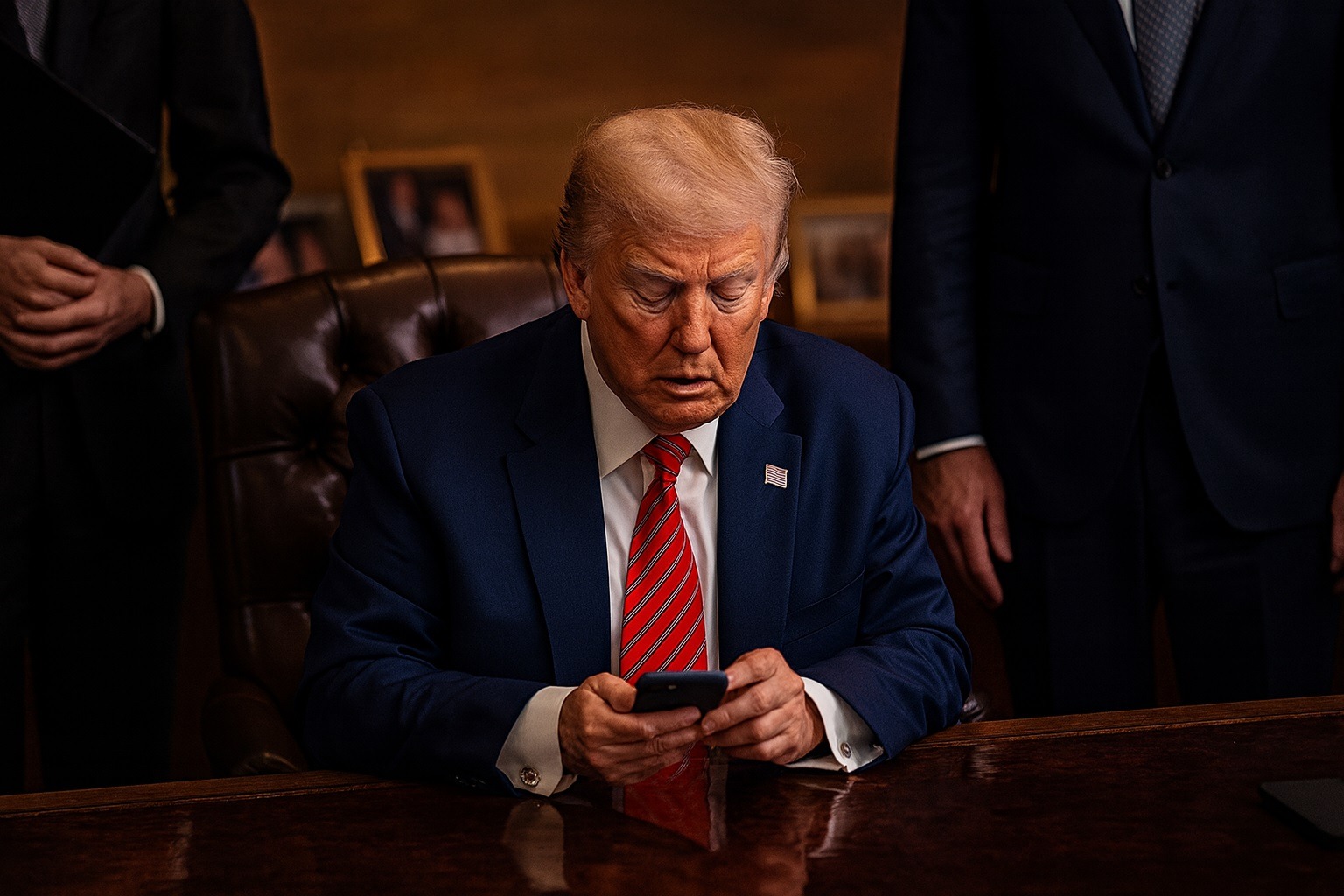
- Trump Mobile launched in mid‑2025 offering a gold‑toned “T1” smartphone and a $47.45/month wireless plan [1] [2]. The campaign slogan promised a phone “designed and built in the United States.”
- In reality, the T1 phone still doesn’t exist – all images have been fake composites of high‑end phones [3]. The website now only says the T1 will ship “later this year,” and any buyers who paid the $100 preorder still “have nothing to show for it” [4].
- Meanwhile, Trump Mobile’s online store is selling refurbished phones – including Apple’s iPhone 14 and 15 – at huge premiums. For example, a “Renewed Apple iPhone 14” goes for $489, about 45% above the normal market price [5] [6]. A renewed iPhone 15 sells for $629 [7], even though Apple and Amazon offer similar models for much less [8] [9].
- Experts are skeptical. Johns Hopkins supply‑chain professor Tinglong Dai notes that a phone truly made in the U.S. today would likely cost “well over $1,000” [10]. Industry analysts call Trump Mobile’s offering more of a marketing stunt. One veteran analyst says it “raises more questions than answers,” noting that Trump Mobile is essentially an MVNO piggybacking on major carriers [11]. Another warns it’s “a marketing idea above all,” with any profit likely coming from a brand premium (he points out a $200 phone could be sold as a $500 “Trump‑branded” device) [12] [13].
Trump Mobile was unveiled in June 2025 by Donald Trump’s sons as a patriotic alternative to major carriers [14] [15]. The pitch included unlimited talk/text/data on Verizon/AT&T/T‑Mobile networks bundled with extras like telemedicine and roadside assistance [16] [17]. The flagship T1 Phone was announced at $499, with a $100 down payment [18] [19]. Donald Trump Jr. even touted telehealth and car care “for one flat monthly fee” [20].
However, within weeks the “Made in USA” claims quietly vanished. Wired reports the site changed wording from “designed and built in the United States” to vaguely “brought to life” with “American hands” [21]. The Verge confirms Trump Mobile no longer even claims the T1 is made in the USA [22]. Device specs have been repeatedly altered (a 6.78″ screen shrank to 6.25″, 12 GB RAM disappeared, a “5000 mAh long-life camera” was fixed to a battery) [23] [24]. As of late October 2025, the Trump Mobile store only allows customers to preorder the phone (paying $100 now and $399 later) [25] [26] – but the phone still hasn’t shipped.
With the T1 perpetually delayed, Trump Mobile turned to selling other handsets. Its store now lists “Renewed” (refurbished) phones at steep prices. A 128 GB iPhone 14 Renewed is $489 [27] [28], vs. about $335 on Amazon. A refurbished iPhone 15 is $629 [29], even though Apple’s own refurbished store sells unlocked iPhone 15 models for $529 [30]. Macworld points out that for $629 Trump charges, you could buy a brand-new iPhone 16e ($599) which is technically superior to the iPhone 15 [31]. Similarly, Samsung Galaxy S23 and S24 “renewed” models are marked at $369 and $459 [32] – well above market prices. In short, Trump Mobile customers end up paying a hefty “branding” premium for older phones.
Industry experts and consumers have taken note. Johns Hopkins professor Tinglong Dai told Newsweek that without Asian manufacturing, a $500 phone simply isn’t realistic – it would cost well over $1,000 to build [33]. Wireless analyst Paolo Pescatore says the launch “raises more questions than answers,” given the lack of details and the fact that Trump Mobile doesn’t operate its own network [34]. Horace Dediu, a longtime mobile analyst, bluntly calls Trump Mobile “a marketing idea above all” – essentially charging for Trump branding. As Dediu observes, “branding might allow a $200 device to be sold for $500” [35] [36].
Meanwhile, social media users have mocked the move as “all MAGA swagger, no substance” [37], noting that even Donald Trump’s tariffs promise was a 45% hike. Tech writers also warn consumers that better deals exist: AppleInsider notes you can get a faster, newer phone (like the iPhone 16e) for less money [38], and suggests avoiding Trump Mobile’s offers entirely.
Bottom line: Trump Mobile’s patriotic marketing has yet to produce a real American‑made phone, and what it does sell – refurbished iPhones – come at a steep markup [39] [40]. Experts advise caution. Unless buyers value the Trump label above all, they would be better off shopping elsewhere for a phone or plan.
Sources: Reporting from AppleInsider, Financial Express, Macworld, Fast Company, Wired, Newsweek, Reuters and The Verge [41] [42] [43] [44] [45] [46] [47]. Each provides detailed analysis of Trump Mobile’s offerings and expert commentary.

References
1. www.reuters.com, 2. www.theverge.com, 3. appleinsider.com, 4. www.theverge.com, 5. appleinsider.com, 6. www.financialexpress.com, 7. www.financialexpress.com, 8. www.macworld.com, 9. www.financialexpress.com, 10. www.newsweek.com, 11. www.fastcompany.com, 12. www.fastcompany.com, 13. www.fastcompany.com, 14. www.reuters.com, 15. www.theverge.com, 16. www.reuters.com, 17. www.fastcompany.com, 18. www.reuters.com, 19. www.wired.com, 20. www.fastcompany.com, 21. www.wired.com, 22. www.theverge.com, 23. www.wired.com, 24. www.theverge.com, 25. www.wired.com, 26. www.theverge.com, 27. appleinsider.com, 28. www.financialexpress.com, 29. www.financialexpress.com, 30. www.macworld.com, 31. www.macworld.com, 32. www.financialexpress.com, 33. www.newsweek.com, 34. www.fastcompany.com, 35. www.fastcompany.com, 36. www.fastcompany.com, 37. www.financialexpress.com, 38. www.macworld.com, 39. appleinsider.com, 40. www.fastcompany.com, 41. appleinsider.com, 42. www.financialexpress.com, 43. www.macworld.com, 44. www.fastcompany.com, 45. www.wired.com, 46. www.newsweek.com, 47. www.reuters.com
