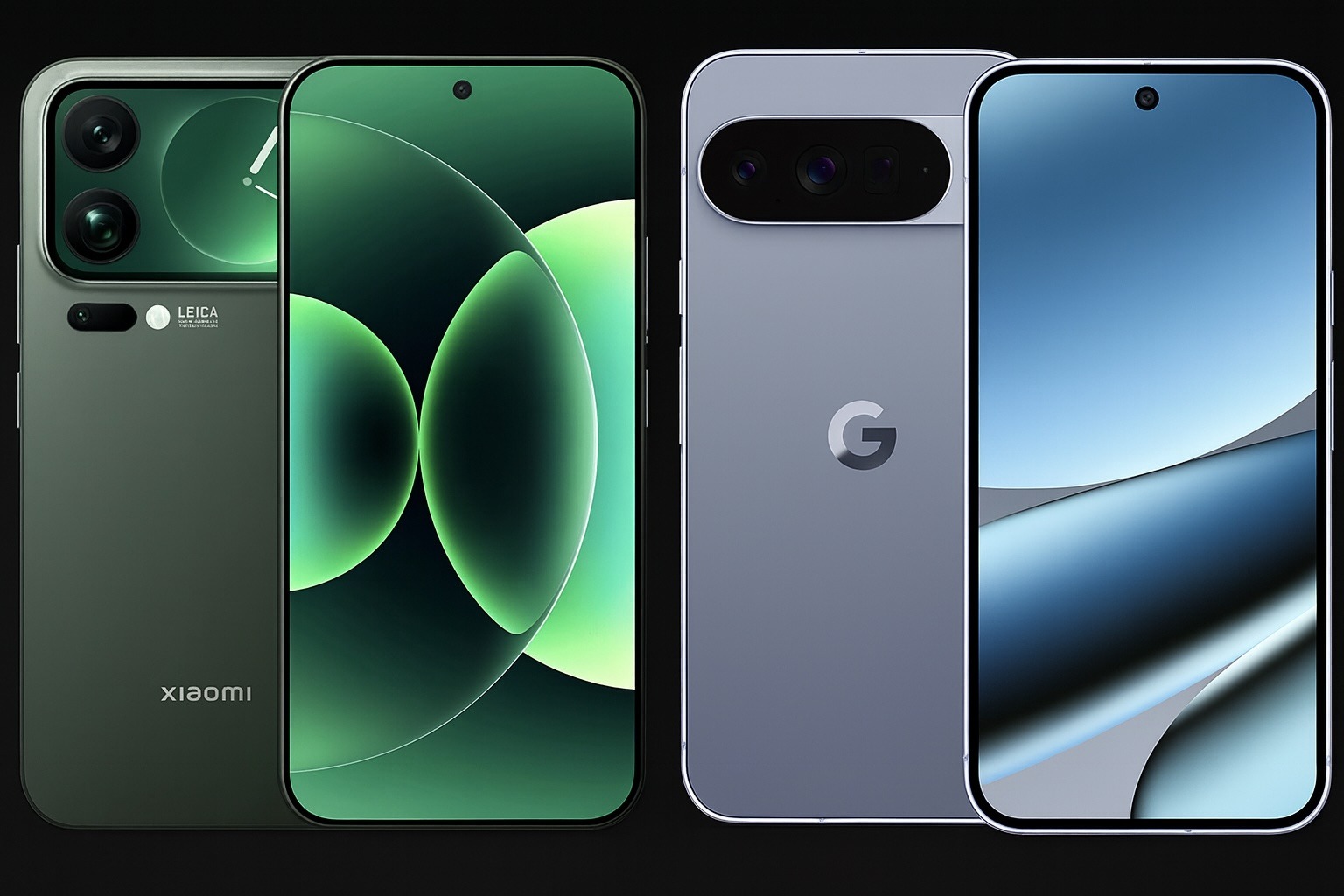

- Xiaomi’s “Battery Monster” vs Google’s AI Flagship: The Xiaomi 17 Pro Max storms in with a 7,500 mAh battery and an innovative second rear display, all at around $840 – a price that undercuts most premium rivals ts2.tech ts2.tech. Google’s Pixel 10 Pro XL, by contrast, packs a 5,200 mAh battery and Google’s latest AI-powered Tensor G5 chip in a refined design, starting at $1,199 Androidauthority Google.
- Design & Displays: Xiaomi’s 6.9-inch AMOLED screen (120 Hz) is flat and bright, and the phone adds a 2.5″ “Dynamic Back Display” on the rear for notifications, music controls, selfie previews, and even retro mini-games with a snap-on gamepad case ts2.tech. The Pixel 10 Pro XL features a slightly smaller 6.8-inch LTPO OLED (QHD+ at 1344×2992) that gets even brighter (up to 3,300 nits) than the iPhone 17 Pro Max’s panel Androidcentral Androidcentral. Google stuck with its familiar premium build – an aluminum frame with Gorilla Glass Victus 2 – and a distinctive camera bar (now a subtle island). Both phones are IP68 water-resistant and solidly built Androidcentral Androidcentral.
- Performance & Software: The Xiaomi 17 Pro Max is the first to debut Qualcomm’s Snapdragon 8 Elite Gen 5 chipset clocked up to 4.6 GHz, which Notebookcheck lauds as “perhaps the fastest smartphone chip in the world” ts2.tech ts2.tech. In contrast, the Pixel 10 Pro XL runs Google’s custom Tensor G5. While Tensor G5 “still lags a bit behind Apple and Qualcomm in benchmarks” for raw speed Androidcentral Androidcentral, it’s optimized for on-device AI – paired with a hefty 16 GB RAM for seamless multitasking Androidcentral Androidcentral. The Xiaomi comes with HyperOS 3 (Android 16) in China, featuring Xiaomi’s new Hyper XiaoAi assistant that offers context-aware suggestions and device integration Wired Wired. The Pixel runs stock Android 16 with Google’s unmatched software polish and update support. It showcases Google’s latest AI tricks: “Gemini” AI features let you converse naturally with the phone or point the camera at an object to get information, brainstorm, or get things done across apps Amazon. In short, Xiaomi bets on brute performance and battery, while Pixel bets on smart software and AI.
- Cameras: Both phones boast impressive triple 50 MP rear camera systems, but their philosophies differ. Co-engineered with Leica, the Xiaomi 17 Pro Max’s setup includes an f/1.67 main sensor and an upgraded 5× periscope telephoto lens (with up to 30 cm tele-macro focus) on the Pro Max model ts2.tech Wired. Xiaomi’s photography leans into Leica-tuned color science and creative modes. Google’s Pixel 10 Pro XL also has wide, ultra-wide, and 5× telephoto lenses (48 MP telephoto) along with Google’s renowned computational photography. It may not flaunt Leica branding, but the Pixel consistently produces stunning shots, especially in low light, thanks to features like Night Sight and HDR+ processing. Google even enabled up to 100× “Pro Res” digital zoom on the Pixel 10 Pro XL to compete in the zoom race Amazon – though at extreme magnifications it’s more of a parlor trick. Both phones can record 8K video, but experts note that Apple’s iPhone still sets the bar for video quality and stabilization in this class Reddit Reddit. For everyday shooting, Xiaomi’s advantage is versatile hardware (like that rear display doubling as a selfie viewfinder and the tele-macro lens), whereas Google’s strength is its software smarts – the Pixel’s new Camera Coach can even use AI to guide you to better shots Techradar Techradar, and editing tools like Magic Editor and Best Take help perfect your photos after the fact. As one reviewer put it, “The Pixel 10 Pro XL is, hands down, the best-made phone I’ve used this year,” praising its camera and build quality alike Androidauthority. Xiaomi’s approach, on the other hand, is to throw in every high-end spec – and that second screen – to “one-up” Apple and others on camera functionality Wired Wired.
- Battery Life & Charging: Here Xiaomi unapologetically dominates on specs. The 17 Pro Max carries a 7,500 mAh battery – frankly enormous for a mainstream phone Techradar – using new silicon-carbon anode technology to pack more density without a brick-like phone Wired. Xiaomi even shaped the battery in an L-shape to utilize space efficiently. The result is multi-day endurance: Xiaomi claims 2 days on a charge is achievable with moderate use Wired. When you do need to recharge, its 100 W fast wired charging can fill the battery extremely quickly (Xiaomi quotes about 20 minutes to 50%, and well under an hour for 100%). It also supports 50 W wireless charging, outpacing most rivals ts2.tech. By contrast, the Pixel 10 Pro XL’s 5,200 mAh battery – the largest ever in a Pixel – offers solid all-day life but not a two-day cushion in heavy use. Google provides 45 W wired charging (about 70% in 30 minutes Google) and 25 W wireless via the new Qi2-based Pixelsnap system Techradar Techradar. This magnetic Pixelsnap feature essentially brings MagSafe-like convenience to the Pixel, letting you just snap on chargers or accessories – a long overdue addition welcomed by Pixel fans Multicore Multicore. While the Pixel’s charging is a step up for Google, Xiaomi still holds the crown for sheer battery size and speed. (Notably, Google hasn’t adopted exotic battery tech yet – “Google isn’t yet pushing the boundaries with silicon-carbon technology, unlike most Chinese phone makers,” tech reviewer Sam Byford points out Multicore – whereas Xiaomi is on the cutting edge here.)
- Price & Value: Xiaomi’s aggressive pricing is a major part of this story. In China, the 17 Pro Max starts at ¥5,999 (≈$840) for the base model ts2.tech – astonishing for a flagship with these specs. Even if international prices land a bit higher after taxes, Xiaomi is clearly positioning it as a value disruptor. Google’s Pixel 10 Pro XL, on the other hand, is positioned at the premium end: $1,199 for the base 256 GB model in the US Androidauthority. You’re paying for Google’s software ecosystem, support, and polished experience – and perhaps a bit of the “Apple-like” premium attached to the Pixel brand now that it’s a mature flagship. Google does offer smaller Pixel 10 and 10 Pro models at lower price points, but the Pro XL is the no-compromise version. It comes with 5 years of updates and Google’s excellent software support, which adds long-term value (Pixel users can expect Android updates through at least 2030). Xiaomi’s update policy is improving (reportedly up to 4 Android version updates on its flagships ts2.tech), but it’s still not as guaranteed or timely as Google’s. One catch with Xiaomi: availability. As of late 2025, the 17 Pro Max is available in China (with a global release expected later ts2.tech), but it might not officially launch in all Western markets. Importing is an option for enthusiasts, but warranty and 5G band support should be considered. Pixel phones, conversely, are officially sold in North America, Europe, and other regions, making support and service straightforward. In pure bang-for-buck, Xiaomi offers more hardware per dollar (you’d pay hundreds more for an iPhone or Samsung with similar specs). Google counters with intangible value: cleaner software, exclusive AI features, and that peace-of-mind of direct Google support.
- Competition & Upcoming Models: The Xiaomi 17 Pro Max and Pixel 10 Pro XL don’t exist in a vacuum – 2025’s flagship arena is ultra-competitive. Xiaomi openly targets Apple’s iPhone 17 Pro Max (even copying Apple’s “Pro Max” naming after skipping a “16” generation to align the number) Wired. Apple’s latest iPhone 17 Pro Max starts around $1,199 as well and brings Apple’s biggest changes in years: a fresh design, a new Apple A19 Pro chip that “runs circles around Pixels in benchmarks” for raw speed Androidcentral, and a periscope-style telephoto that offers 8× optical-quality zoom – the first iPhone to reach that range Wired Androidcentral. Still, Apple kept its battery conservative at ~5,088 mAh (the largest ever in an iPhone) Androidcentral Androidcentral, far below Xiaomi’s giant cell. Then there’s Samsung’s Galaxy S25 Ultra, launched earlier in 2025, which has a more traditional approach: a 6.8″ OLED slab with a 120 Hz display, 5,000 mAh battery, and Samsung’s own 200 MP camera system Techradar. The S25 Ultra is a powerhouse with S-Pen support and a refined One UI software, but its battery and charging (45 W) now look almost pedestrian next to Xiaomi’s monster specs. Google and Xiaomi are each trying to outmaneuver these giants: Xiaomi by going bigger (batteries, screens, specs) for less money, and Google by going smarter (AI and software prowess). Other players are crowding in too. OnePlus and Vivo are expected to release Snapdragon 8 Gen 5 flagships in 2026 that will challenge Xiaomi on specs, and rumors of a Galaxy S26 Ultra suggest Samsung might boost battery tech or add its own spin on secondary displays to keep up. Even Apple is reportedly exploring advanced battery tech (possibly silicon-carbon batteries in a future iPhone “Air”) to catch up on endurance Wired Wired. In this competitive landscape, Xiaomi 17 Pro Max and Pixel 10 Pro XL stand out by each offering something different: one is a specs-and-hardware champion at a shockingly low price, and the other is a software-and-AI king that aims to deliver the most cohesive Android experience.
Conclusion
Both the Xiaomi 17 Pro Max and Google Pixel 10 Pro XL represent the cutting edge of 2025 smartphones – but they cater to different philosophies. Xiaomi’s 17 Pro Max is all about maximum hardware: it’s the phone for spec enthusiasts who crave all-day (or multi-day) battery life, blazingly fast charging, and eye-catching innovations like the rear mini-display. It shocks the flagship scene by delivering ultra-premium features at a mid-premium price ts2.tech. On the other hand, Google’s Pixel 10 Pro XL is about the holistic user experience: it may not win every spec sheet category, but its blend of refined build, brilliant display, top-tier camera software, and Google’s emerging AI features make it “the best of Google in the biggest package” as one reviewer put it Androidauthority. The Pixel feels like the more polished and universally “easy to recommend” device Androidauthority, especially for those who value software smoothness and long-term support. Xiaomi’s flagship will appeal to those who want absolute muscle and battery endurance – and who don’t mind using Xiaomi’s interface (or waiting for a global release).
In 2025’s flagship showdown, the Xiaomi 17 Pro Max vs Pixel 10 Pro XL matchup proves that smartphones can innovate in different directions. Whether you choose the battery behemoth with a quirky second screen or the AI-driven camera powerhouse will depend on what you value most in a phone. The good news: competition like this pushes all brands to up their game. As one tech writer noted, with the 17 Pro Max, “Apple finally has a handset that can compete with Android on pure specs” – and that competition is only getting fiercer Techradar Techradar. For consumers, that means more choice and better tech. Battery monster or AI all-star – either way, you’re getting a cutting-edge smartphone that embodies the best of 2025.
Sources: The information above is compiled from expert hands-on reports and credible tech outlets, including TechRadar Techradar Techradar, Wired Wired Wired, Android Authority Androidauthority Androidauthority, Android Central Androidcentral Androidcentral, and Xiaomi/Google’s own disclosures ts2.tech Google. These sources provide detailed analyses of the devices’ specifications, performance, and real-world usage to ensure an accurate and up-to-date comparison.