Updated: January 7, 2026
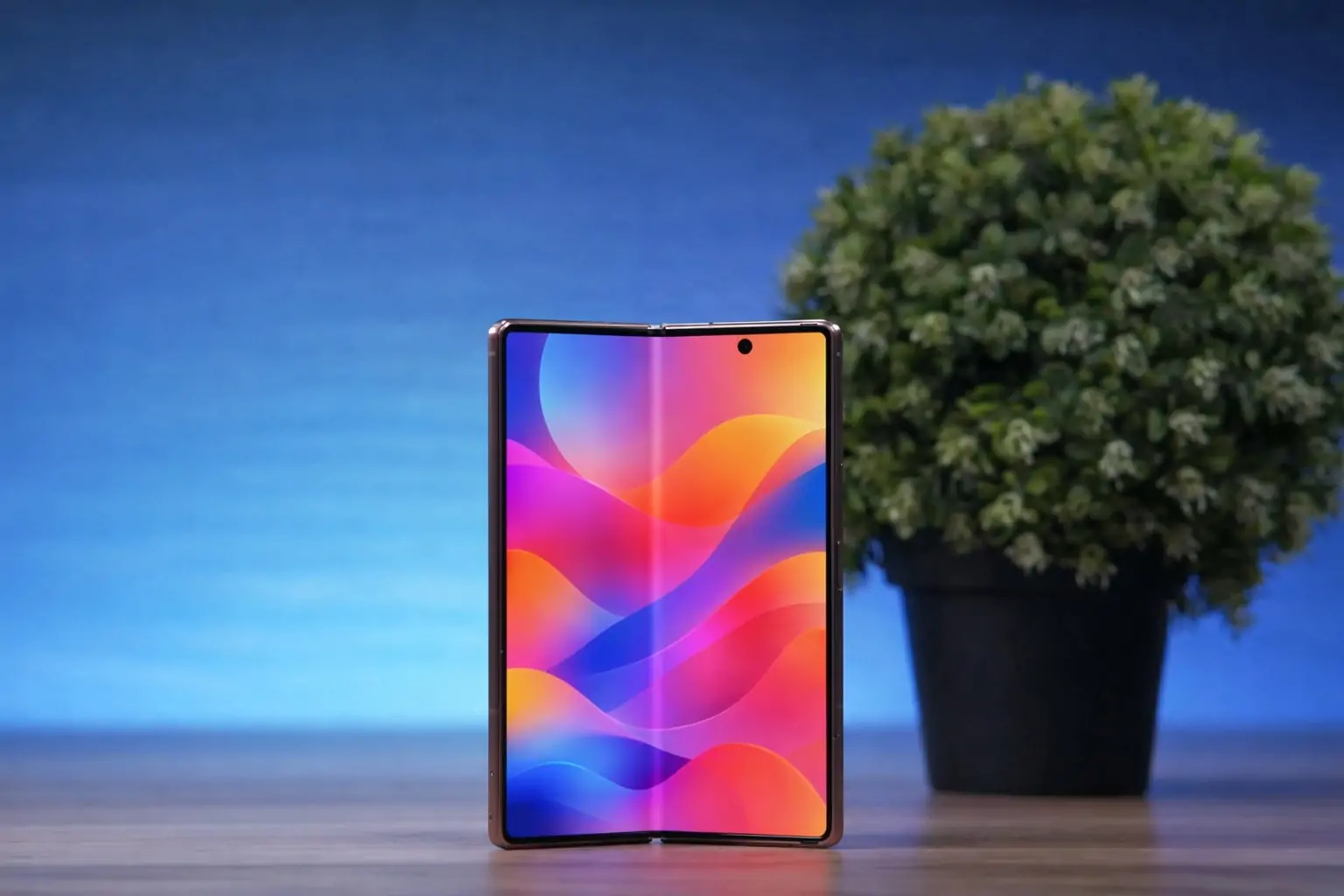
For years, foldable phones have promised “tablet-sized” screens that slip into a pocket—only to remind you, every time you open them, that the technology still has a scar: the crease. At CES 2026, Samsung Display briefly showed what may be the clearest sign yet that the industry is approaching a real fix—an “Advanced Crease‑less” foldable OLED panel that looks almost unnervingly flat when unfolded. 1
The demo didn’t just spark excitement. It also triggered a wave of speculation about two products that could benefit the most from a truly crease-minimized (or even “crease-free”) inner screen: Samsung’s next Galaxy Z Fold generation and Apple’s long-rumored foldable iPhone. And then, just as the story took off, the display disappeared from the booth. 2
Below is everything that’s confirmed so far from CES floor reports—and what today’s (Jan. 7) reporting suggests could happen next.
The CES 2026 moment: Samsung Display’s “Advanced Crease‑less” panel
According to multiple hands-on reports, Samsung Display staged a side-by-side comparison at CES 2026: a “regular” foldable panel associated with the Galaxy Z Fold 7 next to a newer “Advanced Crease‑less” panel. The difference, observers say, was immediate—especially when viewed at angles that normally reveal the fold line. 1
SamMobile, which says it viewed the panel in person in Las Vegas, described the new screen as having “no visible crease at all” compared to the Fold 7 panel next to it. 3
Samsung Display even framed the demo around reading—reportedly setting up a dedicated “Crease Test” area and claiming the new panel offers “seamless text across the fold,” a direct nod to one of foldables’ most common real-world annoyances: text and UI elements warping or reflecting along the crease line. 3
Then it vanished: why the demo panel was removed
Here’s where the story gets more interesting.
The Verge reports that when its team visited Samsung Display’s CES showcase, the crease‑less unit was no longer on display. Samsung Display confirmed the panel existed—but downplayed any near-term product timeline. 2
A Samsung Display spokesperson told The Verge:
“The foldable panel showcased at the booth was an R&D concept, with no fixed timeline or plan for commercialization.” 2
9to5Google echoed the same statement and noted Samsung Display did not explain why the unit had been removed so quickly. 1
That “R&D concept” label matters for two reasons:
- Samsung Display is not the same business as Samsung Electronics. Display prototypes can be shown months (or even years) before the phone division can ship them at scale.
- A crease-free look in a demo doesn’t guarantee mass production readiness. Yield, durability, cost, and repairability often decide what becomes a consumer product.
How does a creaseless foldable display even work?
No one is claiming Samsung “abolished physics.” A foldable screen still bends, and bending creates stress. The breakthrough—if this CES panel reflects a real production path—is about how that stress gets distributed.
Several reports point to a structural change under the OLED: a laser‑drilled metal display plate designed to disperse bending stress more evenly, reducing the visible deformation that becomes a crease. 3
MacRumors summarizes supply-chain reporting suggesting Samsung’s next-generation foldable panels (and the foldable iPhone, if it ships) could share a similar approach, with the metal plate component reportedly supplied by South Korean firm Fine M‑Tec. 4
In simpler terms: if current foldables “fold hard” along a single line, this approach aims to make the bend gentler and more evenly supported—so the surface stays flatter when open.
What this could mean for the Galaxy Z Fold 8
Samsung’s next foldable flagship is the obvious target for this kind of leap.
SamMobile suggests the panel shown at CES is likely tied to the Galaxy Z Fold 8, which it expects to arrive in the second half of 2026. 3
MacRumors also frames the CES panel as potentially “destined” for the Z Fold 8, while emphasizing the important caveat: the foldable iPhone’s panel structure and material process are rumored to include Apple-specific design decisions—meaning even if both companies use “crease-less” screens, they might not be identical. 4
The Verge goes a step further, noting the concept could appear in the Galaxy Z Fold 8—or in Samsung’s rumored “Wide Fold” format—depending on product strategy and cost. 2
Why Samsung might still hesitate (even if the tech is ready)
Even if Samsung Display can manufacture these panels, Samsung Electronics must decide whether to absorb the cost.
A crease-less panel could require:
- more complex internal layers and lamination,
- tighter production tolerances,
- potentially higher warranty risk if durability isn’t proven.
That could mean a slow rollout—first on an ultra-premium model, or in limited regions—before becoming standard across the lineup.
The iPhone Fold angle: is this Apple’s missing piece?
Today’s CES coverage is amplifying the same theme: Apple has long been rumored to want a foldable phone—but not until it can meet a higher screen-quality bar.
Android Authority notes that multiple reports suggest Apple has been holding back partly because it wants a near crease-free display before entering the market. 5
MacRumors reports that CES 2026 may have provided a first public glimpse of the kind of folding display Apple is expected to use—precisely because Samsung Display is already Apple’s primary OLED supplier. 4
Reported iPhone Fold screen sizes and shape
Rumors continue to converge around a smaller outer display and a more “tablet-like” inner aspect ratio than Samsung’s current Z Fold design.
MacRumors summarizes rumors pointing to an outer display around 5.3–5.5 inches and an inner display around 7.5–7.8 inches, which would make the unfolded shape wider and closer to a 4:3 style tablet experience. 4
India’s The Indian Express, in a Jan. 7 update, repeats similar figures (around 5.5 inches outside and 7.8 inches inside) and adds that Apple may rely on Samsung for the inner screen tech while designing key elements like the hinge, lamination, and panel structure itself. 6
Under-display camera: another piece of the puzzle?
One particularly spicy detail in today’s reporting: the CES panel may also incorporate under-display camera tech—something that could help Apple avoid notches or punch-holes on the inner screen.
The Indian Express reports Samsung showcased a crease-less foldable display with “no visible crease” while integrating an under-display camera into the panel. 6
TechRadar also notes social reporting that the crease-free panel “adopts under-display camera technology,” though this is tied to tipster claims rather than an official Samsung Display specification sheet. 7
Bottom line: UDC (under-display camera) is plausible, but treat it as “reported/rumored,” not confirmed.
Price and hardware rumors (handle with care)
The Indian Express cites prior reporting from Bloomberg’s Mark Gurman suggesting Apple’s foldable iPhone could:
- feature multiple cameras (including 48MP rear shooters),
- use Touch ID in the power button,
- land at a premium price around $2,400. 6
None of this is official. But it aligns with the market reality: first-generation foldables are expensive—and Apple is unlikely to enter the category with a “budget” device.
Why “creasing” is the make-or-break issue for foldables
To non-foldable owners, the obsession with the crease can sound cosmetic. In practice, it touches nearly every part of the experience:
- Readability: a crease can distort text, especially on white backgrounds or e-books.
- Reflections: the fold line often catches overhead lighting and creates a bright streak.
- Pen input and drawing: a ridge can interfere with stylus strokes or handwriting.
- Durability perception: even when the crease doesn’t cause damage, it’s a visual reminder that the screen is flexible—and many buyers still worry about long-term wear.
That’s why Samsung Display’s “seamless text across the fold” message is so telling: it targets the exact “I can’t unsee it” criticism foldables get in everyday use. 3
The most important takeaway from CES 2026 so far
Samsung Display’s crease‑less panel is real—but Samsung is signaling restraint.
The strongest confirmed facts today are:
- A crease-less “Advanced Crease‑less” foldable OLED panel was shown at CES next to a Z Fold 7 panel for comparison. 1
- The demo unit was later removed from the booth. 2
- Samsung Display calls it an R&D concept with no fixed commercialization timeline. 2
Everything beyond that—exact launch devices, whether Apple uses the same approach, whether under-display cameras are part of the package—is informed speculation, leaks, and supply-chain reporting.
What to watch next (today and beyond CES)
If you’re tracking this story for signals about the next wave of foldables, these are the checkpoints that matter:
- Does Samsung Display re-show the panel publicly during CES week?
If it returns, that suggests confidence. If it stays hidden, Samsung may be managing expectations. - Summer 2026: Samsung’s foldables launch window.
If the Galaxy Z Fold 8 arrives with dramatically reduced creasing, CES 2026 will look like the teaser. - Supply-chain confirmations around the “laser-drilled metal plate” approach.
This is the technical detail most consistently repeated across reporting. 4 - Apple’s move—if it happens—will likely be the biggest catalyst.
A serious Apple entry could push “crease-less” from a premium differentiator into a baseline expectation across the category.
Quick FAQ
Is the crease really gone?
Hands-on reports describe it as effectively invisible in many conditions—but “crease-less” in marketing often means “dramatically reduced,” not literally absent in every lighting scenario. 3
Is this definitely for iPhone Fold?
No. Samsung Display is a major Apple supplier, and multiple outlets connect the dots, but Samsung and Apple have not confirmed any foldable iPhone product. 2
When could consumers buy a crease-less foldable?
Samsung Display says there’s no fixed commercialization plan yet, suggesting the tech may not be immediately ready for mass market—despite how good it looked on the show floor. 2