Mumbai, Feb 27, 2026, 22:46 IST — Market closed.
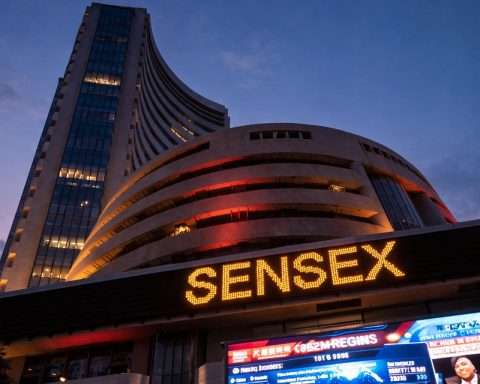
Indian shares closed sharply lower on Friday, with the Sensex down 961.42 points, or 1.17%, and the Nifty 50 falling 317.90 points, or 1.25%, to 81,287.19 and 25,178.65. Realty, metal and FMCG stocks led the retreat, while IT and consumer durables ended in the green. 1
The drop left the Nifty down 0.6% in February and the Sensex off 1.2%, extending a three-month losing run. Information technology (IT) stocks were the drag: the Nifty IT index slid 19.5% — its worst month since September 2008 — after U.S. firms such as Anthropic and Palantir rolled out artificial intelligence (AI) automation tools that investors fear could squeeze outsourcing earnings. “There is a cloud of uncertainty” over profitability, said Saurabh Jain, assistant vice president of retail equities at SMC Global, even as December-quarter profits improved (Nifty 50 up 7.5% year-on-year; BSE 500 up 16%) and trade headlines helped other pockets. 2
After the close, official data showed the economy grew 7.8% in the October-December quarter under a revised GDP series that shifts the base year to 2022-23 — the benchmark used to compare output over time. Chief Economic Adviser V Anantha Nageswaran put 2026/27 growth at 7%-7.4%, while DBS Bank economist Radhika Rao said the numbers showed a “strong lift” in services alongside double-digit manufacturing. ICRA’s chief economist Aditi Nayar sees the Reserve Bank of India staying on hold, with inflation likely to rise temporarily. 3
Financial services and realty shares bore the brunt of Friday’s selloff, with ICICI Bank, Sun Pharma, HDFC Bank and Mahindra & Mahindra among the biggest drags. Vinod Nair, head of research at Geojit Investments, pointed to weak global cues and geopolitical risks, saying stalled U.S.–Iran talks have added to worries while AI-related uncertainty persists. 4
The rupee finished February about 1% stronger — its first monthly rise since April 2025 — but ended Friday marginally lower at 90.9750 per dollar. A pick-up in portfolio inflows helped earlier in the month, and traders said RBI intervention kept the currency from slipping past 91 as equities wobbled. Foreign investors were net buyers of more than $2.5 billion in local stocks in February, and dealers said they will watch whether the rupee’s typical March strength shows up again. 5
Bankers expect the central bank’s extra liquidity support to wind down after March, after a cash surplus pushed the call rate — the overnight interbank borrowing rate — to about 5%, below the 5.25% repo (the RBI’s policy rate). “The RBI’s stealth easing has been particularly effective,” said Mandar Pitale, head of treasury at SBM Bank (India), adding he expects the current approach to run through March. March often tightens liquidity as tax outflows and fiscal year-end balance-sheet needs kick in. 6
Bond traders ended February with lower yields, helped by surplus liquidity ahead of record government borrowing in the next fiscal year. The benchmark 6.48% 2035 bond yield ended at 6.6603% on Friday, down from 6.6943% a day earlier. Abhishek Bisen, fixed income head at Kotak Mutual Fund, said the long end offers “reasonable value” for investors who can take more risk and hold longer. 7
But the market has not found a floor for the AI-driven hit to IT — a heavyweight sector that steers index direction through names such as Infosys, Tata Consultancy Services and Wipro. “Uncertainty in IT is being driven by fears of AI-led disruption, something unprecedented, with no real reference point,” said Siddhartha Khemka, head of research for wealth management at Motilal Oswal Financial, adding the market likely needs fresh triggers for a sustained move. 8
The statistics ministry said it has released a new series of annual and quarterly GDP estimates with 2022-23 as the base year, replacing the 2011-12 series used previously. The change is aimed at updating how growth is measured after shifts in the economy’s structure. 9
When trading resumes on Monday, investors will parse the fine print of the GDP revamp and watch early-month data, starting with the final February manufacturing PMI — a survey-based gauge of business activity — and January industrial production due March 2. The final services and composite PMI readings follow on March 4. 10