
GOTTINGEN, Germany, Jan 22, 2026, 18:51 CET
- Fresh Solar Orbiter data connects major solar flares with a chain reaction of smaller magnetic disturbances
- Images captured every two seconds tracked the flare build-up over roughly 40 minutes
- Researchers say this process sheds light on why flares can intensify rapidly and drive space-weather hazards
Scientists say a “magnetic avalanche” — a swift chain reaction of minor disruptions — can trigger a powerful solar flare, following ESA’s Solar Orbiter capturing one of the clearest views yet of an eruption forming.
This work is crucial because the strongest flares can trigger geomagnetic storms that hit Earth, messing with radio communications and increasing dangers for satellites and other tech. Forecasters continue to face challenges during those initial flare moments, when a calm spot on the Sun suddenly erupts within minutes.
Solar flares are abrupt bursts of energy erupting from the Sun. Linked to its magnetic field, these flares can hurl radiation and charged particles out into space.
Researchers zeroed in on a major flare captured on Sept. 30, 2024, when Solar Orbiter had a rare, close vantage point near the solar disk’s edge. They merged data from four instruments, using high-cadence images snapped every two seconds to follow the flare’s buildup.
“These observations showed us how a chain of minor events can trigger massive energy bursts,” said David Pontin from the University of Newcastle in Australia, who co-authored the study. Sciencedaily
The trigger lies in a process known as magnetic reconnection — where magnetic field lines break and then snap back together, unleashing stored energy. The latest analysis shows that tiny reconnection events multiplied and cascaded, sparking a chain reaction ahead of the main flare’s peak.
Images of the Sun’s corona — its outer atmosphere — revealed a dark, arch-like structure alongside a cross-shaped pattern of magnetic features that brightened and shifted quickly. As the area grew unstable, a series of break-and-reconnect events unfolded, gradually leading up to the main eruption, with fresh strands surfacing in nearly every frame.
The instruments also monitored the energy’s path. X-rays, signaling particle acceleration, spiked as the flare grew stronger. The team observed particles hitting roughly 40% to 50% of light speed. Meanwhile, glowing plasma blobs kept descending through the atmosphere long after the flare died down.
“This ranks among the most thrilling findings from Solar Orbiter to date,” said Miho Janvier, the mission’s co-project scientist at ESA. She highlighted the “avalanche-like” release of magnetic energy as the key driver behind the flare. Esa
The Sept. 30 flare registered as an M7.7, placing it in the mid-range on the standard scale—less intense than the rare but powerful X-class flares. Still, studying these eruptions is crucial since more powerful flares can disrupt satellites and, in extreme cases, strain power grids.
“Stronger solar flares can seriously impact satellites and even disrupt power grids,” said Sami K. Solanki, director at the Max Planck Institute for Solar System Research and lead of the PHI instrument team on Solar Orbiter. Mpg
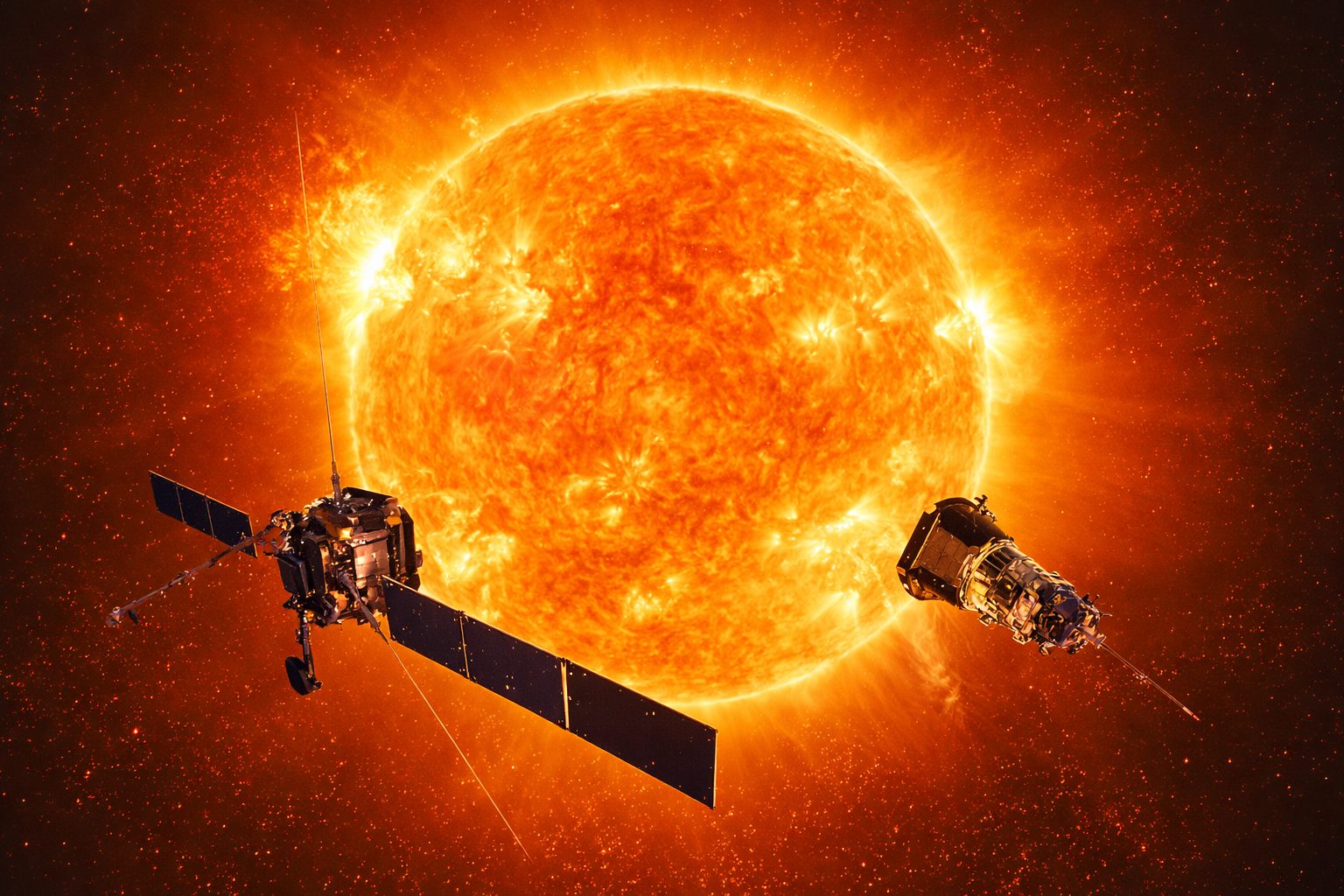
Solar Orbiter isn’t the only mission pursuing the Sun’s secrets. NASA’s Parker Solar Probe is diving close to the star as well, and ground-based telescopes keep an eye on finer details from Earth. It’s a busy arena, yet despite near-Sun imaging and multiple instruments, gaps in coverage remain.
However, there’s a catch: this new result relies heavily on a rare, high-resolution snapshot of a single major flare, recorded during brief observing windows and limited by the spacecraft’s storage and transmission capabilities. Researchers caution that confirming whether the avalanche mechanism drives most flares—and if it can enhance practical warnings—will require capturing more events with similar clarity and, importantly, sharper X-ray imaging on future missions.
The findings appeared on Jan. 21 in the journal Astronomy & Astrophysics. Solar Orbiter, an ESA-led mission with NASA collaboration, seeks to link close-up data with the magnetic shifts that trigger the Sun’s most powerful eruptions.