
WASHINGTON, Jan 27, 2026, 12:22 (EST)
- Bulletin sets its Doomsday Clock at 85 seconds to midnight, four seconds closer than last year
- Group cites nuclear tensions, wars, climate stress and risks from artificial intelligence
- New START nuclear arms treaty between the U.S. and Russia expires Feb. 5
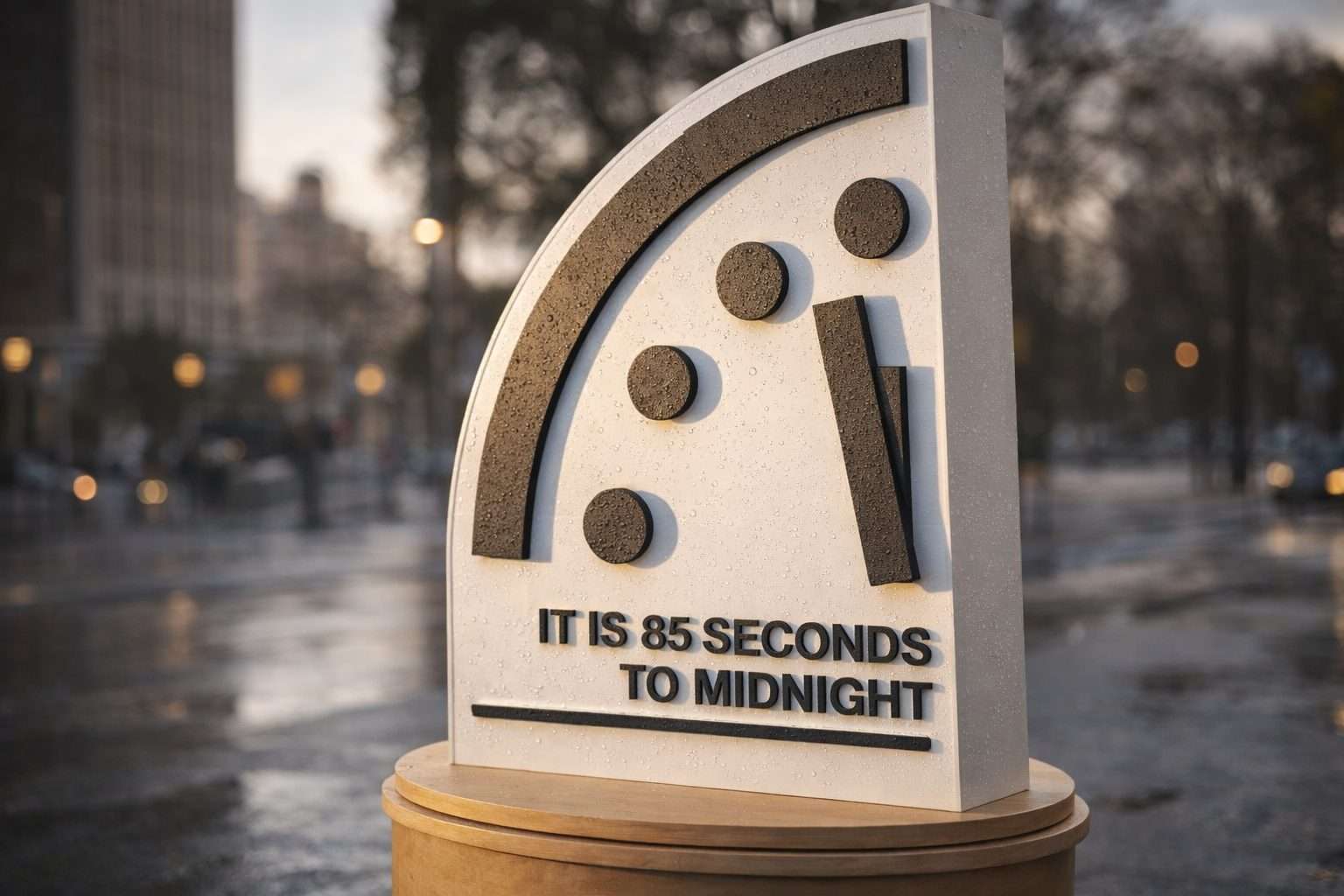
The Bulletin of the Atomic Scientists moved its Doomsday Clock to 85 seconds to midnight on Tuesday, the closest the emblematic clock has ever been to its symbolic end point. The group said nuclear brinkmanship, war and fast-moving technology risks were pulling the world nearer to catastrophe.
The shift comes as the last remaining U.S.-Russia nuclear arms treaty, New START, nears a Feb. 5 expiration, with no successor in place. The Bulletin also raised alarms about generative AI — software that can produce text, images or code — spreading into military systems and the information space.
Last year the clock stood at 89 seconds, and the group said “hard-won global understandings are collapsing” as major powers slide into zero-sum competition. Daniel Holz, who chairs the Bulletin’s science and security board, warned that an “us-versus-them” approach “increases the likelihood that we all lose.” Apnews
Alexandra Bell, the Bulletin’s president and CEO, called the drift “a global failure in leadership” and warned that a shift toward neo-imperial politics and an Orwellian approach to governance would push the clock closer to midnight. It was the third time in the past four years the Bulletin has moved the clock forward. Reuters
Bell said nuclear risks moved the wrong way through 2025, as diplomatic guardrails weakened and the threat of explosive nuclear testing returned. Trump in October ordered the U.S. military to restart the process for testing nuclear weapons after a halt of more than three decades.
No nuclear power other than North Korea, most recently in 2017, has carried out an explosive nuclear test in more than a quarter century. Bell said China would stand to gain from any broad return to testing as it expands its arsenal.
New START caps each side at 1,550 deployed nuclear warheads and is the last major U.S.-Russia arms-control pact still standing. Holz, a University of Chicago professor involved in setting the clock, said that without it there would be “nothing preventing a runaway nuclear arms race.” Uchicago
Russian President Vladimir Putin proposed in September that the two countries observe the treaty’s limits for another year, but Trump has not formally responded. Western security analysts are divided on whether accepting the offer would steady the situation or simply delay a bigger rupture.
The Bulletin also pointed to conflicts involving nuclear-armed states, including Russia’s war in Ukraine, May’s conflict between India and Pakistan, and U.S. and Israeli strikes on Iran. Bell cited tensions on the Korean Peninsula and China’s threats toward Taiwan.
On technology, the group warned about unregulated integration of AI into military systems and the possibility it could aid the creation of biological threats, alongside its use in spreading disinformation. Maria Ressa, a Nobel Peace Prize laureate who joined the announcement, said: “Without facts you can’t have truth, and without truth you can’t have trust.”
Climate change stayed on the list as well, with the Bulletin highlighting extreme weather tied to warming and faulting governments for weak action. The group cited droughts, heat waves and floods, and said nations were failing to strike meaningful agreements.
But the Bulletin says the clock is a metaphor, not a forecast, and that it can move back if leaders act on nuclear arms limits, climate policy and safeguards around AI. The next test arrives quickly, with the Feb. 5 treaty deadline looming over the nuclear piece.
The Chicago-based Bulletin, founded by scientists in 1945, created the Doomsday Clock in 1947 and once set it as far back as 17 minutes to midnight at the end of the Cold War. The group said major countries are becoming “increasingly aggressive, adversarial, and nationalistic,” a mix it argues is making cooperation harder when it matters most.