
WASHINGTON, Jan 30, 2026, 14:24 EST
- NASA announced that a fresh analysis of data from its Galileo spacecraft has revealed the first detection of ammonia-bearing compounds on Europa, one of Jupiter’s moons.
- The agency connected the signals to cracks in Europa’s ice, suggesting a potential pathway from the hidden ocean beneath to the surface.
- NASA noted this discovery provides Europa Clipper, arriving at Jupiter in April 2030, with a new target for further investigation.
On Thursday, NASA announced that scientists have identified ammonia-bearing compounds on Europa’s surface by reevaluating data collected during the Galileo mission decades ago. NASA Science
The agency emphasized the importance of detecting ammonia because it contains nitrogen, a key element for life as we know it on Earth. Additionally, ammonia can function like antifreeze, reducing the freezing point of water. NASA pointed out that ammonia breaks down quickly in space, suggesting it may have arrived on the surface fairly recently.
NASA reported detecting signals near major fractures and pits on Europa’s icy surface, areas where liquid water might be rising. The agency linked these patterns to potential cryovolcanism—icy “volcanoes” that could push water and dissolved chemicals from beneath the surface. NASA’s Europa Clipper mission, set to reach Jupiter in April 2030, plans to use this data to guide targeted follow-up studies.
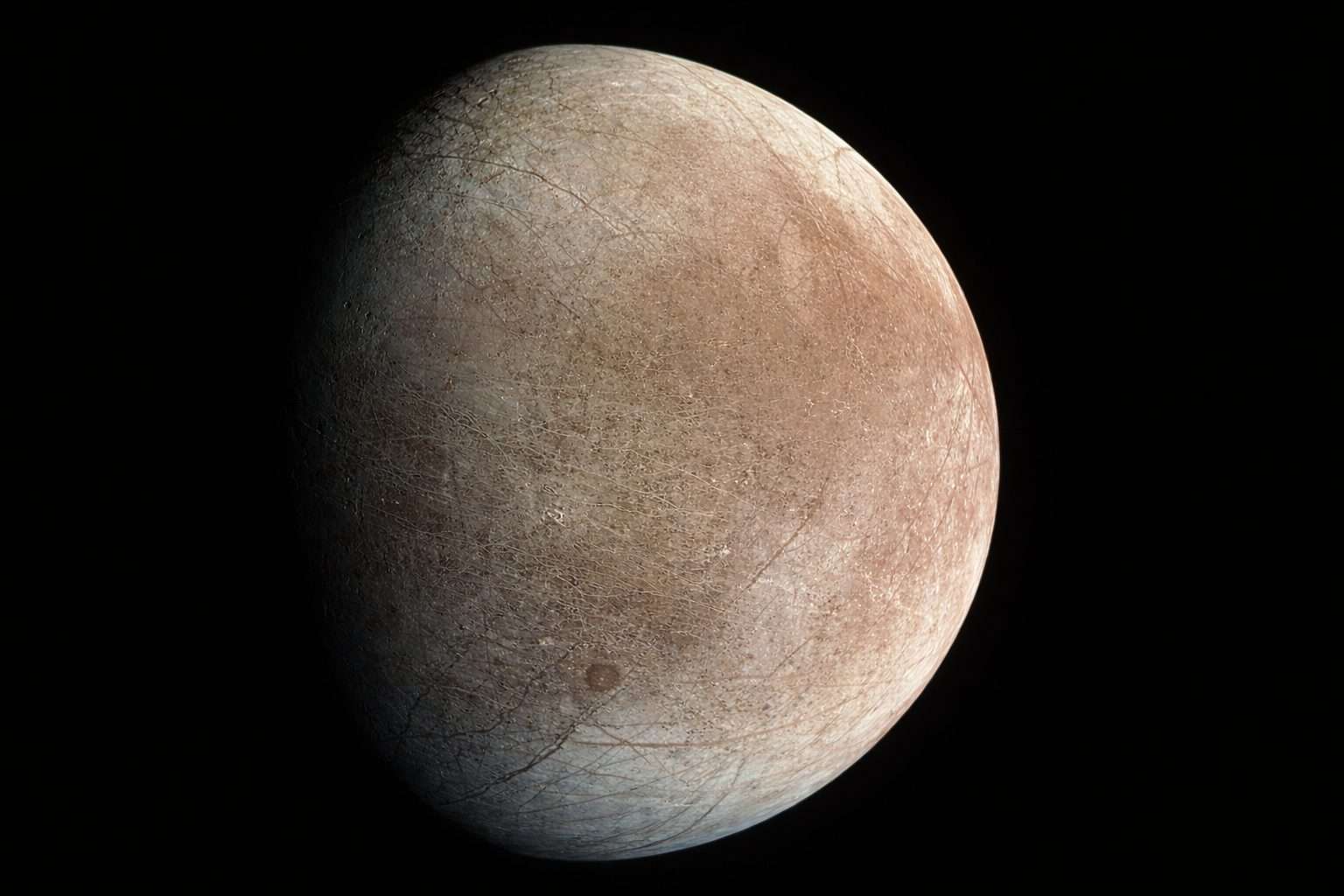
A NASA image released alongside the update reveals a roughly 250-mile (about 400-km) wide section of Europa, with red pixels highlighting spots where ammonia-bearing compounds showed up in Galileo data, while purple marks areas without detection. These readings were gathered by Galileo’s Near-Infrared Mapping Spectrometer, which splits reflected light into wavelengths to identify chemical signatures, during the spacecraft’s 11th orbit of Jupiter back in 1997. NASA Science
NASA reported that Al Emran from its Jet Propulsion Laboratory in Southern California spearheaded the reanalysis, revisiting data collected during Galileo’s tour of the Jupiter system between 1995 and 2003.
“NASA just put out a press release about my paper showing evidence of NH3-bearing materials on Europa,” Emran shared on LinkedIn, using the chemical abbreviation for ammonia. LinkedIn
This discovery comes as multiple agencies prepare missions to explore Jupiter’s icy moons, which likely hide oceans beneath their frozen crusts. Europe’s Jupiter Icy Moons Explorer, Juice, aims to investigate these oceanic worlds, including Europa, but its primary target remains Ganymede. European Space Agency
Reading too much into a weak signal from just one instrument pass carries risks. NASA pointed out that ammonia’s brief lifespan is a double-edged sword: it might indicate recent deposition, but it also means surface chemistry faces intense radiation and complicated mixing, blurring the line between what originated inside Europa and what changed on the surface.
NASA pointed to this finding as a fresh reminder that aged mission archives can still yield surprises through new analysis methods. The agency highlighted the ammonia pattern, concentrated near fractured terrain, as a clear lead that Europa Clipper’s advanced instruments can investigate when it arrives at Jupiter.