
Darmstadt, Germany — February 5, 2026, 20:15 CET
- A fire broke out at the GSI Helmholtz Centre in Darmstadt, leading to an evacuation and warnings issued to nearby residents.
- Hesse’s science minister announced that the December test phase for the FAIR accelerator project has been postponed indefinitely.
- Officials attributed the issue to a short circuit in the accelerator’s high-voltage power supply; thankfully, no injuries occurred.
A fire broke out at the GSI Helmholtz Centre in Darmstadt, forcing officials to postpone a critical test phase for the FAIR particle accelerator project. Hesse science minister Timon Gremmels called it “a black day” and confirmed that the December testing schedule is now on hold indefinitely. Christian Wagner, operations manager for the Darmstadt fire department, said, “Fortunately, we have no casualties so far.” Aa
The fire struck a facility already operating heavy ion accelerators—atoms stripped of some electrons, carrying a positive charge—and currently expanding for the new FAIR complex. This delay injects fresh uncertainty into a project designed to study how matter behaves under extreme conditions.
The incident cast an uneasy light on safety at an industrial site where radiation controls are part of normal operations. “The site was evacuated, there are no injuries, and no hazardous materials were released,” a GSI spokesperson said. Nearby residents were advised to keep doors and windows shut and to turn off ventilation as a precaution. A radiation protection officer told Reuters they had not needed to intervene. Reuters
The centre pointed to a short circuit in the accelerator’s high-voltage power supply as the cause, which happened while staff were gearing up to boost the current system, a spokesperson said. The spokesman couldn’t provide a damage estimate yet but confirmed that the construction site for the new facility remained unaffected.
The alarm went off around 6:30 a.m. local time, prompting officials to dispatch roughly 130 firefighters along with extra rescue teams. Local media footage captured smoke billowing from the fire, visible from several kilometres away.
A spokesperson at the site reported that the fire damaged cables, electrical equipment, and office furnishings. The total cost of the damage remains undisclosed.
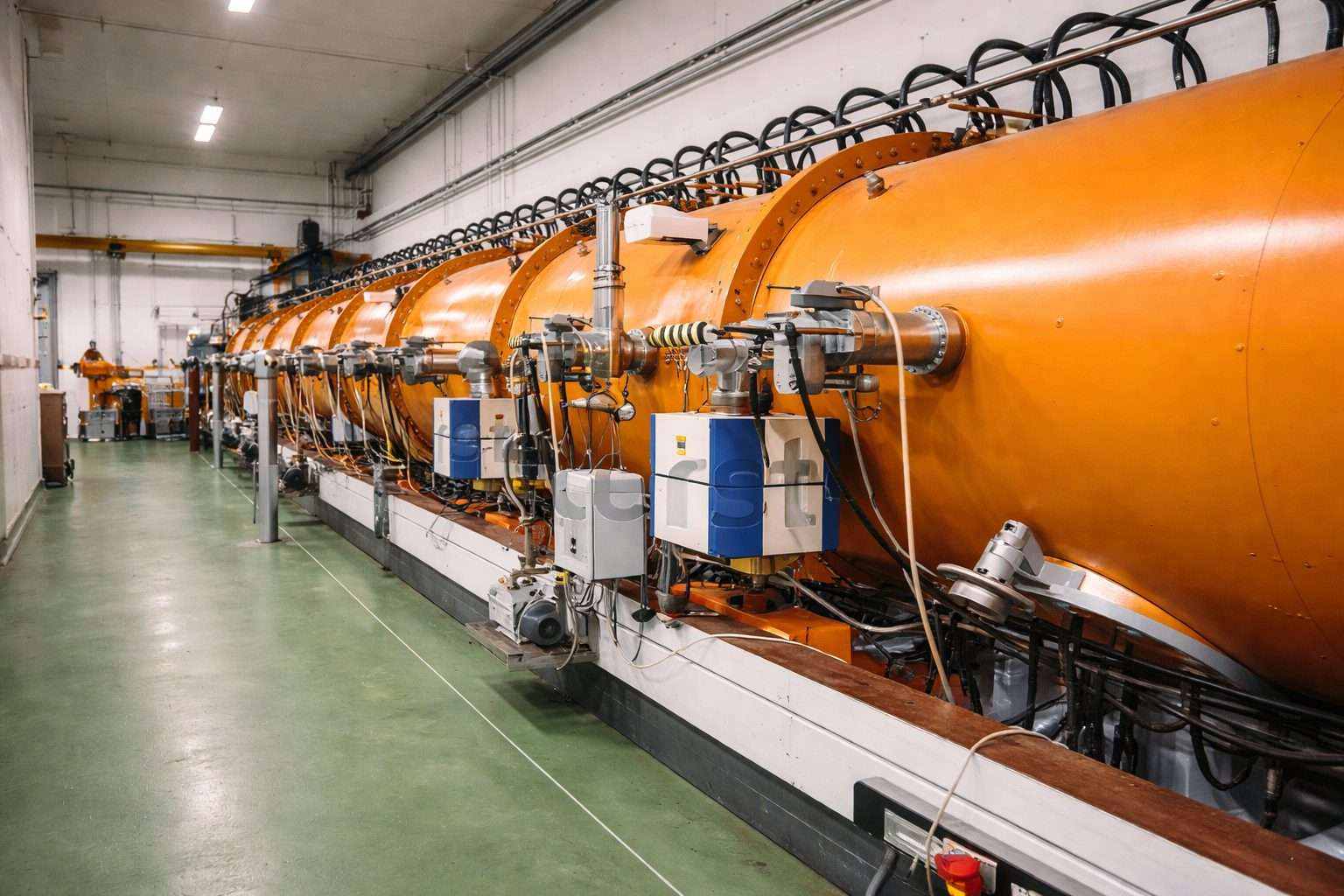
Heavy-ion accelerators focus positively charged atoms into beams, propelling them to incredibly high speeds using magnetic fields. According to the centre, this research aids scientists in exploring the fundamental components of matter and the universe’s evolution, while also supporting advances in technology and medical fields like cancer treatment.
Officials haven’t yet determined the extent of the damage to the UNILAC linear accelerator, a crucial component in the site’s accelerator chain. This device accelerates particles in a straight line before passing them on to subsequent stages.
The timeline, however, remains uncertain. Should major repairs or replacements be needed for damaged high-voltage equipment and cabling, delays could extend far past the rescheduled December test window, impacting subsequent phases tied to the FAIR project.
Fire crews planned to continue working into late Thursday, focusing on cooling the area. Residents were once more advised to keep windows closed and turn off ventilation until the smoke dissipates.