
Las Vegas, April 14, 2026, 04:20 PDT
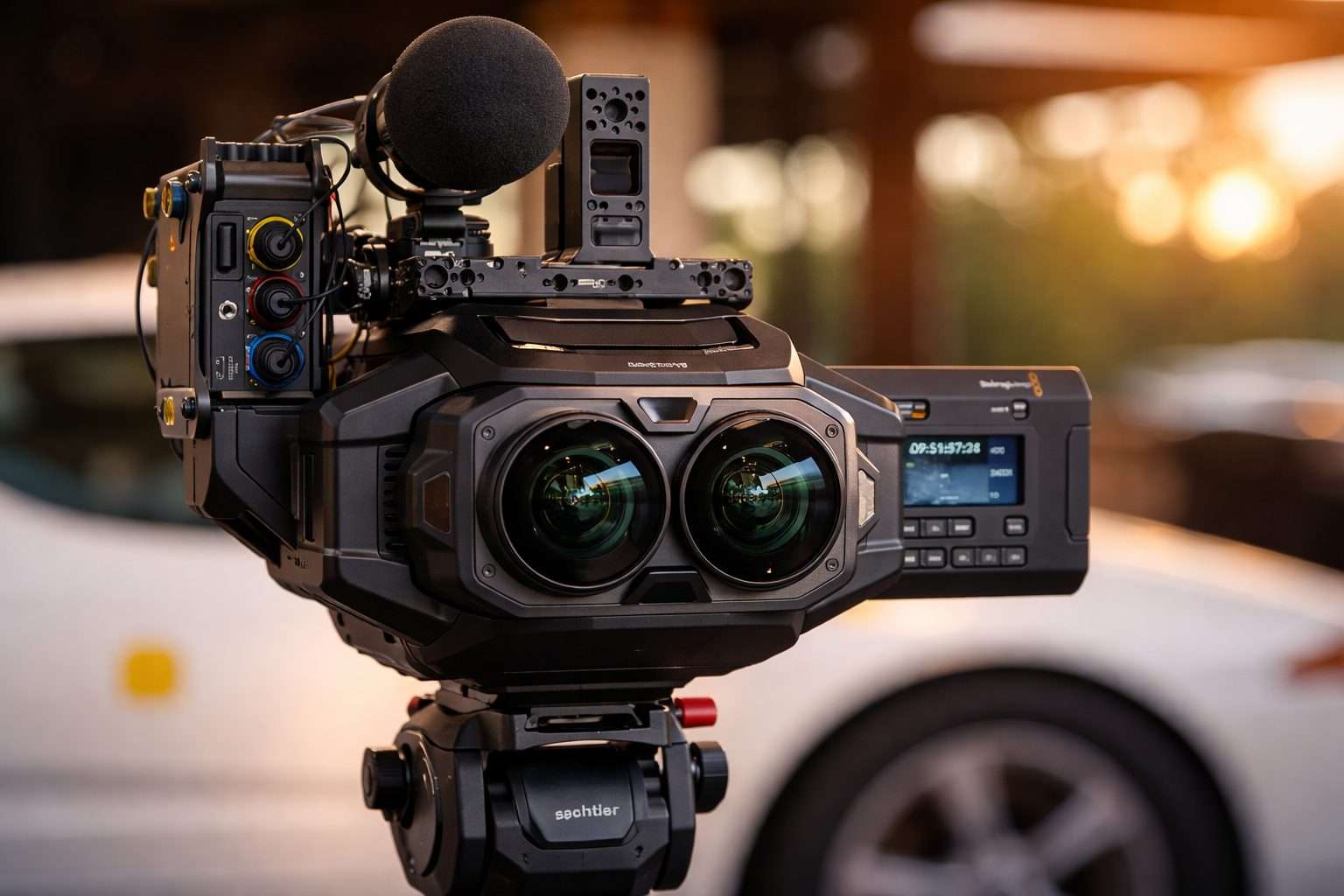
Blackmagic Design rolled out a live-production URSA Cine Immersive camera targeting Apple Vision Pro on Monday night, plus a 100-gigabit Ethernet version of its URSA Cine 12K LF—steps that signal a bigger push into immersive video and IP broadcast as NAB 2026 approaches. The company’s U.S. site posted the URSA Cine Immersive 100G at $29,145, while the URSA Cine 12K LF 100G started at $9,895. Launch materials pointed to a third-quarter release, with starting prices listed at $26,495 and $8,995 before local duties.
Apple’s push into immersive content comes as the company continues building out its Vision Pro catalog. Last year, Bob Borchers, vice president of worldwide product marketing, called the new format a redefining moment for storytelling. Since then, Apple has added Spectrum Front Row—offering live and on-demand Los Angeles Lakers games for Vision Pro—and pointed to fresh films from partners like CANAL+ and MotoGP, some of the first created using Blackmagic’s original URSA Cine Immersive camera.
Apple calls its Apple Immersive Video a 180-degree, 3D video format in 8K, paired with Spatial Audio. The SMPTE ST 2110 standard—key for Blackmagic’s approach—lays out how to send video, audio, and data streams separately over managed IP networks, all in real time. Blackmagic says DaVinci Resolve Studio for Mac wraps up the workflow, taking care of editing and delivering content for Vision Pro.
Blackmagic is touting its URSA Cine Immersive 100G as the first camera designed specifically for live immersive production. The device features dual 8K-by-8K RGBW sensors, capable of running at up to 90 frames per second and offering 16 stops of dynamic range, according to the company. Chief Executive Grant Petty declared live immersive production “is here,” adding that the new camera introduces “an entirely new world in live production” for both sports and concerts. Blackmagic Design
Blackmagic rolled out its URSA Live Encoder, a processor module built to compress stereo signals into Apple ProRes for SMPTE-2110-22—the compressed video side of the standard—on a single 100G Ethernet line. The company pointed to its recent use with Spectrum Front Row. According to Apple, that service pushes feeds up to 150 Mbps and supports as many as seven different viewing angles.
Blackmagic’s URSA Cine 12K LF 100G is pitched directly at traditional live broadcast. The camera keeps the 36x24mm large-format RGBW sensor and the 16 stops of dynamic range seen in the cinema version, but brings in 100G Ethernet, a SMPTE-2110 live mode capable of 2160p60 output, plus live video at up to 440 fps—a spec meant for slow-motion replays. There’s also an optional B4 mount for attaching broadcast zoom lenses and a Studio Viewfinder, pushing the package further into broadcast territory.
The camera launches are part of a larger 100G push. Blackmagic’s NAB 2026 update dropped new IP switchers, converters, storage, and monitoring equipment built around the same broadcast tech. That’s a step further into live production—a space where Sony and Grass Valley already pitch their own studio and IP-native camera solutions.
Blackmagic enters the headset fray just as Apple expands Vision Pro’s video options. According to Apple, visionOS 26 now natively plays 180-degree, 360-degree, and wide-field-of-view video from Canon, GoPro, and Insta360. That leaves Blackmagic targeting higher-tier sports, concerts, and branded projects—areas where custom live workflows still matter.
No getting around it: Apple Vision Pro’s entry price remains $3,499 in the U.S., and availability only stretches to a handful of markets. ST 2110, for its part, is still squarely a professional-media tech geared for real-time production and playout. That means Blackmagic’s workflow upgrade is, at least for the moment, sticking to the premium production tier.
But it’s not just a prototype anymore. Blackmagic’s original URSA Cine Immersive—first shown in June 2024 as the first commercial camera for Apple Immersive Video—now appears on the company’s website next to the new 100G model. Blackmagic continues to position DaVinci Resolve Studio as the go-to solution for producing in this format.