
April 14, 2026, 4:13 AM PDT — Cupertino, California.
Apple still looks on track for a September launch of its first foldable iPhone, and the company might be closing in on a solution to the screen crease—one of the main headaches for foldables. Mark Gurman at Bloomberg, citing sources this week, said September remains the target for rollout. TrendForce, meanwhile, reported that display material upgrades are now key to tackling the crease issue.
Apple’s absence from the foldable scene has left Samsung and Huawei to carve up the early market, but TrendForce sees that changing. If Apple jumps in, it could grab close to 20% of the foldable segment by 2026, with Samsung and Huawei each landing around 30%. According to the firm, competitive advantage isn’t just about hinge design anymore—material tech that controls stress in the display stack is starting to take center stage.
Questions over the launch date intensified after Reuters, referencing Nikkei Asia, said last week that Apple is wrestling with engineering challenges during testing—raising the risk of months-long shipment delays in the worst case. Yet Bloomberg countered, saying Apple is still aiming to unveil the foldable model together with the iPhone 18 Pro and Pro Max in September. Gurman, in his April 12 newsletter, doubled down: the device is still slated to debut, despite the production issues.
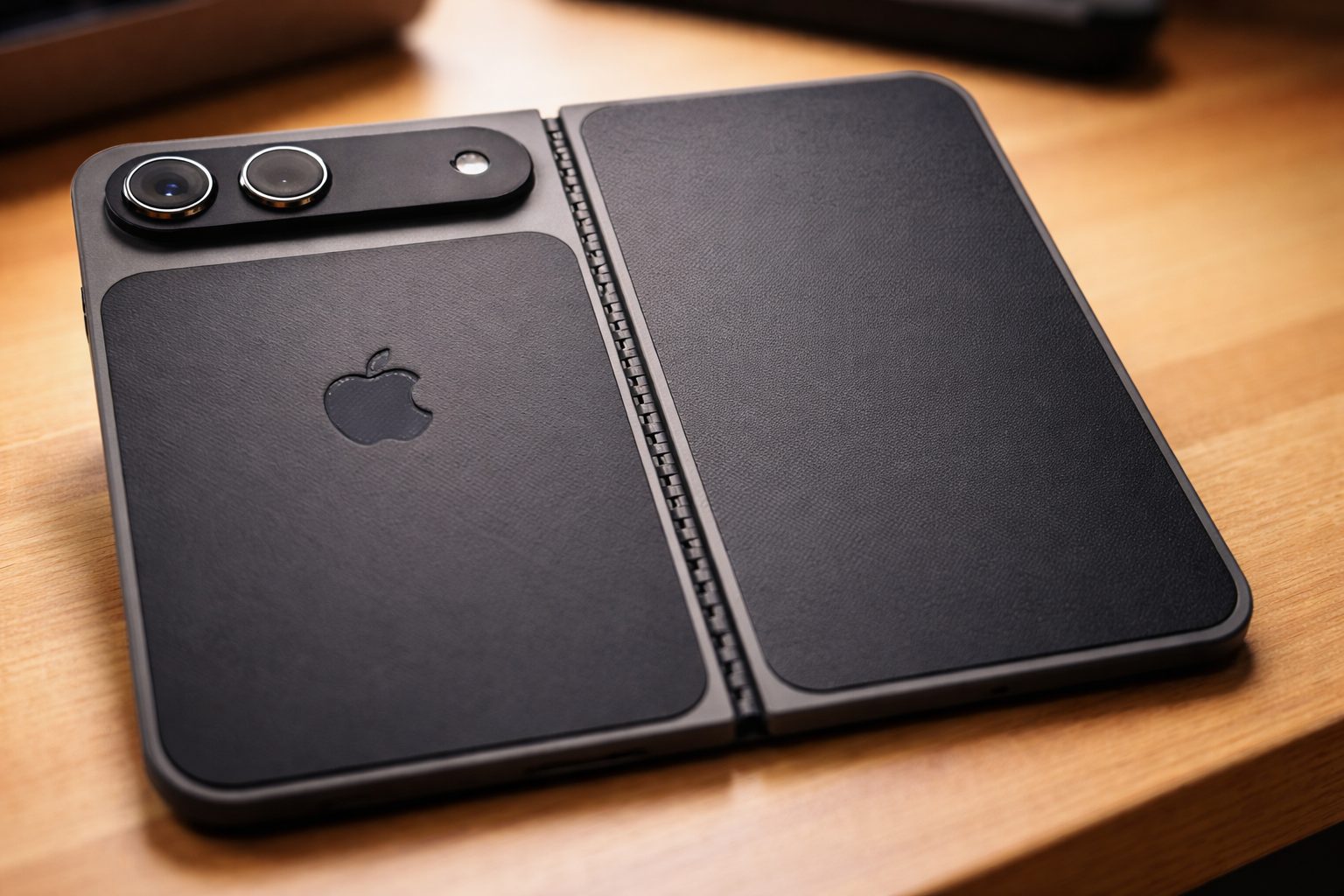
Dummy units surfaced from leaker Sonny Dickson, with The Verge picking up the report, showing off what looks like a book-style phone—wider than usual, two rear cameras packed into a pill-shaped bump. These sat next to iPhone 18 Pro and Pro Max mockups for comparison. But the inside was still a mystery: there’s no sign of the internal camera setup or Face ID hardware.
TrendForce points to ultra-thin glass and optically clear adhesive (OCA) as the technologies to watch for 2026. OCA, a see-through glue layered inside the display, could stay flexible during slow bends and offer extra support during sudden pressure—spreading out the stress, limiting warping, and making the crease less pronounced over time. Analyst Ming-Chi Kuo has called the inner panel “virtually crease-free,” according to MacRumors. Still, subsequent coverage referencing Gurman has dialed back expectations, saying Apple’s target is to reduce the crease, not erase it completely. TrendForce
Most analysts aren’t expecting a delay. Erik Woodring at Morgan Stanley told Investor’s Business Daily he hasn’t spotted any shift in component orders and stuck with his September timeline. Over at Evercore ISI, Amit Daryanani described a hold-up as “unlikely.” Investors
Still, delays haven’t been ruled out. On Monday, MacRumors pointed to a DigiTimes report suggesting that mass production, once expected in June, might get bumped to early August—even if the fall launch target holds. The device is reportedly stuck in engineering validation testing, a step that comes well ahead of large-scale manufacturing. It’s a compressed timeline, which could easily translate into limited availability at launch.
Apple would be stepping into a market already in flux. Just this week, Huawei rolled out its wide-format Pura X Max in China. TrendForce pointed to Samsung’s crease-free panel demo at CES 2026, and Oppo’s Find N6 is now being billed as “virtually crease-free.” Plenty to watch in the coming months: Apple’s real test is whether a late entry with a cleaner display can still translate to volume shipments by September. The Verge