
New York, April 20, 2026, 11:34 EDT
- Micron and Sandisk lost ground in late-morning trading, pressured by a new warning about stretched valuations in the memory-chip sector.
- Sandisk made its way into the Nasdaq-100, drawing more attention to the stock. That spotlight, though, also prompted some investors to lock in gains.
- Earnings remain buoyed by AI demand, but pricing and valuation risks are becoming tougher to overlook.
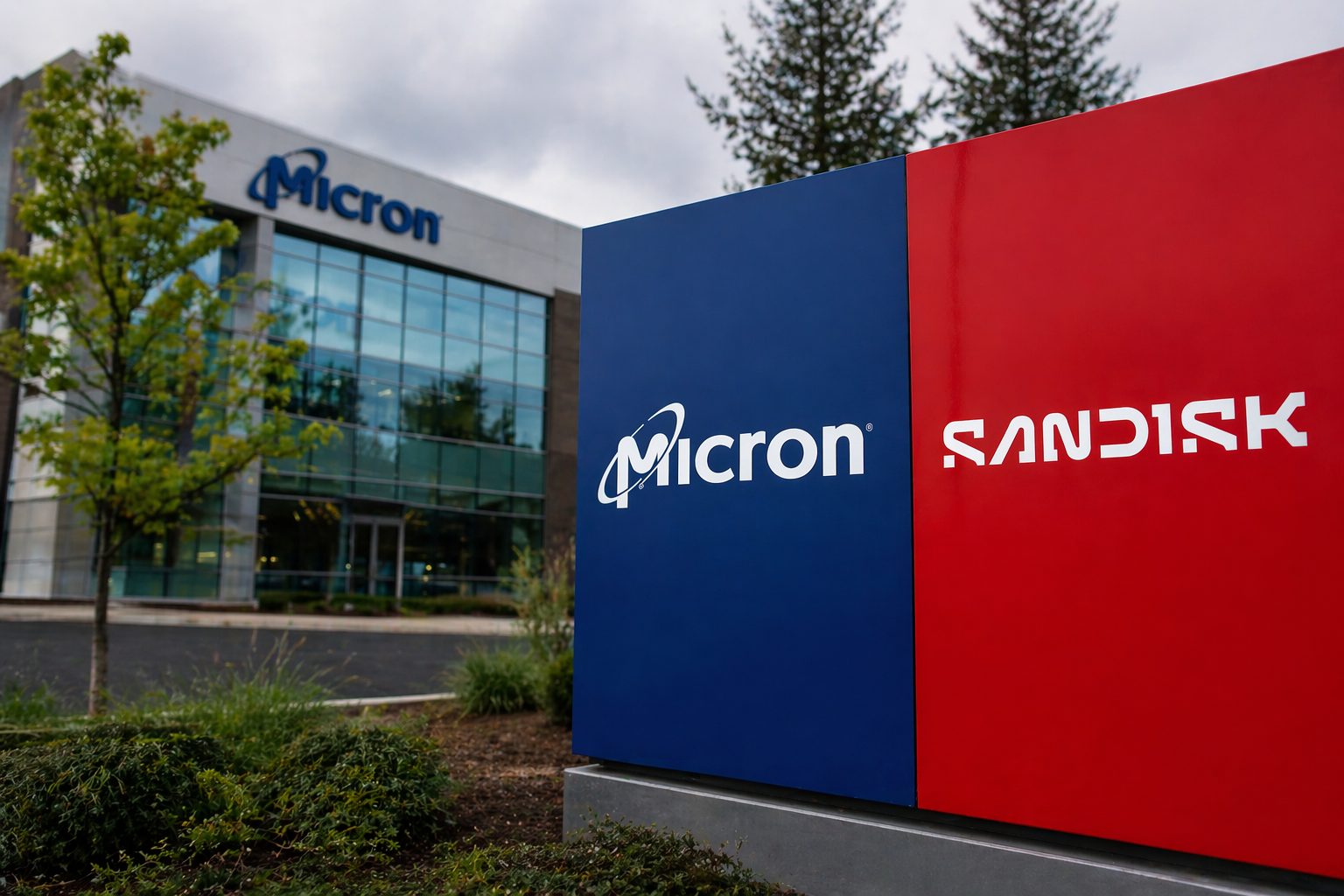
Shares of Micron Technology slid about 3.0% to $441.50, with Sandisk losing 1.2% to $910.06 in late-morning U.S. trading, after a technical warning dented two of this year’s busiest AI memory trades.
The clock mattered here. Sandisk entered the Nasdaq-100 ahead of Monday’s session, bumping Atlassian, and that swap tends to pull in index fund flows—though some traders might fade it after such a sharp rally. Nasdaq notes over 200 investment products track the index, together holding upwards of $600 billion in assets.
Jonathan Krinsky, BTIG’s chief market technician, told Yahoo Finance he sees the memory semiconductor group as “one of the most vulnerable areas” in the market following its big surge. The issue, he said, isn’t just about demand, but also “distance.” Krinsky flagged the significant gaps between current prices and their 200-day moving averages—a key metric traders use to gauge if stocks have moved too far, too quickly. Yahoo Finance
Still, anxiety lingers despite the healthy business climate. Micron’s fiscal second-quarter revenue hit $23.86 billion—a jump from $13.64 billion last quarter and $8.05 billion this time last year. CEO Sanjay Mehrotra called memory a “strategic asset” for customers navigating the AI age. Micron Technology
Sandisk reported January-quarter revenue of $3.03 billion, up 31% from the prior period. Datacenter sales jumped 64%. Looking ahead, the company is guiding for fiscal third-quarter revenue between $4.4 billion and $4.8 billion. CEO David Goeckeler pointed to a stronger product mix, quicker enterprise SSD rollouts, and rising demand. SSDs—solid-state drives—are flash storage built into servers and other hardware.
That growth hasn’t come cheap. Motley Fool analyst Catie Hogan pointed out Saturday that Sandisk shot up 559% in 2025 and is already up more than 277% so far in 2026, with Micron also rallying over the last year and reaching a 52-week high by mid-March. Hogan said Sandisk still lags Micron in terms of scale. Micron, for its part, holds a broader footprint across DRAM and high-bandwidth memory—the stacked memory tech found beside AI accelerators.
Some on Wall Street aren’t expecting the storage cycle to wrap up any time soon. Last week, Evercore ISI analyst Amit Daryanani picked up coverage on Sandisk, slapping an Outperform rating and a $1,200 price target on the stock. He pointed to the company’s exposure to AI data storage—a segment where demand keeps climbing and supply looks tight at least through 2028. Sandisk operates in NAND flash, its main business. That’s the type of non-volatile memory that hangs onto data even with the power off.
Opinions are split on the stock’s remaining potential. Wells Fargo’s Aaron Rakers bumped up his Sandisk price target to $975 from $675 on Monday, but stuck with an Equal Weight call, MT Newswires reported via MarketScreener. Shares were hovering near that target already.
The catch: stocks can stall even when the underlying memory business looks strong. This is a cyclical space. Prices move up on tight supply, but when manufacturers push out too much DRAM, NAND or HBM, prices slide—and earnings estimates can get whacked if the market thinks a peak is in. Investors just saw the reaction to Google’s TurboQuant compression news; memory names sold off hard on fears that AI models would need less capacity per job. Some analysts pushed back, saying greater efficiency might just drive broader usage, but nerves were rattled all the same.
No one’s arguing AI infrastructure isn’t a memory hog—it is. The real issue is whether shares of Micron and Sandisk have already priced in so much future upside that there’s barely any cushion left for a pricing dip, a pause in capex, or just a plain-old pullback after such a strong stretch.