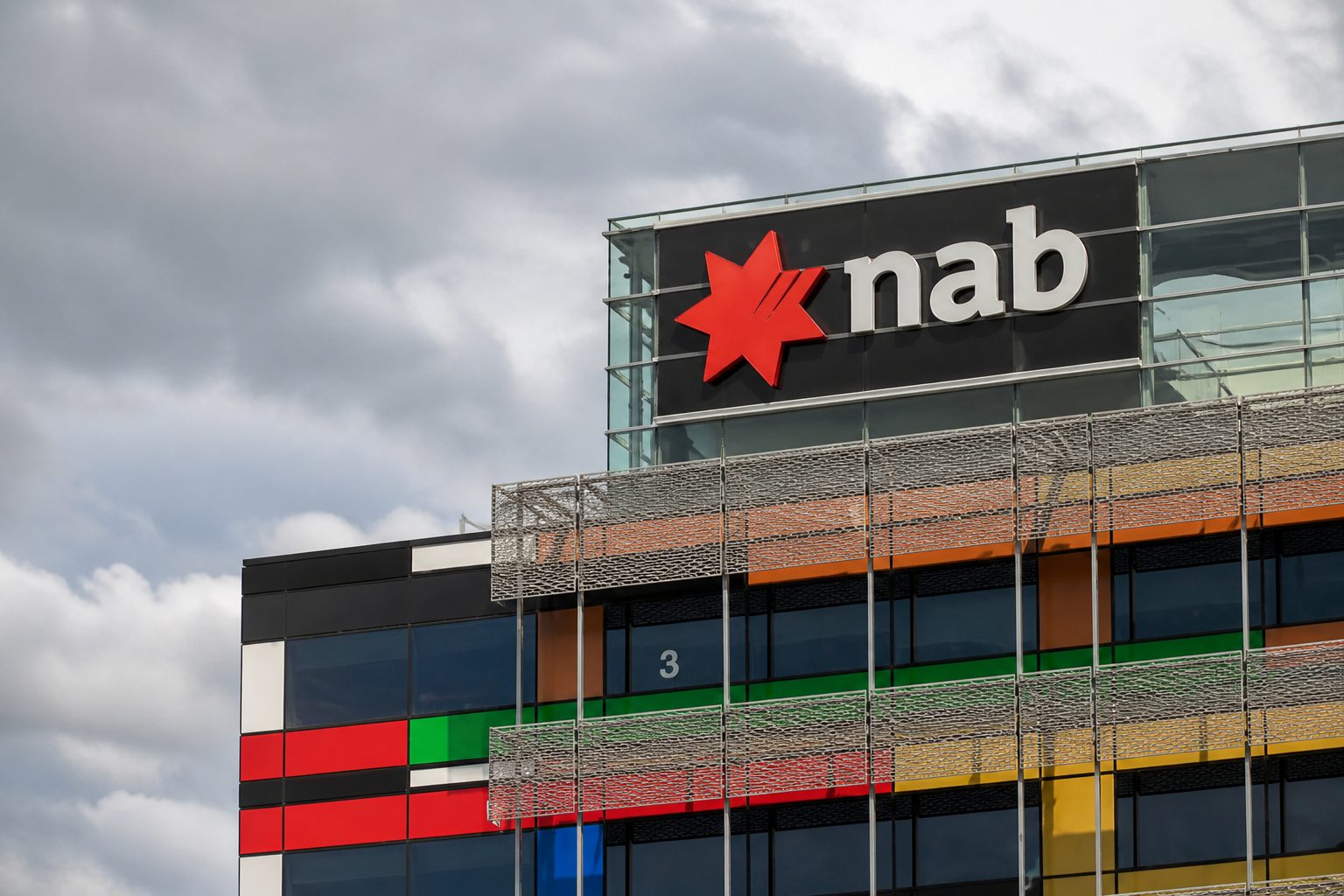

MELBOURNE, May 3, 2026, 02:05 AEST
National Australia Bank heads into Monday’s session with its shares hovering close to A$40, as the bank gears up to unveil first-half numbers. Investors have their eye on rising bad-loan provisions, talk of a capital raise, and questions swirling around the dividend outlook. NAB’s 2026 half-year results are scheduled for release at 10:30 a.m. AEST on May 4.
The release comes at a tricky moment. Just ahead of the Reserve Bank of Australia’s May 5 call, where 30 out of 33 economists polled by Reuters are betting on a 25-basis-point bump to 4.35%. “Inflation is basically too high in Australia,” said AMP economist My Bui. ANZ, CBA, and NAB all stick with a 4.35% peak, Reuters noted, while Westpac stands alone at 4.85%. One basis point equals one-hundredth of a percentage point. Reuters
That’s important for banks: higher rates are a double-edged sword. Sure, they boost lending revenue and bump up deposit yields. But they can also put the brakes on borrowing and leave certain customers squeezed. When it comes to NAB, investors are likely to dig past the headline figures, zeroing in on margin, credit provisions — that’s the cash earmarked for potential bad loans — and the dividend.
NAB slipped 0.13% to finish at A$39.83 on May 1, per Investing.com’s historical data. While the ASX 200 was back on the upswing that session, ABC noted every one of the “big four” banks fell after ANZ’s results—ANZ led the drop, sliding 2.8%. Investing
Kalkine Media’s latest ASX 200 banking note put NAB squarely in the camp of banks whose fortunes swing with lending, deposits, capital allocation, interest rates, inflation, and regulation. That’s exactly why NAB shares can react just as sharply to broad economic headlines as to anything in their own numbers.
Rask Media on Saturday zeroed in on valuation, highlighting the dividend discount model—better known as DDM. The approach, which prices shares by projecting future dividends and then discounting them to the present, is straightforward, especially for an established bank like NAB. Still, the method can be harsh if growing provisions or heavier capital requirements start cutting into how much gets paid out.
MarketBeat’s April 27 look at NAB’s U.S. OTC shares (NABZY) flagged analyst earnings forecasts of $0.4427 per share and $7.7749 billion in revenue. The preview showed the ratings were all over the map—two analysts at Strong Buy, one at Hold, two at Sell, for a consensus of Hold. These numbers, focused on the ADR, reflect market sentiment rather than NAB’s own guidance heading into Monday.
NAB has already laid out its major moving pieces. For the first half of 2026, the bank flagged credit impairment charges of A$706 million—A$300 million of that coming from a net boost to forward-looking collective provisions. There’s also a one-off hit: a A$1.35 billion pre-tax charge tied to an accelerated software amortisation change. On top of that, NAB is planning a 1.5% discount and partial underwriting on its dividend reinvestment plan, allowing shareholders to opt for shares over cash. That move could bring in as much as A$1.8 billion and push the pro-forma Common Equity Tier 1 capital ratio north of 12%.
NAB didn’t head into the half with a soft base. The bank’s first-quarter update showed unaudited statutory net profit at A$2.21 billion and cash earnings—NAB’s preferred profit metric, which removes certain non-core items—at A$2.02 billion. Chief Executive Andrew Irvine described the start to FY26 as “strong.” NAB
This isn’t a simple peer read. ANZ turned in a statutory profit of A$3.65 billion for the half on May 1, with cash profit hitting A$3.78 billion. The bank is proposing an interim dividend of 83 cents. It’s also booked a collective provision charge of A$126 million, with A$175 million of that set aside for possible fallout linked to the Middle East. “The situation remains dynamic,” CEO Nuno Matos said. ANZ
Monday might not resolve the valuation debate. Even if profits come in above low expectations, investors could latch onto the capital raise, software charge, and those credit overlays as fresh trouble for the back half. If results disappoint, the dividend outlook would sour fast.
The real question around NAB’s share price runs deeper than a simple look at profits. Investors want to know if the upcoming dividend, capital buffer and the current state of the credit cycle are enough to support paying close to A$40 a share for National Australia Bank.