
Sydney, June 9, 2026, 18:16 AEST
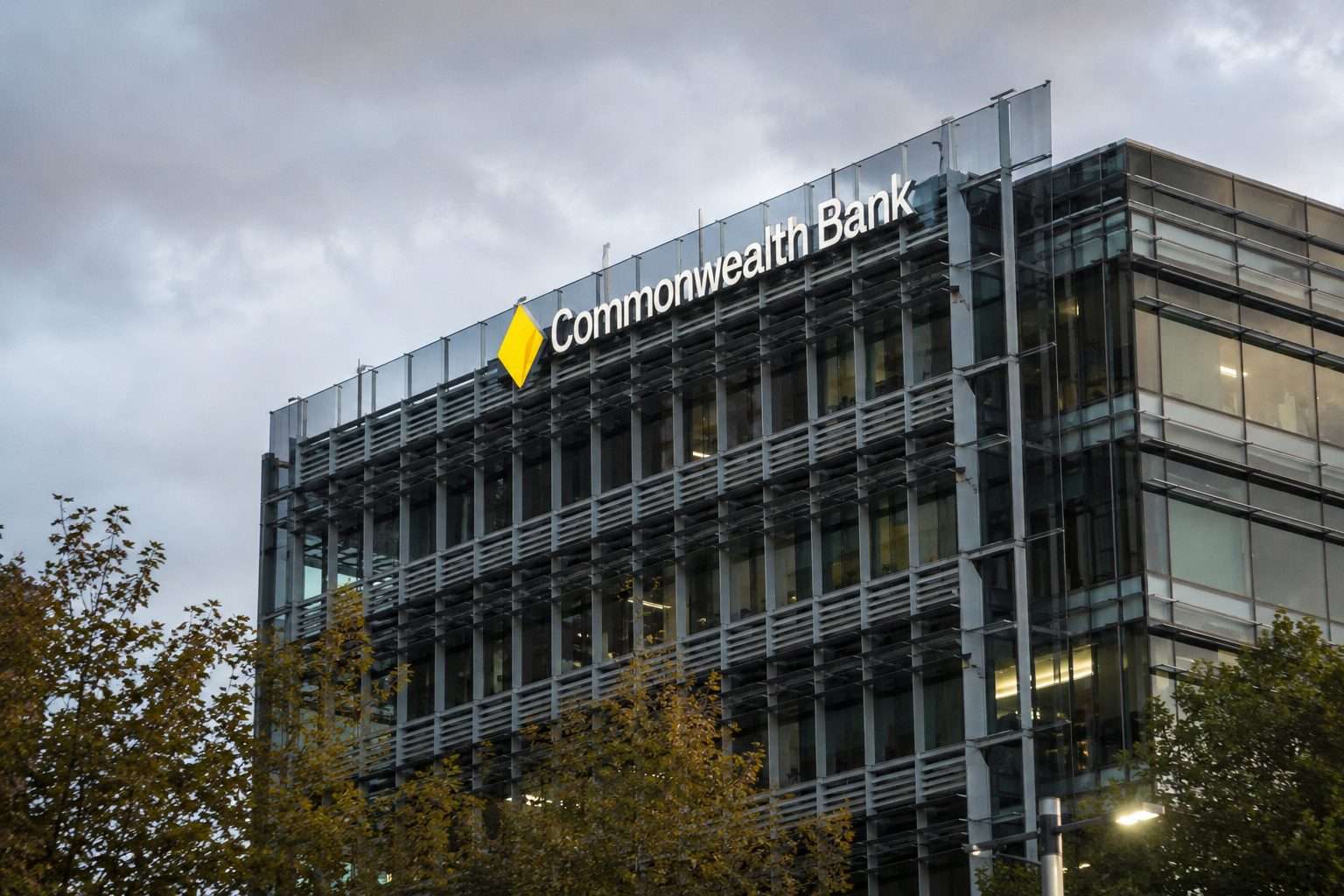
Commonwealth Bank of Australia shares edged lower on Tuesday after the Australian market reopened from Monday’s King’s Birthday holiday, with investors weighing a fresh spending pledge from the country’s biggest home lender against a softer bank-sector tape. CBA last traded at A$160.48, down 0.26%, after moving between A$158.32 and A$161.96. The cash market was closed by publication time, with the ASX regular session ending at 4 p.m. Sydney time.
The S&P/ASX 200, Australia’s main share index, lost 0.24% at the close as gold, metals and mining, and materials stocks led the decline. Decliners outnumbered advancers by 798 to 402, a weak breadth reading that showed the pullback was wider than a few large names.
CBA matters because small moves in the stock carry weight. It had a market value of about A$268.6 billion on Tuesday, and Reuters has described the bank as Australia’s second-biggest company and writer of about a quarter of the country’s mortgages. That makes it a live gauge for views on household credit, housing prices and bank costs.
CommBank said earlier on Tuesday it would invest a further A$140 million in fiscal 2027 to improve service across digital banking, phone support and branches. Angus Sullivan, group executive for retail banking services, said the bank wanted to make sure “human support is available when customers need it most,” while business banking head Mike Vacy-Lyle said “local context still matters” for many customers. CommBank
The spend comes as Australia’s largest banks try to keep service levels high while shifting more customer activity online. CBA also published a separate technology note on Tuesday on modernising systems and using artificial intelligence in banking; last week, Chief Executive Matt Comyn told a Sydney AI event that companies would be “really scrutinising” AI spending, with token costs — the charges tied to units of text processed by AI models — becoming harder to predict as tasks get more complex. CommBank
Peers were mixed, but the tone was not strong. National Australia Bank fell 1.72% and Westpac slipped 0.29%, while ANZ rose 0.44%. The split move suggested Tuesday’s pressure was not a single-stock story, though CBA’s premium valuation leaves little room for disappointment when cost or mortgage-growth concerns rise.
The macro backdrop was not much help. The Westpac-Melbourne Institute consumer sentiment index fell 2.9% in June to 80.6; a reading below 100 means pessimists outnumber optimists. Westpac senior economist Matthew Hassan said the latest reading was back among the “weakest seen in the fifty-year history of the survey.” Reuters
Mortgage risk is still the harder question for bank investors. Reuters reported in late May that Australia’s A$2.4 trillion mortgage market was losing some of its glow after rate rises and proposed housing-tax changes, with Morgan Stanley analyst Richard Wiles saying operating conditions had “shifted so quickly.” K2 Asset Management’s George Boubouras pointed to banks’ “over-reliance on domestic housing,” while Argo Investments’ Andy Forster said CBA looked “pretty full from a valuation perspective.” Reuters
CBA’s last half-year numbers gave bulls something to hold on to, but also showed why margins are being watched. The bank reported cash net profit after tax from continuing operations of A$5.45 billion for the six months to Dec. 31, 2025, up 6% from a year earlier. Its net interest margin — the gap between what a bank earns on loans and pays for deposits and funding — was 2.04%, down 4 basis points; a basis point is one hundredth of a percentage point.
But the downside case is clear enough. If housing credit slows faster, or households come under more strain, CBA could face weaker loan growth and higher bad-debt charges at the same time as it spends more on branches, technology and AI. In May, Reuters reported CBA had lifted collective provisions by A$200 million and that third-quarter loan impairment charges rose to A$316 million from A$223 million a year earlier.
For now, Tuesday’s tape was restrained rather than alarming. The next test is whether investors treat the A$140 million service plan as a defence of CBA’s franchise, or as another cost line in a sector already being asked to prove it can grow without leaning too hard on Australian mortgages.