
London, May 18, 2026, 15:09 BST
BAE Systems shares rose in late London trading on Monday, recovering part of last week’s sell-off as investors weighed fresh U.S. space hardware news against a cooler mood in European defence stocks. The stock was up 34 pence, or 1.84%, at 1,884.50 pence as of 14:54 BST, with 1.30 million shares traded, delayed LSEG data carried by Investors’ Chronicle showed.
The move matters because it repairs only a slice of Friday’s damage, not a clean turn. BAE closed at 1,850.50p on Friday, down from 1,923.00p on Thursday, a 3.77% fall, with volume of 8.25 million shares, according to London South East data.
The market was not in a holiday session. The London Stock Exchange was open for regular Monday trading, with hours listed as 8:00 a.m. to 4:30 p.m. BST, and its next market holiday shown for May 25.
The latest company flow was in space. BAE said it had delivered sensor subassembly and controller components for the U.S. Space Force’s Next Generation Overhead Persistent Infrared Polar programme, keeping a first payload on track for assembly ahead of an expected 2028 launch; Thai Sheridan, vice president and general manager of Military Space at BAE Systems Space & Mission Systems, said the work would support “next-generation defense and intelligence capabilities.” BAE Systems
The share move is still mostly about order visibility. In a May 7 trading update, BAE kept its 2026 guidance for sales growth of 7% to 9%, underlying EBIT growth of 9% to 11%, underlying EPS growth of 9% to 11%, and free cash flow of more than £1.3 billion. EBIT means earnings before interest and tax; EPS means earnings per share. Chief Executive Charles Woodburn said BAE had made a “strong start to 2026.”
Jefferies analyst Chloe Lemarie wrote that BAE was still benefiting from “demand trends strengthening across all core markets,” citing air defence, drones, space and naval platforms as areas aligned with customer priorities. That is the bull case in plain terms: governments are spending more, and BAE sells into many of the buckets where the money is going. Investing
BAE’s Middle East missile exposure remains another thread. Reuters reported this month that the U.S. approved more than $8.6 billion in military sales to allies including Qatar, Israel, Kuwait and the United Arab Emirates, and that BAE was the principal contractor for Advanced Precision Kill Weapon System sales to Qatar, Israel and the UAE. RTX and Lockheed Martin were named on Qatar’s Patriot work, while Northrop Grumman was named on a Kuwaiti system, giving investors a quick peer read on where U.S.-linked defence spending is landing.
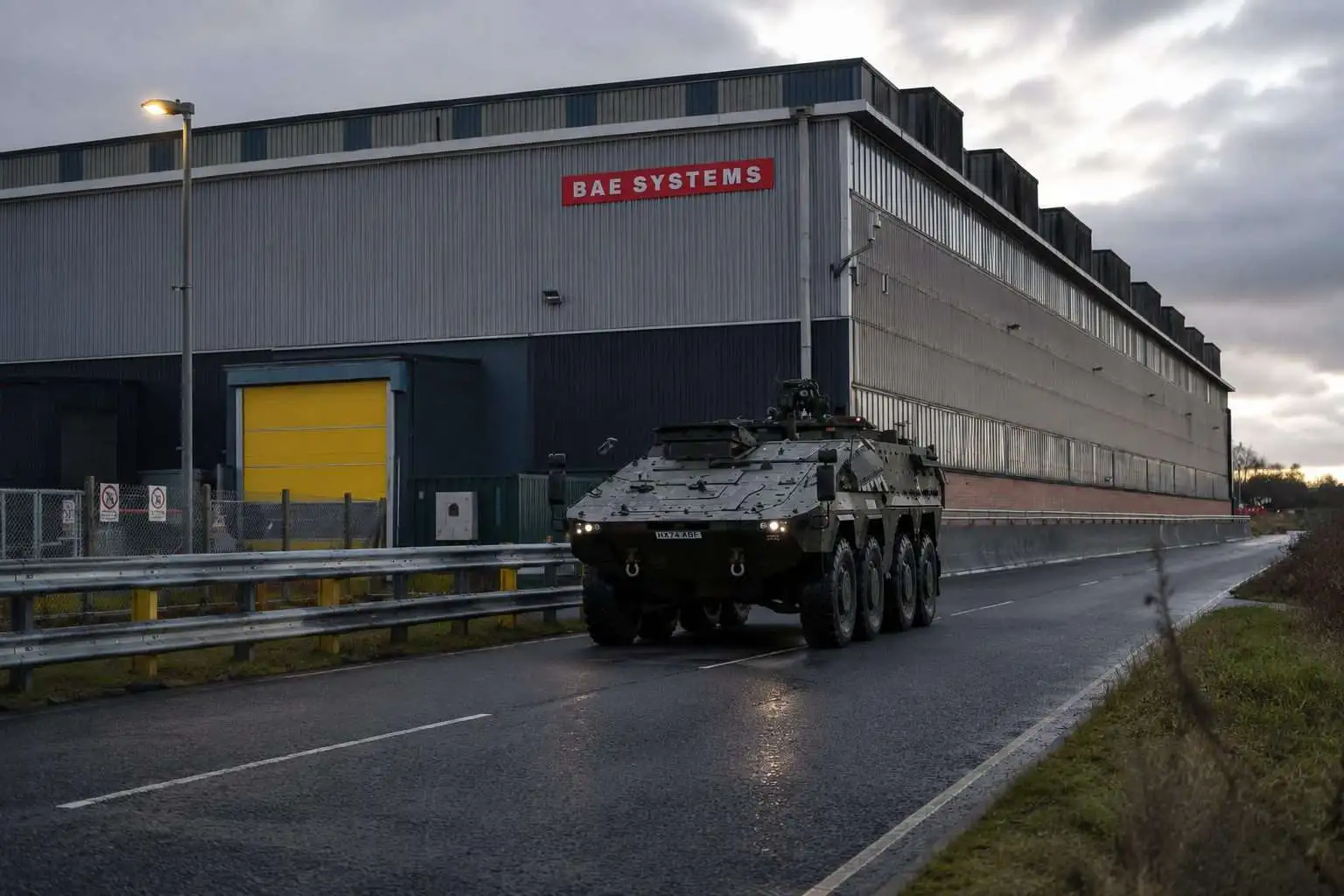
BAE’s own mix explains why the stock moves with defence-budget expectations. Reuters has described the company as Britain’s biggest defence contractor, making Typhoon fighter jets, nuclear submarines and warships in Britain, while supplying the United States with space and satellite equipment, combat vehicles and munitions.
But the trade is not one-way. A Reuters analysis in April said MSCI’s Europe Aerospace and Defence Index fell 9.2% in March as profit-taking, stretched valuations and questions over the future of warfare hit the sector; Rheinmetall and Saab were among names lower since the Iran conflict, while cheaper drones raised fresh questions about demand for some high-cost legacy platforms. BAE can win from that shift, but it still has to convert orders on time and at margin.
For now, Monday’s bounce looked more like a repair trade than a new breakout. The next test is whether management can turn guidance, space milestones and missile demand into firm order intake, not just another headline in a crowded defence tape.