WASHINGTON, Jan 25, 2026, 08:29 (EST)
- A modeling study indicates that salty surface ice on Jupiter’s moon Europa may fracture and sink, transporting nutrients down into the subsurface ocean
- Simulations indicate the process might begin in roughly 30,000 years within fractured ice, yet could span millions of years in more robust shells
- NASA’s Europa Clipper will arrive in 2030, conducting dozens of close flybys to explore the moon’s ice shell and subsurface ocean
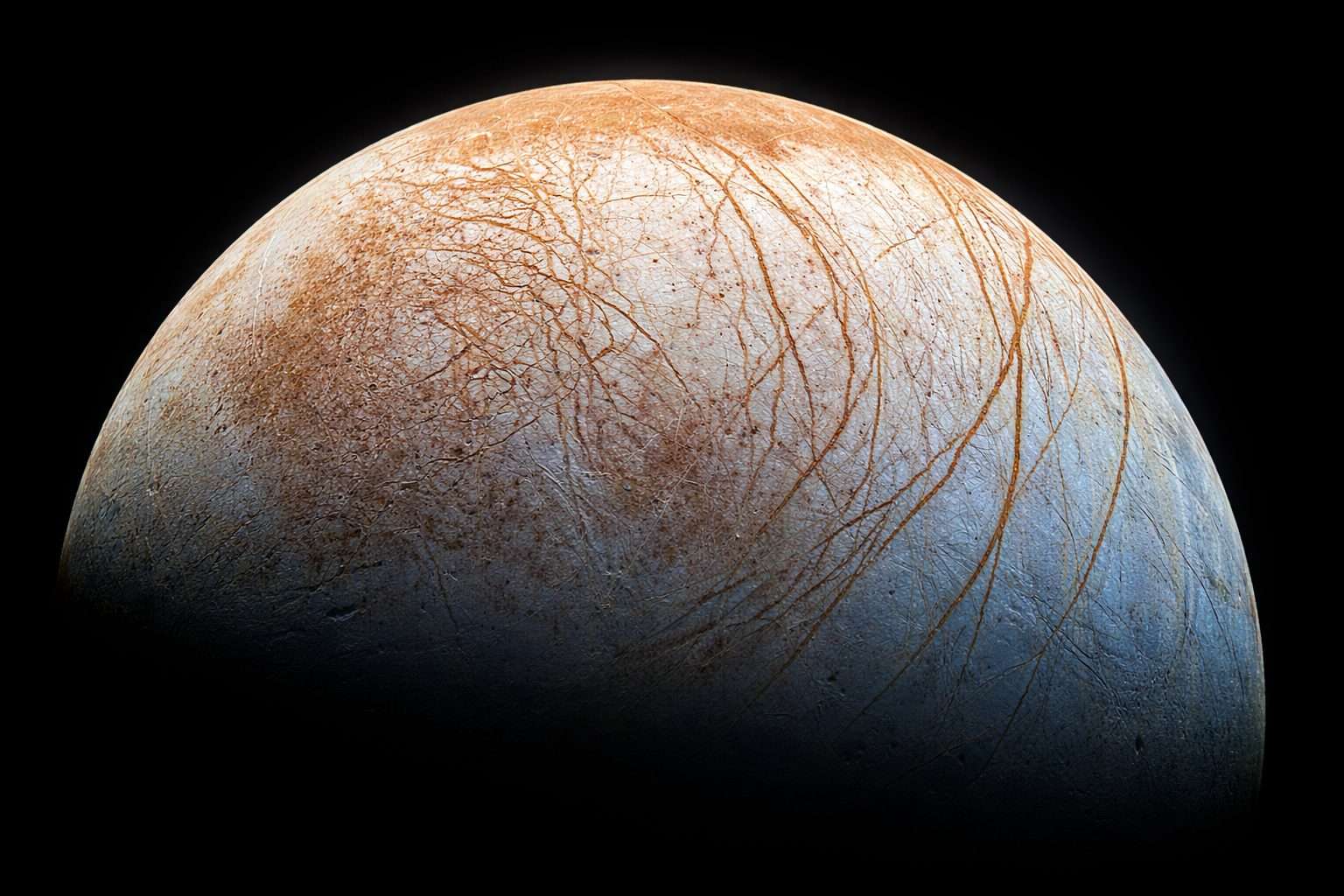
A new modeling study reveals that salty ice patches on Jupiter’s moon Europa might break off and sink through its ice shell, ferrying oxidants and other chemicals down to the ocean below — possibly creating a route for life-supporting ingredients. 1
This is significant since Europa is among the best bets in the solar system to hunt for life beyond Earth. It holds more liquid water beneath its icy shell than all Earth’s oceans together. Jupiter’s radiation creates compounds on the surface that microbes might exploit, but scientists have wrestled with how those surface materials could reach the ocean below. 2
Timing couldn’t be more critical. NASA’s Europa Clipper, which launched in 2024, is set to reach the Jovian system by April 2030. Over the next four years, it will perform nearly 50 close flybys, offering scientists a rare opportunity to study the interactions between Europa’s icy surface and its hidden ocean. 3
This research ties into a larger debate about the solar system’s so-called “ocean worlds”—icy moons like Saturn’s Enceladus that may conceal liquid seas beneath their frozen surfaces. But having water isn’t the whole story; scientists are probing whether these environments can circulate energy and nutrients, or if they’re locked in place.
Austin Green, currently at Virginia Tech, teamed up with Catherine Cooper from Washington State University to run computer simulations testing if dense, salty ice can sink despite buoyancy. They applied a geology idea known as crustal delamination—where a dense piece of the crust detaches and sinks deeper into Earth’s interior.
The model hinges on one basic imbalance: salt adds weight to ice, and impurities can weaken the bonds between ice crystals. In these conditions, salt-rich ice pockets can detach from the purer ice nearby, rather than just sliding sideways across Europa’s ever-stressed surface.
One scenario considered an ice shell roughly 30 km (19 miles) thick. In fractured ice, sinking might start in just 30,000 years, but in more intact shells, it could take 5 to 10 million years for material to reach the base.
Oxidants play a key role here. These reactive chemicals unleash energy when they interact with other compounds—basically serving as a chemical “fuel” for life in the dark. Since Europa’s surface is bombarded by radiation, the main question is whether those chemicals created on the surface can make their way down to the ocean.
“This is a novel idea in planetary science, inspired by a well-understood idea in Earth science,” Green said in a statement. He argued the mechanism helps explain a long-standing puzzle about Europa: intriguing surface chemistry paired with an ocean that seems completely sealed off.
But this mechanism hinges on assumptions that are tough to verify from Earth. Europa’s ice shell might lack the right combination of salts, fractures, and weaknesses needed for large-scale “ice drips” to occur. Even if they do happen, a slow cycle could still leave the ocean without enough usable chemistry for extended periods.
Still, the study gives mission scientists a clear target: evidence that salty, weakened ice is cycling downwards. If Europa Clipper detects surface-to-interior exchange of this kind, it would boost the argument that Europa’s ocean isn’t as cut off as it seems — and the next challenge would be uncovering what, if anything, might survive there.