Fresh reports today paint a clearer picture of the Galaxy Z Fold 8 and Apple’s first foldable iPhone—covering design leaks, crease-free display tech, and renewed liquid‑metal/titanium rumors.
Published: January 15, 2026
Foldables are heading into their most consequential year yet—and the rumor mill is moving fast. On January 15, new reporting and fresh leak roundups put Samsung’s Galaxy Z Fold 8 and Apple’s long-rumored iPhone Fold on a collision course, with two themes dominating the headlines: a push toward (nearly) crease-free screens and a hardware arms race centered on materials, hinges, and “wider” display shapes. 1
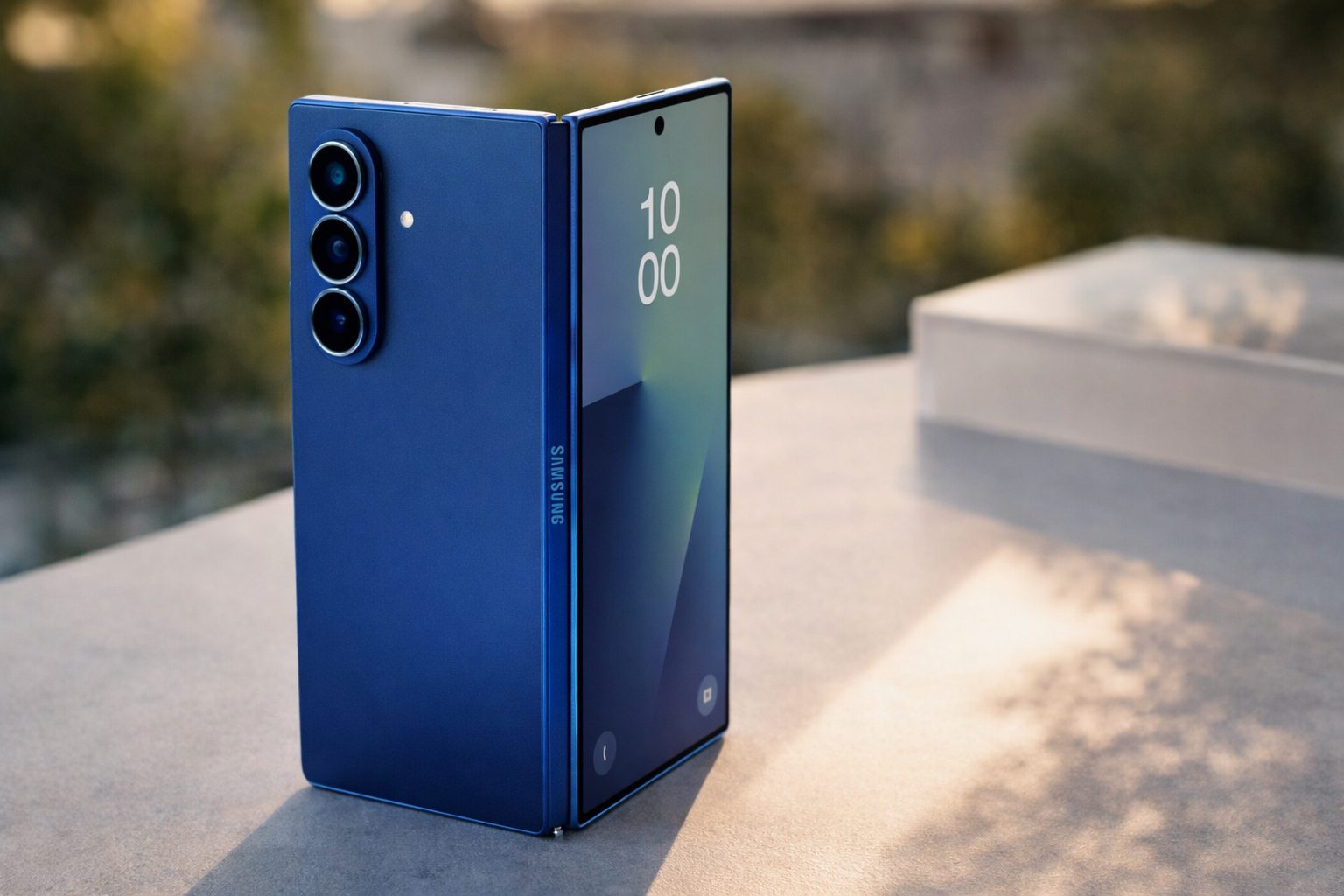
Samsung’s side of the story reads like an aggressive spec sheet upgrade: a lighter Fold, a bigger battery, and another attempt to minimize the inner-screen crease. Apple’s, meanwhile, is a mix of alleged industrial design clues (a case-maker “mold” leak) and a renewed wave of material rumors—especially liquid metal for the hinge and titanium (or maybe not) for the body. 2
Below is what’s being reported as of today, Jan. 15, 2026, what overlaps between sources, and what still doesn’t add up.
What’s new today: the foldable fight is shifting from “bigger screens” to “better physics”
For years, foldables competed mainly on screen size, thinness, and “can it survive in a pocket?” durability. The latest leaks suggest the battleground is now more specific:
- The crease problem (how visible it is, how it feels under your finger, and how it reflects light)
- Hinge longevity (fatigue resistance over hundreds of thousands of folds)
- Weight distribution (foldables are larger devices; the hinge area becomes a structural hotspot)
- Form factor (book-style folds are trending wider and more tablet-like)
That’s why the most repeated words in today’s coverage are not “megapixels” or “refresh rate”—they’re glass, metal plates, adhesives, laser drilling, and liquid metal. 3
Galaxy Z Fold 8: Samsung’s rumored plan is thinner, lighter, and aimed directly at iPhone Fold
Expected launch timing and price: July/August window, with pricing pressure
Tom’s Guide reports Samsung’s likely Galaxy Z Fold 8 window is July or August 2026, following the recent pattern of summer Fold launches. The same report also flags continuing upward pressure on pricing, noting the Galaxy Z Fold 7 debuted at $1,999 in the U.S. and that Fold pricing has climbed across generations. 4
A second Fold may be coming: the “Wide Fold” concept
One of the more interesting rumors is that Samsung could expand beyond a single book-style Fold model. Tom’s Guide says a Korean publication claims Samsung is developing a “Wide Fold” variant intended to counter Apple’s rumored aspect ratio, offering a more square-like layout. In that version, the rumored screens are 5.4 inches outside and 7.6 inches inside, and the report suggests a potential fall release for that extra model.
If this plays out, Samsung’s strategy is pretty clear: keep a “classic Fold” for existing fans, and add a second model that is deliberately optimized for the kind of wider, tablet-like experience many people associate with an iPad-style workflow.
Design and display: the crease is the headline feature
On the Z Fold 8 itself, the core rumor isn’t a dramatic redesign—it’s what happens to the fold line.
Tom’s Guide notes:
- A report from South Korea claims the Z Fold 8 could hit 200 grams, which would be 15 grams lighter than its predecessor.
- It also warns that a lighter device may make S Pen fans nervous, since stylus support was reportedly dropped from the prior model in a bid to slim the phone down.
- For the crease, the same roundup points to “laser drilling technology” as a method expected to “greatly decrease” the visible crease.
Importantly, the rumor framing implies Samsung’s progress may still be measured against a tougher benchmark: Apple is said (in the same report) to have eliminated the crease “completely”—a claim that remains unverified publicly, but is increasingly repeated across outlets covering Apple’s foldable ambitions.
Cameras: the Fold keeps the 200MP lead, but supporting lenses may jump
Tom’s Guide says Samsung is likely to keep the 200MP main camera, while the supporting cameras could see meaningful upgrades:
- Ultrawide: rumored move from 12MP to 50MP
- Telephoto: rumored move from 10MP to 12MP, keeping 3x optical zoom
- Front cameras: expected to remain dual 10MP units (one per screen)
Performance and battery: Snapdragon 8 Elite Gen 5, but Exynos uncertainty lingers
On chips, Tom’s Guide expects the default path—Qualcomm’s Snapdragon 8 Elite Gen 5—but adds that Samsung’s increasing use of Exynos in certain models makes it worth watching whether Fold follows.
The headline battery rumor is also significant: a leak cited by Tom’s Guide claims a jump from 4,400mAh to 5,000mAh, and a later post suggests charging could rise from 25W to 45W.
In other words, if these rumors hold: Samsung’s next Fold isn’t just “Fold 7 with a new chip.” It’s trying to solve the three biggest practical complaints about book-style foldables: weight, crease, and battery life.
iPhone Fold: a case-maker “mold” leak collides with renewed liquid-metal + titanium rumors
Apple still hasn’t announced a foldable iPhone, so every “iPhone Fold” detail comes with an asterisk. But today’s coverage shows two rumor streams converging: what it may look like and what it may be made of.
The design leak: a case-maker might have revealed the shape
Macworld reports that a Turkish manufacturer posted images claiming to show a metal mold used by case makers—the kind of form used to ensure cases match the final device dimensions. Based on that post, Macworld says the foldable iPhone would be roughly iPhone mini-sized when closed and iPad mini-sized when unfolded. 2
The same piece notes several specific design cues:
- Two rear camera lenses in a straight (not diagonal) arrangement
- No obvious “plateau” style camera bump—more like a typical protruding camera module
- A circular element suggesting MagSafe support 2
Macworld also urges skepticism: this kind of leak is rare precisely because companies that expose Apple’s secrets don’t stay in the supply chain for long, implying it could be a mistake, a one-off, or not authentic. 2
The materials rumor: liquid metal hinge, titanium body… or aluminum instead?
The other major storyline is materials—specifically, the hinge.
AppleInsider says leaker Yeux1122 claimed in a Naver post that Apple’s iPhone Fold would use titanium for the casing and liquid metal for the hinge, and adds the hinge material is described as an improved version of the liquid metal used in Apple’s SIM-eject tool. AppleInsider also stresses that Yeux1122 has a mixed track record, and notes prior rumors suggesting Apple might instead use a hybrid titanium/aluminum frame or aluminum alone. 5
PhoneArena’s Jan. 15 piece underscores exactly why this is getting confusing: it notes earlier rumors suggested liquid metal hinge + titanium body, but that “the majority of rumors” later shifted toward an aluminum body—and now the titanium talk is back again. PhoneArena’s take is that liquid metal feels plausible for the hinge, while titanium is harder to believe due to cost, complexity, and weight/cost tradeoffs—suggesting aluminum or a hybrid could still be the realistic outcome. 1
MacRumors, citing supply-chain information via the same Naver user, similarly reports that Apple’s foldable iPhone hinge could be made from liquid metal (amorphous material) while the body could use a revised titanium that improves strength while reducing weight. 6
What about specs and timing?
MacRumors adds a bundle of rumored “first-gen foldable iPhone” details—stressing these are expectations/rumors—including:
- Book-style fold
- 7.8-inch inner display and 5.5-inch outer display
- A crease-free display claim
- A20 chip and Apple’s C2 modem
- Two rear cameras
- Touch ID 6
AppleInsider places timing more cautiously, suggesting an expected launch window around late 2026 or early 2027, while noting that mass production could start within months—again, framed as rumor rather than confirmation. 5
Taken together, today’s read is simple: the iPhone Fold story is still not “what Apple will ship,” but it’s increasingly “what Apple is prototyping,” with repeated emphasis on the hinge and crease.
The crease-free display arms race: Samsung’s solution may not be Apple’s solution—even if the OLED supplier overlaps
If you only read one section, make it this one—because it’s where today’s most interesting (and most technical) reporting lives.
Samsung may have “solved” the crease—by changing what’s behind the OLED
PhoneArena reports that Samsung has “solved” the foldable crease and that the Galaxy Z Fold 8 is expected to use a creaseless panel, citing coverage of an industry report. The key detail: Samsung is said to have replaced a PET support layer with a metal reinforcing plate, which helps reduce wrinkles and crease impressions. 3
Apple’s approach is rumored to be different: glass reinforcement
The same PhoneArena report says Apple is expected to use glass as the reinforcing material—contrasting with Samsung’s metal plate choice. It also notes that a modified OCA (optical clear adhesive) is part of the strategy for reducing the crease. 3
Tom’s Guide: MONT Flex Display at CES 2026 points to the split
Tom’s Guide (in a separate report) says Samsung Display’s creaseless MONT Flex Display, shown at CES 2026, is rumored to land in Samsung’s Galaxy Z Fold 8—but that Apple’s version would likely use ultra-thin glass (UTG) instead of a metal-backed approach. It also describes Samsung’s claim that new adhesives help reduce crease visibility by making the panel more flexible and reducing the severity of the bend.
This is the big takeaway: “crease-free” is not one technology. It’s a stack of decisions across reinforcement layers, adhesives, hinge geometry, and even manufacturing techniques. Two phones can both claim “reduced crease” while achieving it in fundamentally different ways—with real implications for durability, repairability, and cost.
What it all means: Samsung is defending its lead, but Apple is targeting the pain points
Samsung’s rumored Z Fold 8 plan looks like a defensive championship strategy: keep iterating on what already works, add real-world upgrades (battery/weight), and make the crease less noticeable. 4
Apple’s rumored iPhone Fold strategy looks more like a “late entry advantage”: don’t show up until you can credibly claim you fixed the main compromises—crease visibility, hinge durability, and premium build. 5
And the “Wide Fold” rumor matters because it hints Samsung believes the iPhone Fold might reset expectations for what a book-style foldable should look like—more square, more tablet-like, and more optimized for content without black bars.
If these reports are even partly accurate, 2026’s foldable competition won’t be decided by who folds first. It’ll be decided by who makes the fold feel invisible in daily use.
What to watch next (Jan. 15 roadmap)
Here are the next likely checkpoints that could confirm or kill today’s rumors:
- Samsung’s summer window (July/August)—the period Tom’s Guide highlights as most likely for the Z Fold 8 reveal. 4
- Whether the “Wide Fold” becomes real—a second Fold model would be a clear sign Samsung is taking Apple’s rumored form factor seriously.
- More clarity on Apple materials—multiple outlets say liquid metal is plausible, but titanium vs aluminum remains unsettled. 1
- The crease-free proof moment—at some point, “improved crease” turns into hands-on photos and teardown-level details (reinforcement layers, adhesives, hinge parts). 3