
NEW YORK, June 3, 2026, 17:05 EDT
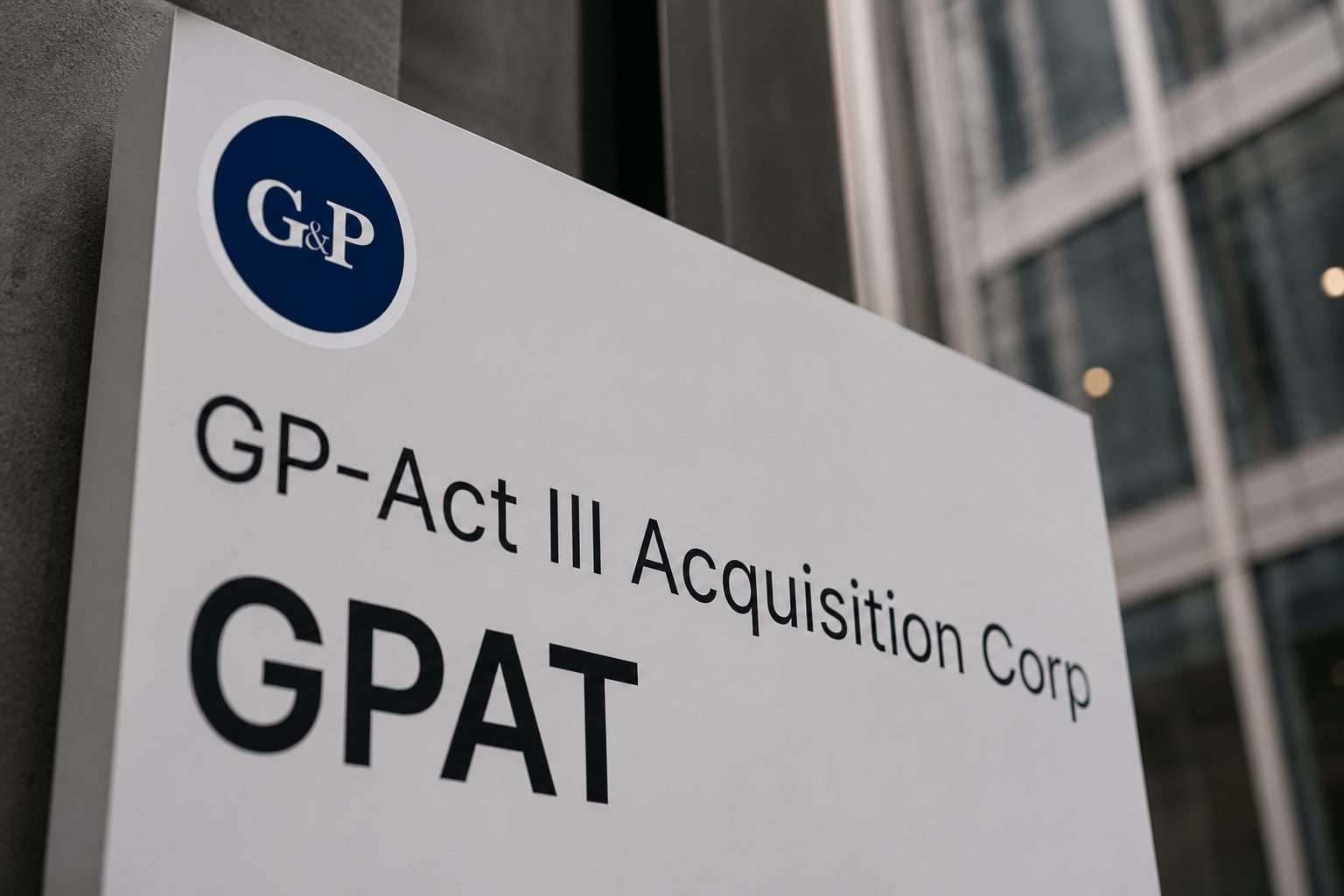
GP-Act III Acquisition Corp. shares ended nearly flat on Wednesday, last quoted at $10.83, down a penny, on just 199 shares traded after the regular Nasdaq session. The market value was about $389.6 million.
The quiet tape matters because GP-Act III is a SPAC, or special purpose acquisition company — a listed shell that raises cash to buy a private company and take it public. It has no operating business or revenue, so the stock trades less on earnings momentum and more on cash, deadline risk and deal prospects.
That test got sharper in May. Shareholders approved an extension of GP-Act III’s business-combination deadline to Nov. 13, 2026, but holders of 19,776,272 Class A shares redeemed at about $10.89 a share, taking out roughly $215.4 million and leaving about $97.8 million in the trust account, the IPO cash pool available for a merger. The company also struck non-redemption agreements covering 8,074,387 shares, with the sponsor due to transfer 403,720 Class A shares if an initial deal closes.
The first-quarter numbers show why investors are focused on the trust. GP-Act III had $311.9 million of marketable securities in trust at March 31, before the May redemptions, and reported $2.15 million in net income, driven by interest income rather than operating sales.
The May vote bought time. It did not name a target.
Competition for both targets and investor attention is not light. Boardroom Alpha’s SPAC tracker showed 101 U.S. blank-check IPO pricings this year, raising $17.6 billion, and listed three new June 3 pricings: Aeon Acquisition I Corp., AmperCap Acquisition Co. and Keystone Acquisition Corp., sized at $125 million, $125 million and $250 million, respectively.
The broader IPO market also gives SPAC sponsors a mixed backdrop. FTI Consulting said SPACs accounted for 69% of U.S. IPO deal volume in the first quarter, up from 58% in the prior quarter, as traditional IPO access stayed selective and issuers looked for alternative routes to public markets.
Doug Ellenoff, founder of Ellenoff Grossman & Schole LLP and a long-time SPAC lawyer, has cautioned that the sector’s rebound should avoid the excesses of 2020 and 2021 and move toward “disciplined, solid growth.” He told Gallagher that private-company supply and sponsor demand looked more balanced than during the boom years. Gallagher
But the downside case is plain. If GP-Act III cannot announce and finance a credible merger before the November deadline, the stock may stay pinned close to cash value, and another redemption wave at a deal vote could shrink the trust further. Company filings have pointed to redemption requests and market, financial, political and legal conditions as risks around forward-looking plans.
For now, GPAT is a waiting trade. The next move is unlikely to come from the income statement. It is more likely to come from a target announcement, financing terms, or another look at how much cash investors are willing to leave in the vehicle.