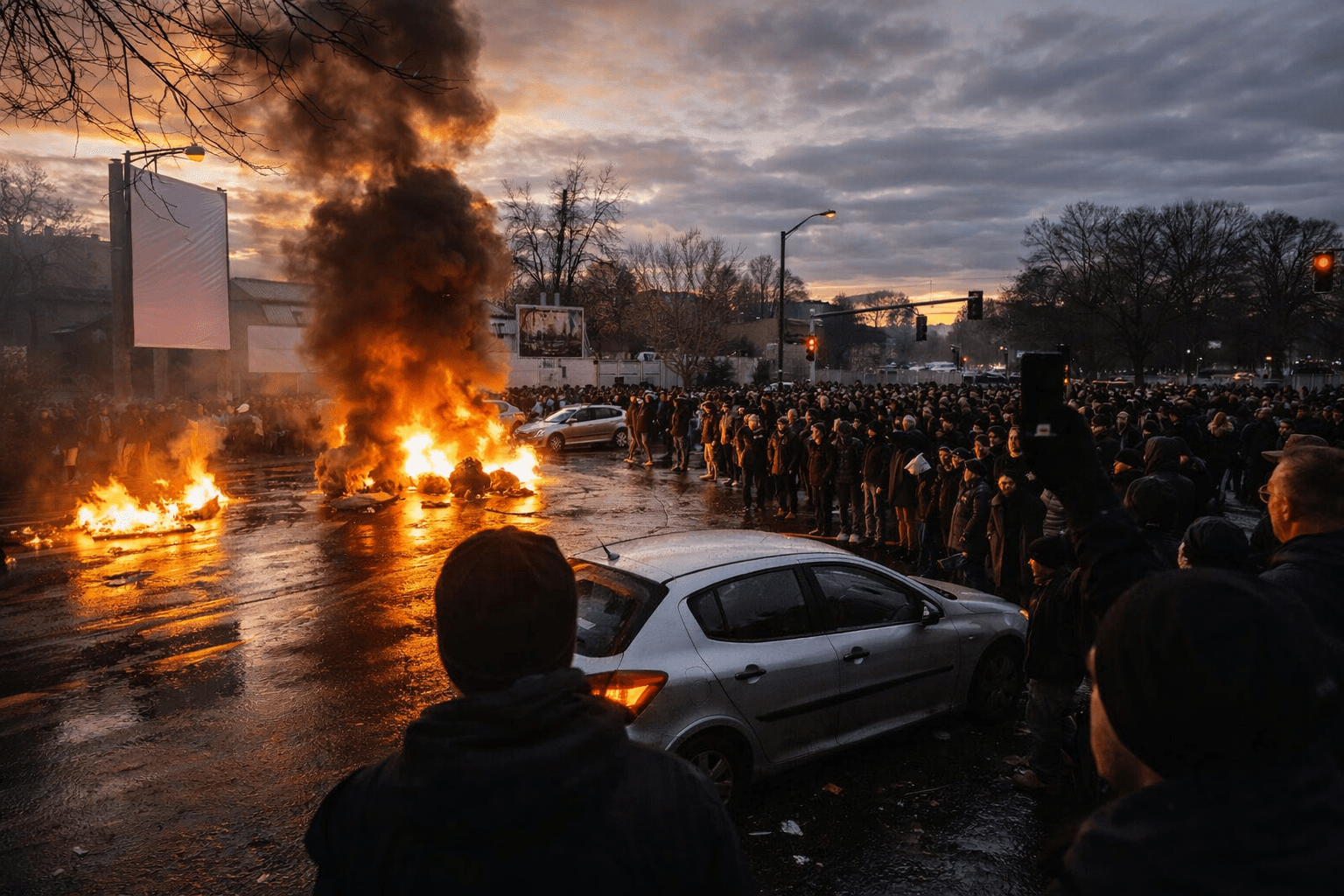
- Iran launched a near-complete internet blackout starting January 8, coinciding with escalating nationwide protests, the Committee to Protect Journalists reports. 1
- According to CPJ, the majority of calls to Iran are now not connecting, and numerous Iranian news websites are inaccessible, severely complicating fundamental reporting and fact-checking. 1
- The Wall Street Journal reported that as Starlink turns into one of the few remaining routes for footage to exit the country, authorities are actively hunting down and seizing terminals. 2
Iran’s almost complete internet blackout has shifted gears: Starlink now stands as one of the few remaining avenues for sharing protest videos. Authorities are actively tracking down the satellite terminals enabling these uploads. 1
This situation extends beyond Iran because it serves as a real-time experiment in how fast a government can “shut down” public internet access—and what unfolds when users switch to satellite connections that bypass local telecom providers. It also thrusts a consumer connectivity device into the heart of an information battle. 3
The Committee to Protect Journalists reported that the blackout started on January 8, following protests that kicked off in late December over economic strain, currency devaluation, and soaring living costs. CPJ called it an almost complete shutdown, severely restricting journalists from reporting and cutting off much of the country’s communication with the outside world. 1
Even before the complete shutdown, reporters faced disrupted mobile data and sluggish or throttled internet connections. According to CPJ, media workers also encountered pressure to avoid covering events, including warnings, intimidation, and summonses. 1
As connectivity dropped further, even the faintest traces of access vanished. According to CPJ, phone calls to Iranian numbers no longer go through, and most websites of Iranian media outlets won’t load in browsers. 1
The issue boils down to verifying details layered over a connectivity challenge. CPJ highlighted the difficulty of confirming reports on arrests, injuries, and deaths, referencing a U.S.-based human rights organization’s findings. They also pointed out how limited independent verification is from outside Iran. 1
Starlink has moved into that gap—though only a small group with access to the gear can benefit. According to CPJ, most of the scarce info getting out of Iran has traveled via Starlink, a satellite service banned by the government. Reports also mention authorities confiscating the satellite dishes in crackdowns. 1
The Wall Street Journal revealed that Iranian authorities are ramping up attempts to track down and seize Starlink terminals, especially in Tehran’s protest hotspots. Citizens have been relying on the service to share videos and spread proof of the government’s crackdown beyond Iran’s borders. 2
The WSJ highlighted the supply chain supporting that connectivity: U.S.-based digital rights nonprofits like Miaan Group and NetFreedom Pioneers have facilitated the delivery of Starlink terminals into Iran, using routes through Dubai and Iraqi Kurdistan, according to the report. 2
The Financial Times described the shutdown as part of a broader technical trajectory. It noted that Iran’s government-run National Information Network (NIN) was designed to separate services from the global internet. Still, the country has resorted to wide-ranging blackouts—this month cutting off most global internet access, including for privileged users with “white SIMs.” Early disruptions also affected banks, ATMs, and other critical services. 3
The FT characterized Iran’s approach as shutting down the global internet while selectively “whitelisting” approved services—permitting access only to certain sites and platforms—rather than maintaining a wide-ranging domestic internet with edge filtering. Experts, the report noted, expect Iran to shift toward even tighter control over time. 3
What remains uncertain—and could quickly become problematic—is whether any of the remaining channels can deliver reliable information on a large scale. CPJ cited a journalism expert who warned that blackouts increase pressure to loosen verification standards, even as the consequences of errors grow heavier. The organization also noted it hasn’t been able to verify details about journalists inside Iran since the internet was cut off. 1
Legal pressure is mounting alongside the digital crackdown. According to CPJ, Iran’s Prosecutor General declared that participants in the unrest would face charges of mohareb—a serious accusation that could lead to the death penalty—and issued a warning to social media activists. This language significantly raises the risks for anyone attempting to share footage through the limited remaining connections. 1
For businesses and daily services, the blackout isn’t just a side effect—it’s the main blow. According to the WSJ, Iran’s already fragile economy has been hammered by the internet shutdown, leaving companies at a standstill. Yet, some video streams still slip out thanks to Starlink’s small, hard-to-trace connections. 2