Updated: January 11, 2026
Motorola and Samsung just turned foldables into CES 2026’s biggest smartphone story — and the ripple effects are still building as we head into mid-January. Motorola has finally stepped beyond clamshell “flip” nostalgia with the Motorola Razr Fold, its first book-style foldable built to take on Samsung’s Galaxy Z Fold line and Google’s Pixel Fold family. Meanwhile, Samsung is pushing the category in an even bolder direction with the Galaxy Z TriFold, a triple-folding device that stretches into a 10-inch mini-tablet.
If you’ve been loyal to flip phones, this is the moment you may start questioning that loyalty. Android Central’s Derrek Lee put it plainly this weekend: both the Razr Fold and Galaxy Z TriFold are tempting even flip-first users to switch — for very different reasons.
Below is everything that matters right now — what’s official, what’s rumored, and why the foldable phone market suddenly feels like it’s speeding up.
Motorola Razr Fold is Motorola’s biggest foldable pivot in years
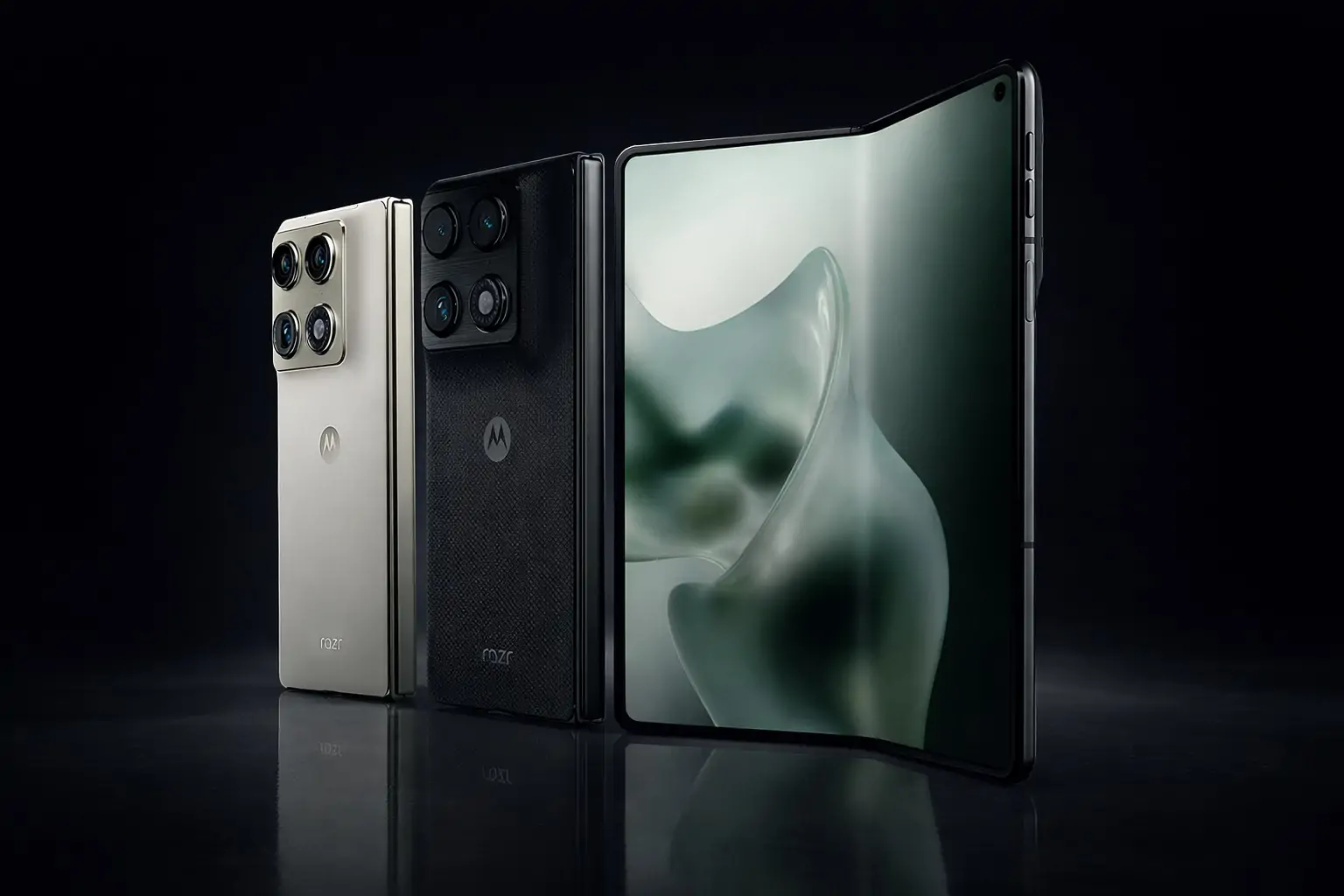
For the past half-decade, Motorola’s folding identity has been almost entirely clamshell: modern Razr flips designed to be compact, stylish, and practical. CES 2026 marks a clear break from that strategy. Motorola’s new Razr Fold opens “like a book or passport,” signaling the company’s first direct entry into the same productivity-focused category dominated by Samsung’s Z Fold line and Google’s Pixel Fold series.
Razr Fold key specs (confirmed so far)
Motorola and Lenovo have shared enough to define the Razr Fold’s positioning — even if some key details (chipset, RAM, battery, price) are still missing.
- Cover display: 6.6 inches — meant to feel like a normal “candy-bar” phone when closed.
Main display: 8.1-inch 2K LTPO panel when opened.
Rear cameras: triple 50MP system — main, ultrawide/macro, and 3x periscope telephoto (Motorola notes a Sony LYTIA sensor).
Selfie cameras:32MP external selfie camera + 20MP internal camera.
Video: Lenovo’s release references Dolby Vision recording and stabilized video capture.
Colors/finish: Pantone Blackened Blue and Pantone Lily White, with a vegan leather finish noted in early coverage.
Stylus support: works with Moto Pen Ultra.
Timing: expected to launch in summer 2026 (with more info promised “in the coming months”).
In other words: Motorola is not treating this as a weird experiment. The display sizes, camera stack, and stylus support put it squarely in the premium “work + play” foldable lane.
The price question: Motorola hasn’t said — but a $1,500 rumor is fueling buzz
Motorola has not confirmed pricing. Multiple reports, however, point to a $1,500 starting price rumor — which would undercut many mainstream book-style foldables in the U.S. market.
That rumored number matters because it reframes the Razr Fold as something Motorola has historically done well: make premium features feel less financially painful. Android Central’s commentary argues that aggressive pricing could be Motorola’s best chance to shake up a category where Samsung often sets the “default” price ceiling.
The stylus angle: Moto Pen Ultra makes the Razr Fold a productivity play
The most attention-grabbing “why now?” move from Motorola isn’t just launching a book-style foldable — it’s doing it with a serious stylus push.
Motorola introduced the Moto Pen Ultra as part of its expanding “moto things” ecosystem, describing it as a stylus designed for both the Motorola Razr Fold and the Motorola Signature phone.
Moto Pen Ultra: what Motorola says it does
Motorola’s own product description emphasizes drawing and productivity features that sound like a direct pitch at note-takers, students, and mobile creatives:
- Pressure sensitivity and tilt detection for shading/texture
- Palm rejection for writing and sketching naturally
- Ultra-fine tip for accuracy (markups, selecting/extracting text)
- A quick access toolbar for brushes, note tools, magnify, and customization
- AI-assisted features including Quick Clip, Speed Share, Sketch to Image, and Circle to Search with Google
Wired adds two practical details that matter in real life: the pen is not stored inside the phone, and it comes with a carrying case that doubles as a battery.
When can you buy Moto Pen Ultra?
Motorola says Moto Pen Ultra will roll out to select regions in spring, with North America coming “in the coming months.”
Motorola didn’t just launch a foldable — it’s building an ecosystem around it
CES 2026 wasn’t “Razr Fold only.” Motorola used the show to present a broader strategy: one foldable, new accessories, and a cross-device AI platform that tries to glue it all together.
Moto Watch: Polar partnership and long battery are the headline
Motorola’s new moto watch features a 47mm round face and emphasizes wellness tracking backed by a partnership with Polar. Motorola also highlights up to 13 days of battery (or up to 7 days with always-on display) and notes a built-in mic/speaker for calls.
Motorola’s own release says the moto watch will be available in the U.S. starting January 22 on Motorola’s website.
Moto Tag 2: UWB + 500+ days battery life
The moto tag 2 gets Ultra-Wideband (UWB), Bluetooth channel sounding, and integration with Google’s Find Hub network, plus an attention-grabbing battery claim: more than 500 days of battery life. Motorola also says it supports ringing your phone and acting as a remote camera shutter button.
Moto Sound Flow: a Bose-branded speaker with UWB tricks
Motorola’s first portable speaker, moto sound flow, leans into “Sound by Bose,” a 30W output, UWB features that can transfer calls/music based on proximity, and a 6000mAh battery with IP67 rating.
Why does this matter for the Razr Fold story? Because foldables are expensive, niche devices — and brands keep trying to make them feel like the “center” of a lifestyle stack rather than a single flashy gadget.
Samsung Galaxy Z TriFold: triple-folding goes mainstream (with a very premium price)
If the Razr Fold is Motorola joining the mainstream book-fold battle, the Samsung Galaxy Z TriFold is Samsung betting that the next step isn’t incremental — it’s a new category.
Samsung’s own description frames TriFold as a multi-folding device designed to balance portability and productivity, with an inward-folding mechanism meant to protect the main display. Samsung also describes an “auto-alarm” that warns users about incorrect folding through on-screen alerts and vibrations.
Galaxy Z TriFold key specs (Samsung’s official details)
Samsung’s newsroom post includes unusually deep technical specifics:
- Main display: 10.0-inch QXGA+ Dynamic AMOLED 2X, up to 120Hz
- Cover display: 6.5-inch FHD+ Dynamic AMOLED 2X, up to 120Hz
- Thickness (unfolded): as low as 3.9mm at its thinnest point (with other measurements depending on section)
- Battery:5,600mAh three-cell system across the three panels
- Charging:45W super-fast charging
- Chipset: Snapdragon 8 Elite Mobile Platform for Galaxy
- Camera: includes a 200MP wide camera (plus other lenses listed in the spec section)
Samsung says TriFold was expected to be available for purchase in Korea on Dec. 12, 2025, followed by additional markets including China, Taiwan, Singapore, the UAE, and the U.S.
The “tablet promise” that foldables have been chasing
A lot of book-style foldables have sold the idea of “phone plus tablet” for years — but the squarer ~8-inch inner screens have left some people unconvinced. Android Central’s take is that TriFold is closer to delivering the experience users expected all along: it can feel like a true middle ground between smartphone and tablet.
Android Central also reports that TriFold can run a standalone DeX-style desktop setup and handle up to 20 apps across multiple workspaces, positioning it as a legitimate multitasking machine for power users.
The downside: price (especially in the U.S.) is still the big unknown
Samsung has shared plenty of specs — but U.S. pricing is still not officially confirmed in the sources above. Commentary from Android Central points out that Korean pricing suggests TriFold will cost significantly more than the Galaxy Z Fold line — putting it out of reach for many buyers even if the hardware is thrilling.
Flip phones aren’t dead — but these launches explain why people are starting to look elsewhere
Flip phones remain popular because they’re compact, fun, and often cheaper than book-style foldables. But CES 2026 made one thing clear: the innovation spotlight is shifting to larger foldables — and that shift is pulling attention (and potentially buyers) away from flips.
- Razr Fold’s pitch: “normal phone” outer screen + big inner display + stylus productivity, with a rumored price that could be more approachable than the usual ultra-premium foldable ceiling.
TriFold’s pitch: go beyond the “8-inch compromise” and make the tablet mode feel genuinely tablet-like — at flagship-plus pricing.
Add in the fact that Samsung Display is reportedly showing off crease-reduction/creaseless panel tech at CES 2026 (with speculation about where it might land next), and it’s easy to see why the category feels like it’s accelerating again.
The next foldable headline is already here: iPhone Fold price rumors enter the chat
Today’s foldable conversation isn’t only Motorola vs Samsung. On January 11, new chatter around Apple’s first foldable is adding fuel to the entire segment.
Tom’s Guide reports the iPhone Fold could land at around $2,400, potentially putting it in the same financial neighborhood as Samsung’s most ambitious foldables. The piece argues Apple may be able to charge that much, citing analysts who say Apple still hasn’t found the “upper limit” of what iPhone buyers will pay.
Why this matters for Razr Fold and TriFold: market-watchers expect Apple’s entry to dramatically raise foldable awareness. IDC estimates cited by MacRumors suggest the overall foldable phone market could grow around 30% in 2026, with Apple capturing a significant share of foldable units and value in its first year.
What to watch next in 2026’s foldable race
As of January 11, the most important “unknowns” aren’t about whether these devices exist — they’re about whether they can break through beyond early adopters:
- Razr Fold pricing and full specs
Motorola has confirmed the form factor and the core experience, but the missing details (chipset, battery, final configurations, final price) will decide whether it’s a true disruptor or just another premium foldable.
TriFold’s U.S. rollout and cost reality
Samsung has the spec sheet ready — now it has to prove that a 10-inch pocketable “phablet-tablet” is something more than an impressive flex.
Software and multitasking that justify the hardware
Big screens only matter if apps and workflows are optimized — and if stylus + AI features feel useful rather than gimmicky.
The ecosystem strategy
Motorola’s accessories push (watch, tag, stylus, speaker) suggests brands know foldables need more than “cool hinge engineering” to win.
Foldables have spent years trying to convince buyers they’re not just expensive experiments. CES 2026 — and the news cycle continuing into January 11 — shows the pitch is changing: bigger screens, better cameras, serious stylus support, and a stronger ecosystem story. Whether that’s enough to pull the mainstream away from flips (and slabs) depends on what comes next: pricing, durability, and software that feels built for the fold.