
MELBOURNE, May 16, 2026, 02:06 AEST
- NAB picked up Banked in a move to broaden its real-time, account-to-account payment offerings for business clients.
- NAB shares hover near recent lows, with investors eyeing bank credit stress as the deal lands.
- Polymarket traders are putting the RBA’s odds of holding steady in June at 83%, while the chance of a hike sits at 18%.
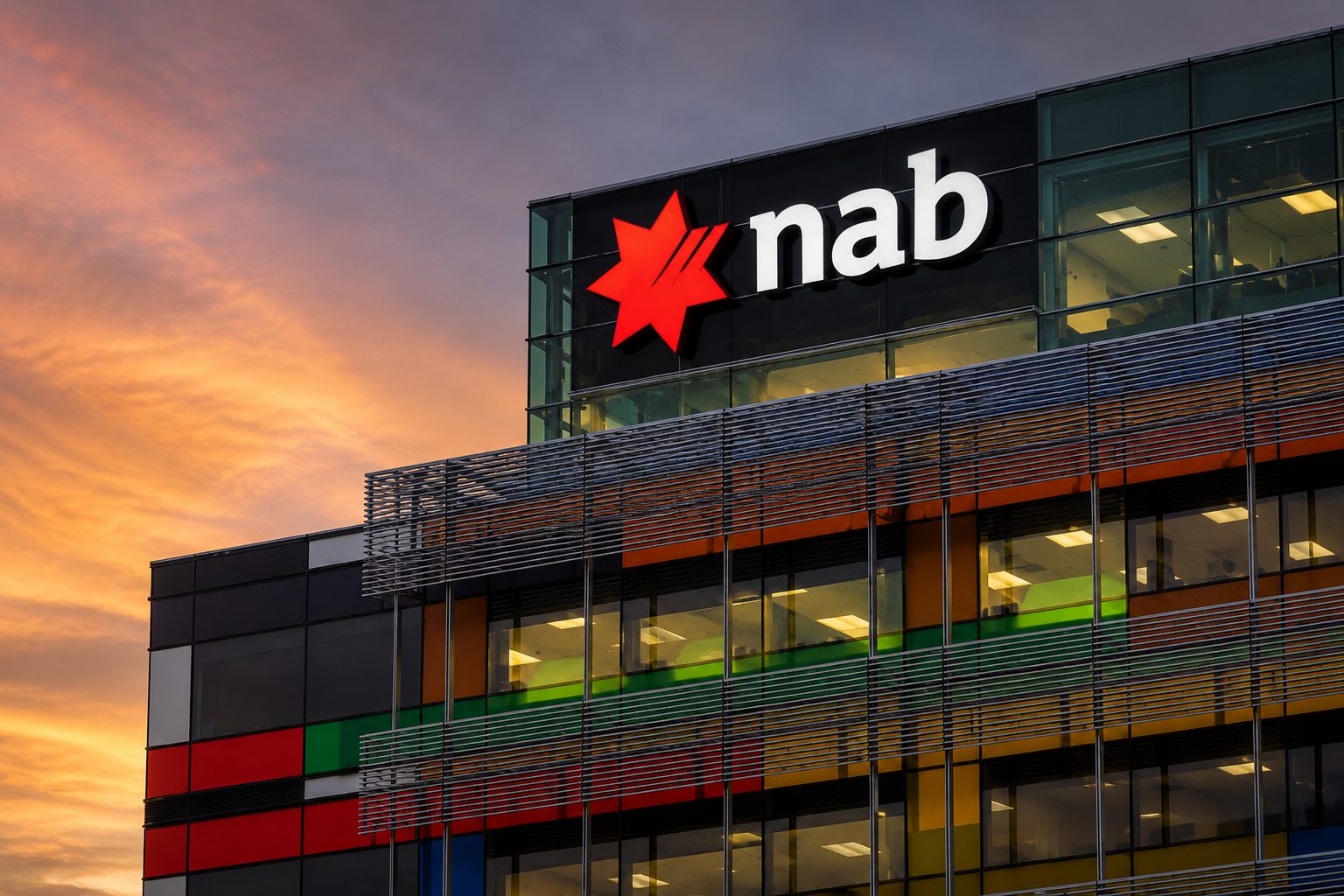
National Australia Bank has snapped up fintech firm Banked, landing direct ownership of a payments tool that lets merchants pull funds right from a customer’s bank account—no cards needed. The country’s top business lender kept the deal’s price tag under wraps in its release.
That’s significant at this stage, with Australian banks stepping up the battle for payments income and merchant ties. Their core lending operations are taking a hit: higher rates, softer consumer demand, and mounting bad-debt provisions are all in play. Account-to-account payments, stripped down, shift money straight between bank accounts—potentially sidestepping some card-network fees.
NAB says Banked will boost its payments arm, promising quicker and cheaper fund transfers for businesses. The bank’s been using Banked’s platform since 2024, after backing the fintech via NAB Ventures through three separate funding rounds between 2022 and 2024.
“Pay by Bank is part of a broader shift,” NAB transformation chief Shane Conway said. Customers, he noted, want payments to be “fast, easy and reliable.” Banked gives merchants “a faster and lower-cost way” to get paid, Conway said. NAB News
Banked, launched back in 2018, is set to become a wholly owned subsidiary of NAB for now, as the bank moves to fold the fintech into its tech stack in the next few months. Banked CEO Brad Goodall said NAB’s support gives the platform an opportunity to “reach more customers.” NAB News
Competition is fierce. According to Cuscal, ANZ, Commonwealth Bank of Australia, Westpac, and NAB now all support PayTo for retail customer accounts. More than 90% of individual accounts are already enabled for PayTo, Australia’s bank-account payment system that allows customers to authorise and manage payment agreements via online banking.
NAB’s real advantage might hinge less on the basic tech—the rails themselves—and more on whether merchants actually pick up the surrounding checkout, reconciliation, and settlement features. According to Australian Payments Plus, PayTo enables merchants to kick off real-time payments straight from customer bank accounts. Its New Payments Platform? Nearly 2 billion real-time payments processed in 2025.
The deal lands just as bank investors are having a tough stretch. NAB shares edged up 0.27% to A$36.52 at 4:16 p.m. AEST on Friday, but that’s still well off from the A$39.51 recorded back on May 7, according to historical data. The ASX was closed when this was published.
NAB’s first-half cash earnings came in at A$2.64 billion earlier this month, missing the Visible Alpha forecast of A$2.93 billion, as the bank absorbed one-off items and looming bad debt provisions. Reuters said the lender took a A$706 million credit impairment charge; roughly A$300 million of that is set aside for possible future losses tied to the Middle East conflict.
After the results, NAB Chief Executive Andrew Irvine described the operating environment as tough. “It’s very hard to forecast in these times,” he told analysts. Net interest margin edged up three basis points to 1.81% for the half, according to Reuters. Reuters
New NAB numbers showed customers pulling back. Consumer spending dropped 1.1% in April, reversing March’s 2.1% gain. Discretionary outlays took a particular hit, with travel sliding 9.3%. “Lower fuel prices” and less stockpiling drove the drop, NAB Chief Economist Sally Auld said, but she noted some discretionary segments managed to hold up. NAB News
Housing is back on the radar. NAB’s May housing monitor had dwelling prices up just 0.3% in April, a slowdown, while Sydney and Melbourne both slipped 0.6%. New housing loan commitments didn’t fare better—down 3.8% for the March quarter. For lenders with big mortgage and business loan portfolios, shrinking credit demand can bite fast.
Banks aren’t getting much help from the rate picture. On May 5, the Reserve Bank of Australia bumped the cash rate target up by 25 basis points to 4.35%, pointing to stickier inflation and fallout from Middle East tensions on fuel and commodities.
Prediction-market traders aren’t betting on any move from the RBA by June. Over on Polymarket, odds for no change at the June 16 meeting sat at 83%. An increase drew 18%, a cut barely registered—less than 1%. The market resolves based on the RBA’s official call.
NAB faces a timing problem: payments investments can be slow to turn up in earnings, but the credit cycle doesn’t wait. Should merchants drag their feet on moving away from cards, or if integration costs overshoot, or another rate hike pinches borrowers and spending, the Banked deal risks looking like a slow-build infrastructure project instead of something that quickly boosts profits.