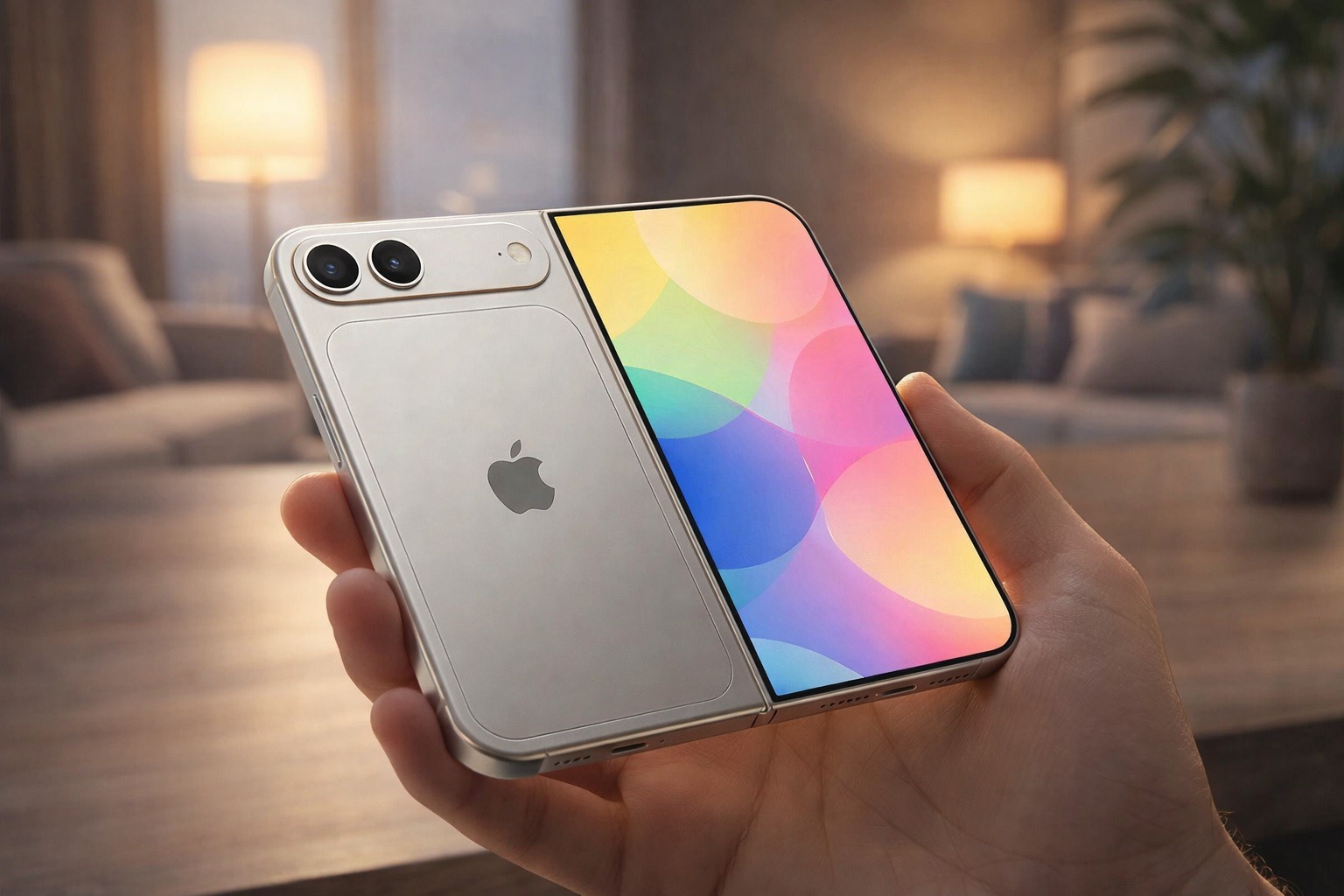
New reports dated January 5, 2026 say Apple’s first foldable iPhone—often called the iPhone Fold—could arrive in September 2026 with a book-style design, an iPad-like display, a Liquidmetal hinge built to hide the crease, Touch ID on the side, and a $2,000+ price tag. Here’s what we know today and what it could mean for the iPhone 18 launch plan. [1]
A fresh wave of reporting and rumor roundups today is sharpening the picture of Apple’s long-rumored foldable iPhone. Across multiple outlets, the story is converging on a “book-style” iPhone Fold that opens into a mini‑tablet experience, prioritizes thinness, and aims to do what no mainstream foldable has convincingly nailed: make the center crease nearly disappear. [2]
At the same time, today’s news isn’t just about hardware. Several reports published on January 5 also claim Apple may be preparing a major shift in its iPhone launch calendar—one that could put the foldable iPhone alongside the most expensive “Pro” models in September 2026, while pushing the “standard” iPhone 18 models into 2027. [3]
Below is a detailed, publication-ready breakdown of what’s being reported today—what appears consistent across sources, where the rumors conflict, and what to watch next as the foldable race heats up in 2026.
Today’s headline: The iPhone Fold “design leak” and what it suggests
A Geeky Gadgets report published this morning frames the latest discussion as a design leak that “changes everything,” emphasizing an iPad-like usage model rather than a tall, narrow phone that merely happens to unfold. The article highlights an iPad-style aspect ratio (described as “4:3”) and predicts Apple will lean heavily into multitasking and productivity—essentially treating the unfolded iPhone as a small, pocketable work surface. [4]
That direction aligns with MacRumors’ broader 2026 outlook: Apple is said to be working on a book-style device that opens “like a book,” expanding to roughly a small‑tablet footprint. In other words, Apple doesn’t appear to be chasing a flip-phone clamshell; it’s aiming straight at the Galaxy Z Fold / Pixel Fold category. [5]
Why this matters for readers: Apple entering the book-style foldable market—if it happens—could be the most consequential foldable moment since Samsung popularized the form factor. Not because Apple will be first, but because Apple typically waits until it believes it can solve the compromises. And the compromise being discussed most loudly today is the crease. [6]
Rumored iPhone Fold design: book-style, iPad-like, and extremely thin
Across today’s reporting, three design claims show up repeatedly:
1) A book-style fold that opens into a mini tablet
MacRumors says the foldable iPhone is expected to open and close like a book, with an unfolded display around 7.6 inches and a folded experience around 5.3 inches—and that the open device could resemble an iPad mini-like footprint. [7]
Tom’s Guide echoes the expectation of a big inside screen and a smaller outside screen, calling out rumors of roughly 7.8 inches inside and 5.5 inches outside. [8]
2) Ultra-thin hardware
MacRumors’ 2026 guide claims Apple is prioritizing thinness, with the foldable iPhone potentially around 4.5mm when open and 9–9.5mm when closed. [9]
Gulf News, summarizing the same rumor stream, also highlights that 4.5mm unfolded figure and repeats the 9–9.5mm folded range. [10]
3) A more “square” display approach
Geeky Gadgets leans into the idea of an iPad-like ratio (described as “4:3”), while other reporting also frames the unfolded experience as closer to an iPad than a stretched phone screen. [11]
The takeaway: even allowing for normal leak noise (5.3 vs 5.5 inches, 7.6 vs 7.8 inches), the consensus is surprisingly consistent: Apple’s foldable iPhone is being positioned as “a phone that becomes a small iPad,” not “a phone that folds smaller.” [12]
The big promise: a crease that’s “nearly invisible” — and the hinge tech behind it
If there’s one theme dominating today’s foldable iPhone coverage, it’s this: Apple is reportedly trying to ship a foldable where the crease stops being a daily annoyance.
MacRumors writes that Apple has been focused on ensuring the iPhone Fold doesn’t have a noticeable crease and claims it has addressed the issue with display improvements and a durable Liquidmetal hinge—describing the crease as “nearly invisible” when unfolded. [13]
The MacRumors foldable iPhone roundup adds a specific engineering detail: a metal plate that can help disperse and control stress from bending the display, paired with liquid metal in the hinge to improve durability and reduce creasing. [14]
Gulf News similarly says the device is rumored to have “no visible crease,” and points to liquid metal / amorphous metal as a durability play for the hinge. [15]
Tom’s Guide also flags the “truly crease-free display” rumor as a potential first for mainstream foldables—exactly the kind of differentiator Apple would want if it’s going to charge iPhone‑Pro‑Max-plus pricing. [16]
Touch ID might return on an iPhone — and Face ID is the big question
One of the most eye-catching claims in today’s coverage: Touch ID could come back, mounted on the side button.
Geeky Gadgets says the iPhone Fold is rumored to include a side-mounted Touch ID sensor as an alternative to Face ID. [17]
MacRumors’ 2026 outlook is more direct: it says the foldable iPhone may not have Face ID at all, and could instead use a Touch ID side button, similar to certain iPad models. [18]
Gulf News goes even further, stating the device is expected to “ditch Face ID” due to internal space constraints and thinness, using Touch ID in a side button instead. [19]
But there’s a twist: in-display Face ID rumors are also circulating
A separate report published today by SoyaCincau says Apple’s premium 2026 iPhones—including the foldable iPhone—may introduce in-display Face ID, enabling a near-uninterrupted display, potentially leaving only a punch-hole camera visible. [20]
MacRumors also reports that the iPhone 18 Pro models could be the year under-screen Face ID arrives, shrinking or removing the Dynamic Island (with a hole-punch camera remaining). [21]
How to read this:
- Multiple sources today point to Touch ID on the foldable as the practical solution for a super-thin chassis. [22]
- Separate reporting suggests under-display Face ID could appear on premium 2026 iPhones, but it’s less clear whether Apple would put that system into the first-gen foldable (a device already dealing with thinness, hinge complexity, and durability). [23]
Cameras: dual rear lenses, plus separate selfie cameras for folded and unfolded use
While exact camera specs remain all over the map, the broad shape is consistent across today’s coverage:
- MacRumors’ 2026 guide says the foldable iPhone will have a selfie camera in the top-left corner, plus a pair of rear cameras. [24]
- MacRumors’ foldable roundup says a dual rear camera is expected and that there will be a front-facing camera for both folded and unfolded states—effectively implying multiple “selfie” viewpoints depending on how you use it. [25]
- Gulf News says rumors point to four total cameras, including an under-display camera for the interior and a hole-punch camera for the exterior, plus a rear setup with main + ultrawide lenses. [26]
Geeky Gadgets also frames the rear system as a dual-camera setup aimed at wide use cases (photos, video, AR). [27]
Software: “iPadOS-like” multitasking could be the real selling point
Hardware is only half the story for a foldable. The other half is: what happens when you open it?
Geeky Gadgets argues Apple could bring iPad-like features to make the bigger screen feel purposeful—specifically citing possibilities like split-screen multitasking, drag-and-drop, and app layouts optimized for a larger, unfolded display. [28]
That emphasis matters because foldables often win or lose on software polish. A foldable that opens into a big screen but still behaves like a stretched phone can feel like a gimmick. The rumor narrative today suggests Apple is aware of that—and may be preparing a foldable-specific interface strategy rather than relying on developers to fix it later. [29]
Price: nearly every report says “over $2,000”
If there’s one point of broad agreement in today’s coverage, it’s the price: this will not be a mainstream iPhone—at least not in generation one.
- Geeky Gadgets puts the estimate at $1,800 to $2,500. [30]
- MacRumors says rumors suggest $2,000 to $2,500, noting the latest info trends toward the higher end. [31]
- Tom’s Guide points to a rumored $2,000–$2,500 band and notes that Samsung’s book-style foldables already sit at premium price points—meaning Apple will have to justify a potentially higher tier. [32]
- Gulf News repeats the $2,000–$2,500 expectation, while also citing a wider spread from other analysts and research notes. [33]
Macworld’s commentary today also suggests the foldable iPhone is likely to be “too expensive” for most buyers at first—but that Apple may not need it to sell in huge numbers initially; it may simply need a foothold and mindshare. [34]
Release date: September 2026 looks like the target — and the iPhone launch calendar may change
Multiple reports point to a fall 2026 window.
MacRumors’ 2026 guide explicitly says the foldable iPhone is on track for September 2026. [35]
Tom’s Guide also lists the iPhone Fold under September 2026 expectations. [36]
The bigger news today: Apple may split the iPhone lineup
Today’s reporting also focuses on a possible iPhone launch shake-up:
- SoyaCincau reports that Apple’s September 2026 iPhone event could focus on premium models—iPhone 18 Pro, iPhone 18 Pro Max, the foldable iPhone, and possibly the iPhone Air 2—while the standard iPhone 18 and iPhone 18e may slip into the first half of 2027. [37]
- MacRumors similarly states that Apple may hold back the standard iPhone 18 until 2027, leaving September 2026 as a premium-heavy launch with the foldable and Pro models. [38]
- Tom’s Guide flags the same timing shift idea, noting that “when we’ll actually see new handsets could be shifting,” and calls out the possibility that the iPhone 18 might not arrive until 2027. [39]
If this proves true, it would be a major strategic change: Apple would be treating the foldable iPhone not as an experimental side product, but as part of the flagship fall lineup—essentially redefining what “the new iPhone” means each September. [40]
The iPhone Fold rumor reality check: what’s solid vs. what’s still shaky
Here’s a practical way to summarize today’s reporting:
What multiple sources generally agree on
- Book-style foldable iPhone, iPad-like when open [41]
- Inner screen around 7.6–7.8 inches; outer screen around 5.3–5.5 inches [42]
- Extremely thin hardware (roughly ~4.5mm open; ~9–9.5mm closed) [43]
- A major push to reduce or nearly eliminate the crease, with Liquidmetal hinge talk [44]
- A premium price likely starting around $2,000 [45]
- Target window: fall / September 2026 [46]
What’s still conflicting or speculative
- Face ID vs Touch ID: multiple reports say Touch ID side button; others suggest in-display Face ID could expand to premium models, possibly including foldable [47]
- Specific camera configuration details (under-display camera, resolutions, exact lens specs) [48]
- The precise pricing floor (closer to $1,800–$2,000 vs $2,400–$2,500) [49]
FAQ: quick answers people are searching for today
Will Apple really launch a foldable iPhone in 2026?
Today’s reporting from multiple outlets points toward fall 2026 as the target window, commonly framed as September 2026 alongside premium iPhone models. None of this is confirmed by Apple, so timelines can still slip. [50]
How much will the iPhone Fold cost?
Most reports cluster around $2,000–$2,500, with some estimates suggesting Apple could try to hold closer to the lower end. [51]
Will it have Face ID?
Some coverage says the foldable iPhone could skip Face ID to save internal space, returning Touch ID in a side button. Separately, there are rumors of in-display Face ID for premium iPhones in 2026, but it’s not fully clear whether that will extend to the first foldable model. [52]
What makes Apple’s foldable different from Samsung’s?
The repeated claim is a near crease-free display using new hinge/display engineering (often tied to Liquidmetal and other structural solutions). If Apple can deliver that at scale, it would be a meaningful differentiator. [53]

References
1. www.geeky-gadgets.com, 2. www.geeky-gadgets.com, 3. soyacincau.com, 4. www.geeky-gadgets.com, 5. www.macrumors.com, 6. gulfnews.com, 7. www.macrumors.com, 8. www.tomsguide.com, 9. www.macrumors.com, 10. gulfnews.com, 11. www.tomsguide.com, 12. www.macrumors.com, 13. www.macrumors.com, 14. www.macrumors.com, 15. gulfnews.com, 16. www.tomsguide.com, 17. www.geeky-gadgets.com, 18. www.macrumors.com, 19. gulfnews.com, 20. soyacincau.com, 21. www.macrumors.com, 22. www.macrumors.com, 23. soyacincau.com, 24. www.macrumors.com, 25. www.macrumors.com, 26. gulfnews.com, 27. www.tomsguide.com, 28. www.geeky-gadgets.com, 29. www.geeky-gadgets.com, 30. www.geeky-gadgets.com, 31. www.macrumors.com, 32. www.tomsguide.com, 33. gulfnews.com, 34. www.macworld.com, 35. www.macrumors.com, 36. www.tomsguide.com, 37. soyacincau.com, 38. www.macrumors.com, 39. www.tomsguide.com, 40. soyacincau.com, 41. www.macrumors.com, 42. www.macrumors.com, 43. www.macrumors.com, 44. www.macrumors.com, 45. www.geeky-gadgets.com, 46. www.macrumors.com, 47. www.macrumors.com, 48. gulfnews.com, 49. www.geeky-gadgets.com, 50. www.macrumors.com, 51. www.geeky-gadgets.com, 52. www.macrumors.com, 53. www.macrumors.com