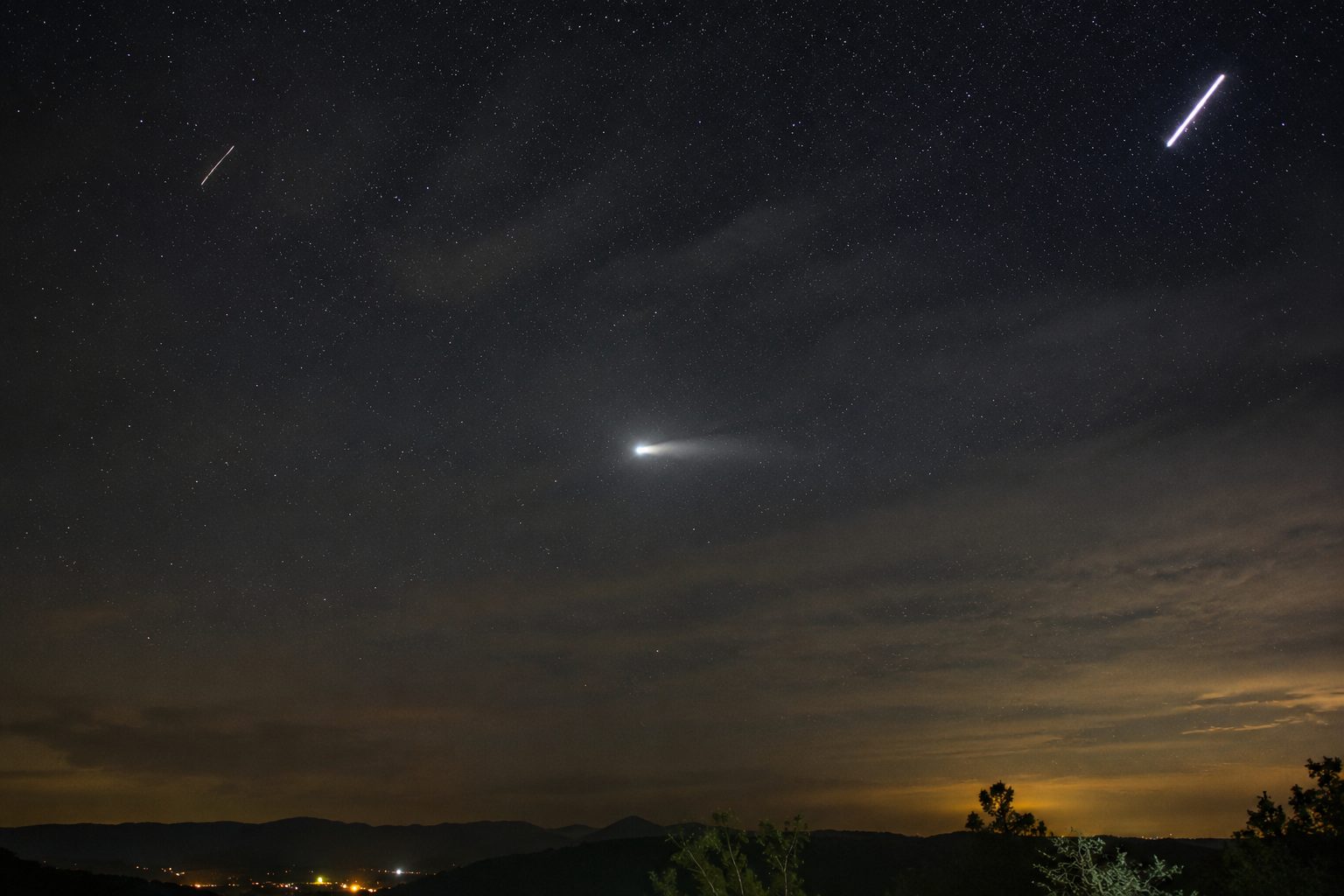

MAUNAKEA, Hawaii, May 6, 2026, 12:04 HST
- Observations from Subaru Telescope indicate 3I/ATLAS altered its chemistry following its nearest approach to the Sun.
- These results build on ALMA’s earlier findings—namely, that the comet’s water has an uncommonly high deuterium content, pointing to formation in a cold region.
- This marks just the third time astronomers have confirmed an interstellar object—following ‘Oumuamua and 2I/Borisov.
A group led by Yoshiharu Shinnaka at Kyoto Sangyo University spotted fresh evidence of chemical changes in 3I/ATLAS, the interstellar comet, after it swung close to the Sun—suggesting what’s under the surface doesn’t necessarily match what’s on top. The observations came from the Subaru Telescope on Maunakea, according to a Wednesday piece in Big Island Now.
That discovery carries weight: 3I/ATLAS is exiting the solar system, so researchers have only a brief observational stretch to gather clues about how extrasolar bodies take shape. The Subaru team’s findings, out in The Astronomical Journal on April 22, join a growing batch of reports zeroing in on the comet’s gases, ice, and dust after its pass.
NASA says 3I/ATLAS marks just the third time astronomers have spotted an interstellar visitor passing through the solar system’s vicinity. The object trails ‘Oumuamua—discovered in 2017—and 2I/Borisov. But unlike the rocky ‘Oumuamua, 3I/ATLAS fits the comet profile, sporting a coma, that hazy envelope of gas and dust around its icy core.
On Jan. 7, just after 3I/ATLAS swung through perihelion, Subaru’s team captured observations. Focusing on the coma’s light, they gauged how much carbon dioxide versus water was venting from the nucleus.
Subaru reported a lower carbon dioxide-to-water ratio than what earlier space-telescope data suggested. That points to solar heating possibly exposing new regions of the comet’s nucleus, causing gases from both its outer crust and deeper interior to vent.
Shinnaka pointed out that the research gives scientists a chance to “directly compare comets hailing from both inside and outside the Solar System,” something that doesn’t happen often since interstellar objects are rarely observed early enough for in-depth analysis. Subaru Telescope
On April 23, a second paper in Nature Astronomy added detail to the story. Researchers, analyzing ALMA data, pegged the water deuterium-to-hydrogen ratio in 3I/ATLAS above 6.6 × 10^-3—roughly 40 times the amount found in Earth’s oceans, and over 30 times what’s typical for comets in our solar system. Deuterated water, or HDO, simply has one hydrogen atom swapped out for its heavier isotope, deuterium.
Luis E. Salazar Manzano from the University of Michigan, who headed up the ALMA research, described the chemistry as “really sensitive to temperature,” and noted it tends to indicate regions colder than 30 Kelvin—roughly minus 406 Fahrenheit. That’s much colder than where most known solar-system comets originated. ALMA Observatory
Teresa Paneque-Carreño from the University of Michigan noted that ALMA stood out: “most instruments can’t point toward the Sun.” Its radio dishes managed to track the comet just days past perihelion, a stretch when most optical telescopes had trouble getting a clear view. National Radio Astronomy Observatory
But there are some important caveats. According to the Nature Astronomy team, this deuterium result is based on just one observing window, and ALMA itself didn’t actually pick up normal water above its detection limit during that session. Instead, the water output was estimated using models anchored partly on methanol line data. So the precise ratios may shift as researchers line up results from other dates and telescopes.
NASA reports that over a dozen of its science missions, among them TESS, MAVEN, Webb and SPHEREx, managed to capture observations of 3I/ATLAS; all that data is staying put in public archives. For ground-based teams like Subaru and ALMA, attention has already shifted. The focus: what worked on 3I/ATLAS could set the playbook for tracking the next object from beyond the solar system.