
WARSAW, August 17, 2026, 04:08 CEST
- A custom Nubia Z70 Ultra rig reported 99% stability across 20 graphics stress-test loops.
- The creator reported 20–30 frames per second in The Witcher 3 at 1080p Ultra.
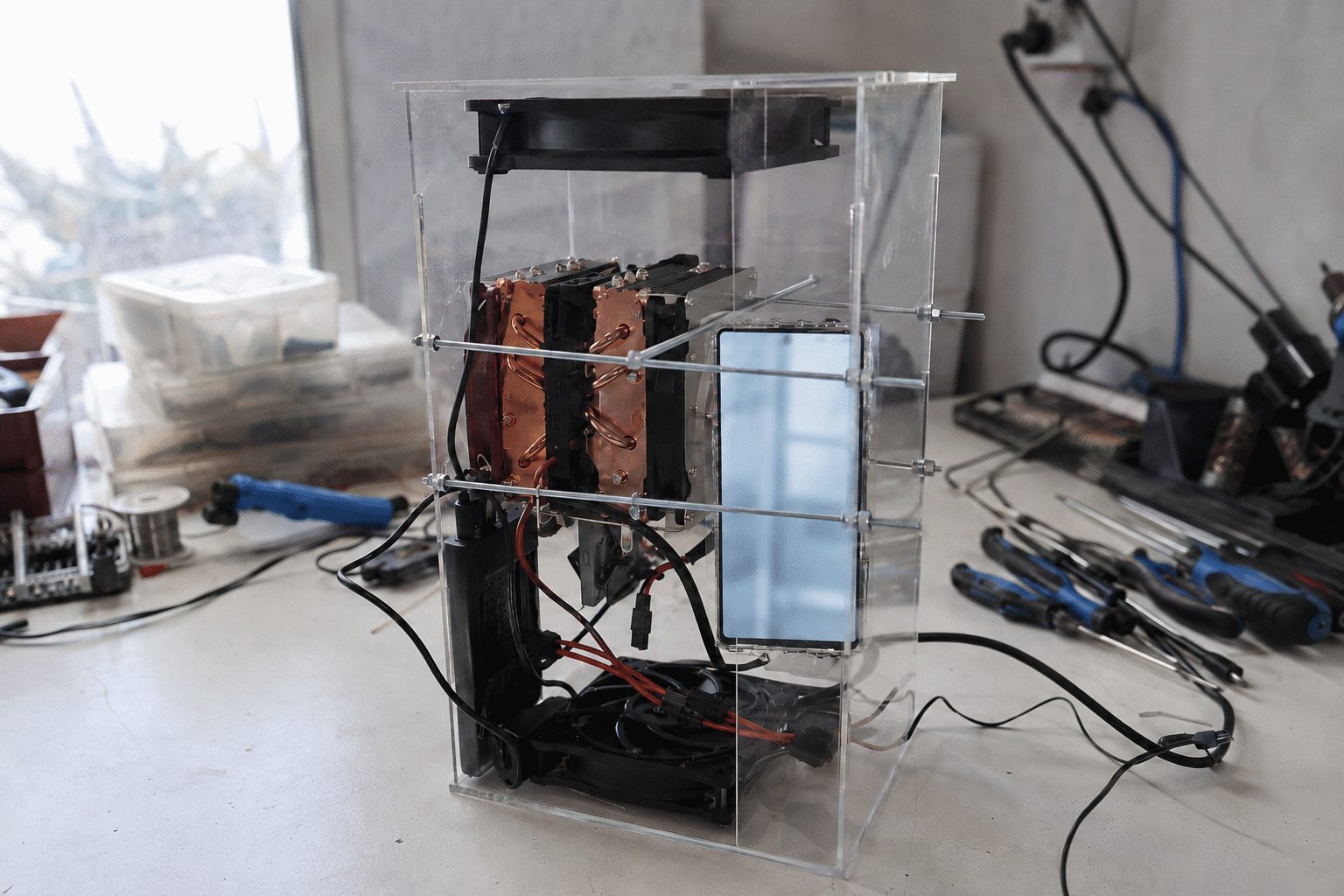
A hardware modder has converted ZTE’s (HKG:0763) Nubia Z70 Ultra into a desktop-style computer. Two full-size CPU coolers clamp the phone’s mainboard inside an acrylic case. The result highlights heat, not only silicon, as a limit on sustained phone performance.
The creator, who uses the name ntsow, reported 99% stability in a 20-loop graphics test. The best and worst loop scores differed by 70 points. That narrow spread matters more than a short peak score.
The experiment asks a blunt question. “How far can I push a smartphone if I stop treating it like a smartphone?” ntsow wrote. The answer required removing most qualities that make a phone portable.
| Feature | Retail Nubia Z70 Ultra | Custom desktop rig |
|---|---|---|
| Form | 164.3 × 77.1 × 8.6mm; 228g | Acrylic desktop enclosure; dimensions and weight not disclosed |
| Cooling | Factory phone cooling | Two full-size desktop CPU coolers |
| Display | Integrated 6.85-inch AMOLED | Original panel moved to the case front |
| Cameras and mobile hardware | Three rear cameras and dual-SIM connectivity | Camera and mobile-network hardware removed |
| Primary use | Handheld Android phone | Desktop Linux and local PC-game experiment |
The phone uses Qualcomm’s (NASDAQ:QCOM) Snapdragon 8 Elite. Its prime CPU cores run at up to 4.32GHz. Nubia sells configurations reaching 24GB of LPDDR5X memory and 1TB of UFS 4.0 storage.
| Creator-reported 3DMark result | Measurement |
|---|---|
| Wild Life Extreme stress-test loops | 20 |
| Best loop | 6,980 |
| Lowest loop | 6,910 |
| Best-to-lowest spread | 70 points |
| Reported stability | 99% |
| Separate ranking screenshot | 10,533 |
The cooler plates cover the main components directly. This gives the chip more thermal headroom than an 8.6mm handset body. Tom’s Hardware said the rig’s sustained performance was more notable than its ranking score.
The mod also ran The Witcher 3 through several software layers. The creator reported about 20–30 frames per second at 1920×1080 using the Ultra preset. Some scenes exceeded 30 frames per second.
| Gaming workload | Creator-reported setting or result |
|---|---|
| Game | The Witcher 3 |
| Resolution | 1920 × 1080 |
| Graphics preset | Ultra |
| Frame rate | Approximately 20–30 fps |
| GPU use | Approximately 99% |
| Best observed scenes | Slightly above 30 fps |
This is not Windows running natively. Android remains the host operating system. A Termux environment runs the XFCE4 Linux desktop, while compatibility tools translate Windows applications and games.
| Software layer | Role in the rig |
|---|---|
| Android | Host operating system |
| Termux plus XFCE4 | Linux desktop environment |
| Turnip and Vulkan | Hardware-accelerated graphics path |
| Wine, Box64 and Hangover | Windows and x86 application compatibility |
| GameNative | Additional local game-running path |
The project does not prove that a phone can replace a current gaming PC. Its 20–30 fps result is modest. The acrylic case, external peripherals and oversized coolers also remove portability.
It does show why sustained tests matter. Thin devices often deliver strong short benchmarks, then reduce clocks as heat builds. Larger cooling systems can preserve performance, but they impose size, noise and power costs.
Risks: The results come from one custom build and remain creator-reported. Power draw, component temperatures and frame-time consistency were not fully disclosed. Direct comparisons with retail phones or PCs would therefore be premature.