
WASHINGTON, Jan. 30, 2026, 12:16 p.m. EST
- Webb and Chandra detected a galaxy cluster forming roughly 1 billion years post-Big Bang, which is sooner than anticipated
- JADES-ID1, the system in question, seems to contain at least 66 candidate galaxies and holds roughly 20 trillion times the mass of the Sun
- Scientists say this discovery intensifies the challenge to standard models of how fast massive cosmic structures formed
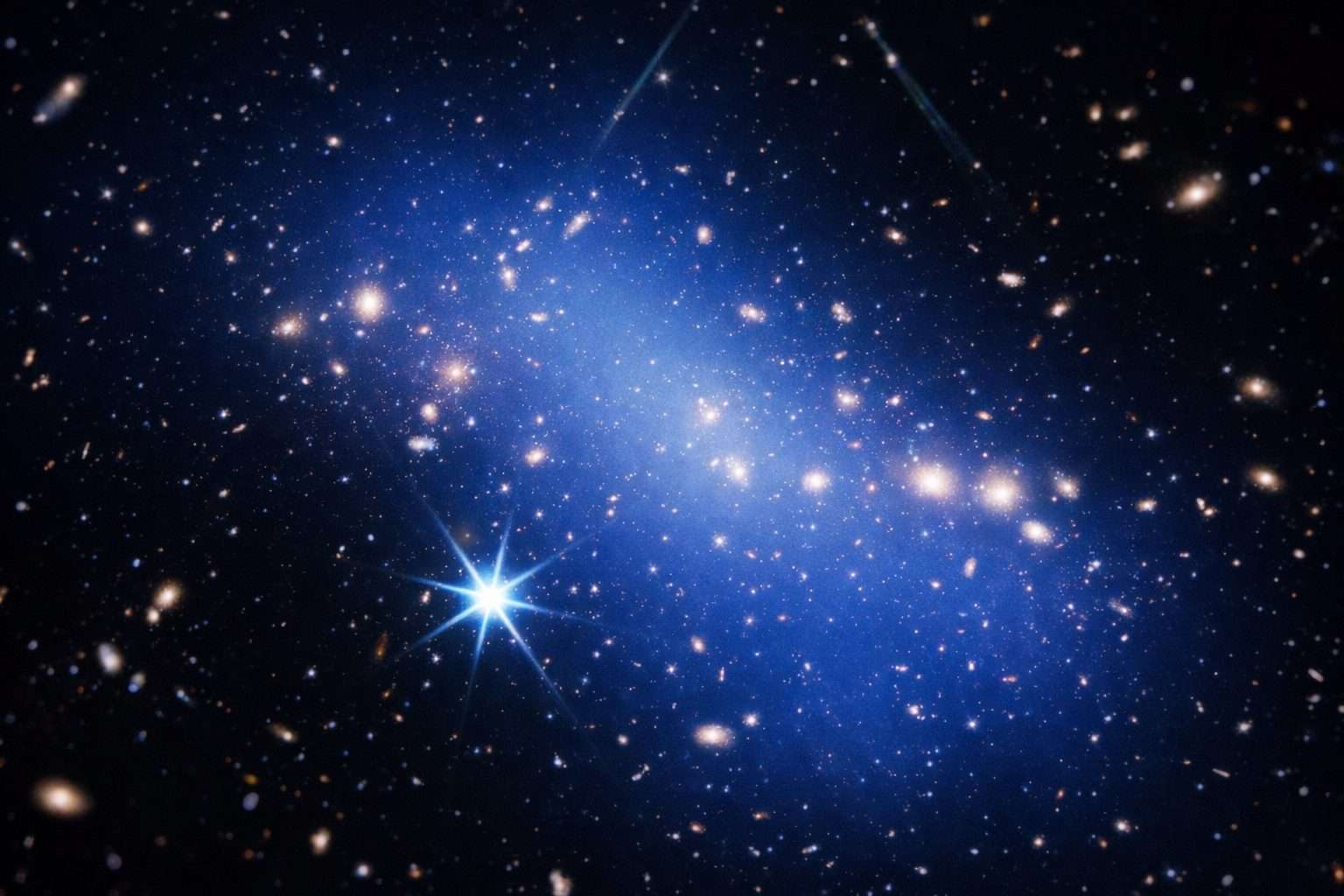
NASA’s James Webb Space Telescope and the Chandra X-ray Observatory have detected a forming galaxy cluster dating back to about a billion years after the Big Bang, researchers announced on Friday. Dubbed JADES-ID1, the system includes at least 66 candidate galaxies and an estimated mass around 20 trillion times that of the Sun, from a time when the universe was still very young. Reuters
The timing is crucial since galaxy clusters rank among the largest gravity-bound structures and serve as cosmic benchmarks for dark matter and dark energy—the mysterious force behind the universe’s speeding expansion. Spotting one this early, complete with a hot gas halo, might push astronomers to rethink when these massive structures first started coming together. Harvard
JADES-ID1 lies within a deep-sky survey area where Webb’s infrared data intersects with the Chandra Deep Field South, a rare zone earmarked for the most intense X-ray scrutiny. This overlap proved crucial, allowing scientists to verify the cluster’s X-ray emission instead of depending solely on galaxy tallies. NASA
The team identified the system at a redshift near 5.68 — a redshift gauges how much the universe has stretched since the light departed, with higher numbers indicating earlier epochs. Their paper in Nature estimates the total mass at roughly 1.8 × 10^13 solar masses and puts the system’s overall X-ray luminosity at about 1.5 × 10^44 ergs per second.
Webb identified JADES-ID1 as a dense cluster of extremely distant galaxies, and Chandra picked up diffuse X-rays emitted by hot gas in that spot. This gas, known as the intracluster medium—the superheated plasma between galaxies—is a critical sign that the protocluster is beginning to heat and coalesce. Si
“This may be the most distant confirmed protocluster ever seen,” said Ákos Bogdán from the Center for Astrophysics | Harvard & Smithsonian, who led the study. Co-author Gerrit Schellenberger likened the discovery to “watching an assembly line make a car.” Meanwhile, University of Manchester researcher Qiong Li noted the team anticipated finding such a system “two or three billion years after the big bang — not just one billion.” The University of Manchester
Researchers had previously identified the earliest similar structure with X-ray emission as forming about three billion years after the Big Bang. According to most models, there simply isn’t enough time for a cluster-scale halo to accumulate that much mass and heat gas to X-ray temperatures so early on.
This finding joins a string of early-universe mysteries uncovered by Webb, like unusually bright primordial galaxies and supermassive black holes that existed just a few hundred million years post-Big Bang. According to the Reuters report, researchers believe these hints suggest structures formed faster than anticipated in certain pockets of the infant cosmos.
The researchers noted that Webb data revealed other protocluster candidates in the same survey area, but only JADES-ID1 features galaxies surrounded by a hot gas cloud bright enough to be detected in X-rays. This likely explains why it emerged first—this field pairs Webb’s depth with an exceptionally deep Chandra exposure.
But there’s a major caveat: this is just one object, detected right at the edge of what current deep-field data can reveal. The authors note the system probably isn’t fully settled into a mature cluster yet. They’ll need more examples to determine if JADES-ID1 is an unusual outlier or if it points to a gap in our understanding of early growth.
Researchers are set to search for similar systems in other areas where deep infrared surveys coincide with long-exposure X-ray data. Gathering a bigger sample could help astronomers determine if early cluster formation is truly widespread or just a rare event in particularly dense regions of the early universe.
Over billions of years, the team expects JADES-ID1 to grow into a massive galaxy cluster similar to those found much nearer to Earth today. For now, it offers a snapshot — hot gas, densely packed galaxies, and a universe that seems to have kicked off large-scale structure formation earlier than expected.