
New York, June 1, 2026, 15:05 EDT
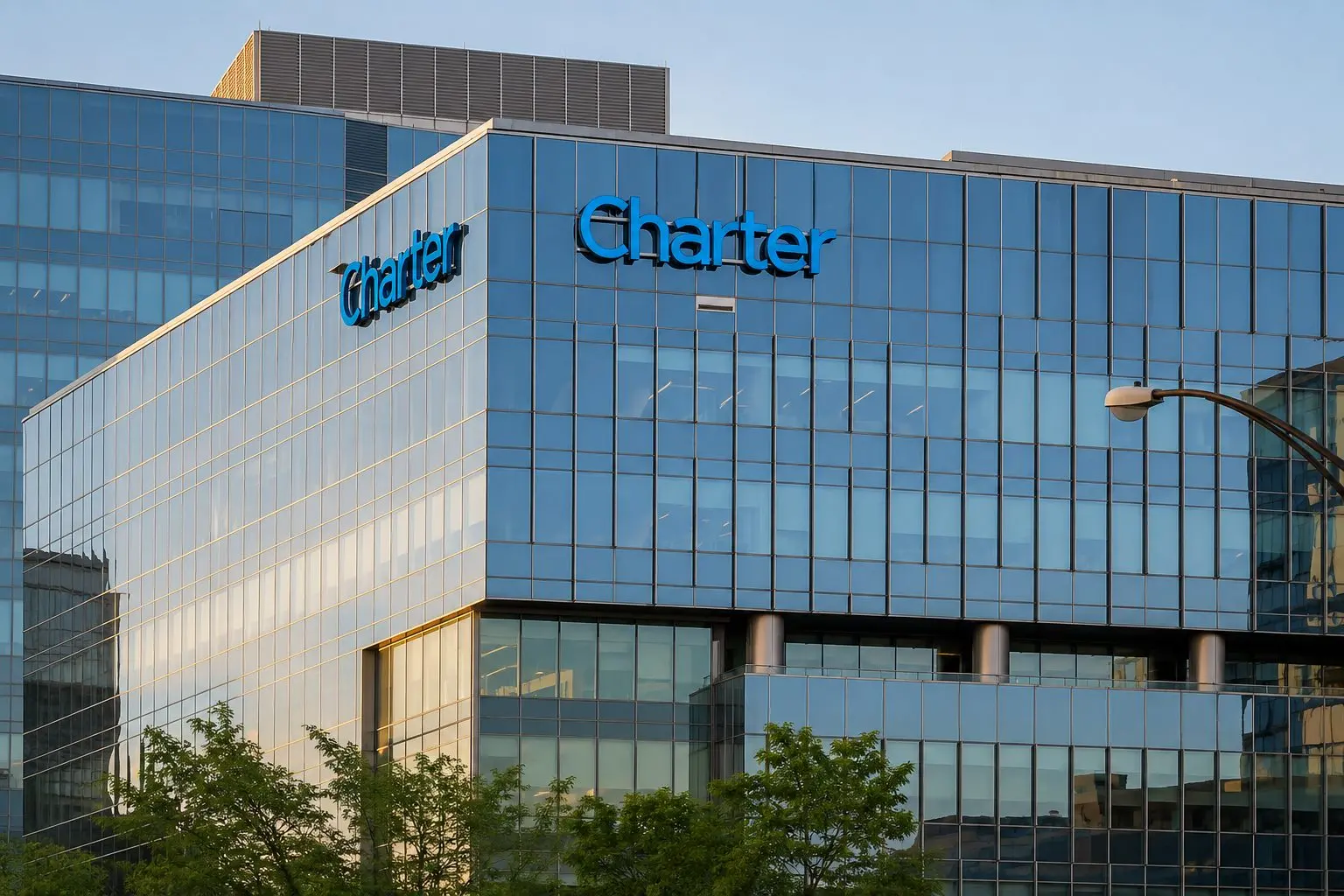
Charter Communications shares lost ground Monday, going against a stronger Wall Street session. Investors stayed cautious on the Spectrum parent after its big selloff earlier this spring on broadband subscriber losses.
The stock slipped 0.6% to $143.24 by the afternoon, opening at $143.40 and moving between $141.18 and $145.92. Comcast, seen as its top listed cable rival, added 0.6% to $25.03.
The move stood out since the broader market was higher. Reuters said the S&P 500 rose 0.43% and the Nasdaq Composite added 0.69% on Monday. Tech gains had both headed for new record closes.
Charter finished Friday at $144.05, off 2.18% for the session. Investor-relations numbers showed Charter shares changed little in the short week, ending at $144.00 on May 26. The stock is still trading well under its 52-week high of $422.29.
Spectrum Internet lost 120,000 customers in the first quarter, Charter reported. Revenue slipped 1.0% to $13.6 billion. Adjusted EBITDA was down 2.2%. Free cash flow also dropped, hitting $1.4 billion. CEO Chris Winfrey said Charter is still confident it can “win in the marketplace,” mentioning pricing, network upgrades, and service improvements. Charter Communications
Charter’s broadband losses last quarter came in heavier than the 100,036 drop expected by analysts, Reuters said in April, citing Visible Alpha. Wireless carriers pushing fixed-wireless home internet — broadband through mobile networks — are raising the heat on cable players, the report added.
ARPU, or average revenue per user, is under the spotlight now. New Street Research’s Vikash Harlalka said “results alone cannot explain” how shares traded after earnings, Light Reading reported. Investors got spooked over cable’s “long-term pricing power” after Charter dropped its plan to boost broadband ARPU this year, Harlalka added. Light Reading
Video subscriber losses slowed at Charter. MoffettNathanson’s Craig Moffett told Light Reading Charter’s bundling play was “showing up in the numbers.” Charter dropped 60,000 video subs in Q1, down from 181,000 lost last year in the same quarter. Moffett said the video segment was “rolling back the clock.” Light Reading
Investors have merger numbers to go over too. The U.S. Federal Communications Commission signed off on Charter’s $34.5 billion deal to buy Cox Communications in February. Reuters said the combination would make it the biggest U.S. cable TV and broadband company with about 38 million subscribers, topping Comcast. The two expect to save $500 million in costs within three years, if the deal closes as planned by mid-2026.
But the risk hasn’t gone away: if fiber and fixed-wireless players keep pulling broadband customers from Charter, or if Charter needs to cut prices more to hold onto them, Cox won’t be enough to ease cash-flow worries that have hurt the shares. Investors will watch the second-quarter subscriber numbers to see if losses slow down.
Charter is trading on broadband moves first. There’s a buyback, the Cox deal coming, and analysts point to a video bundle as a plus, but the market still wants proof.