
SEOUL, July 8, 2026, 22:01 KST
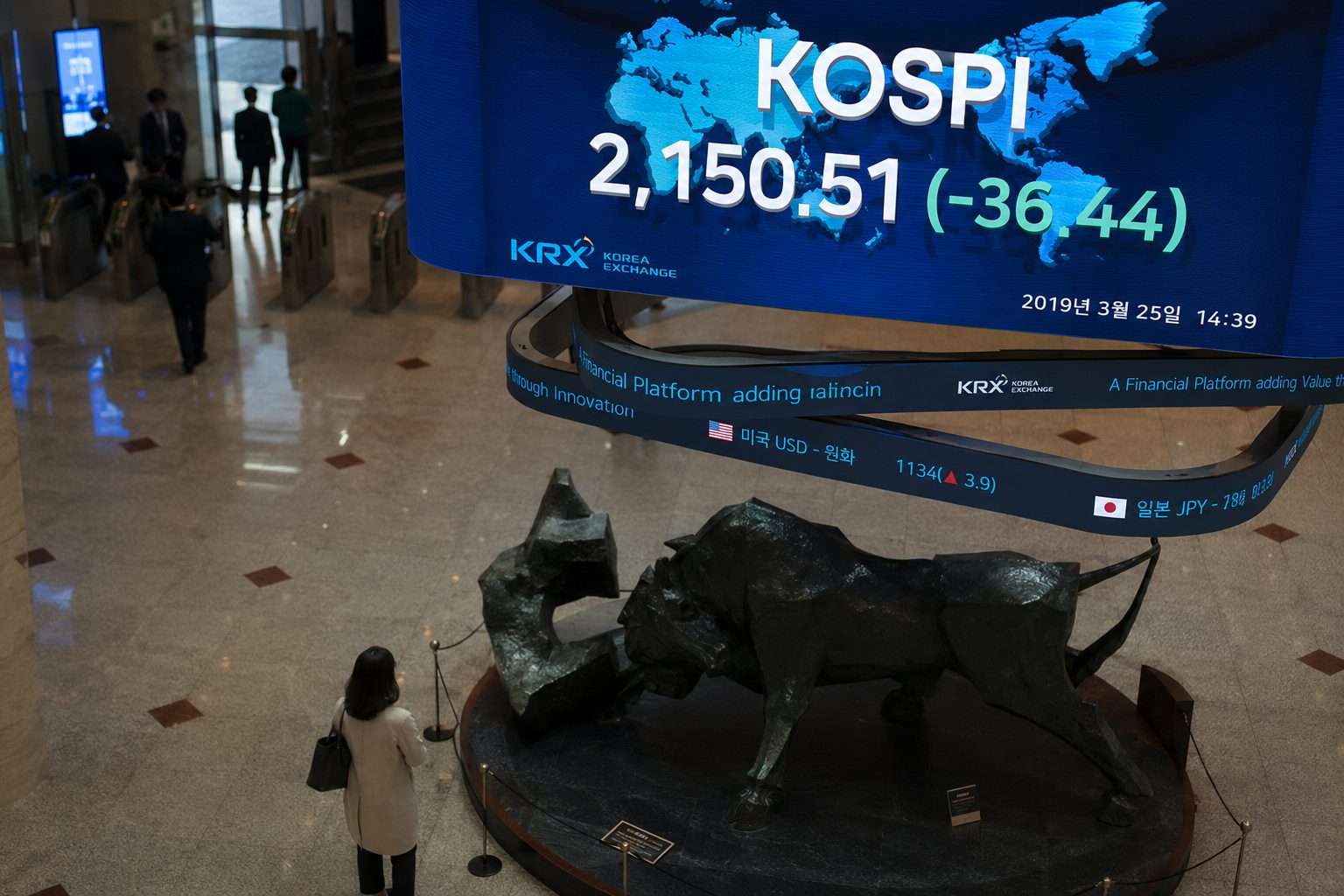
- KOSPI dropped 5.35% to finish at 7,246.79, which puts it 20.5% under its June 22 record close.
- Samsung Electronics KRX:005930 slid 6.3%, while SK Hynix KRX:000660 dropped 5.7%.
- The won firmed to 1,498.5 against the dollar, with SK Hynix ADR-linked dollar selling showing up in the FX market.
- Regulators are reviewing single-stock leveraged ETFs that track chipmaker names.
South Korean shares tumbled into a bear market on Wednesday, but the won moved up, leaving foreign funds with a murkier picture. By 22:01 KST, both regular and after-hours stock sessions were closed on Korea Exchange. The KRX holds regular equity trading from 0900-1530 and after-hours trade from 1540-1800.
KOSPI dropped 409.52 points, or 5.35%, to end at 7,246.79, its weakest finish since May 20. The index has now fallen 20.5% from its June 22 record close of 9,114.55, falling past the 20% threshold that signals a bear market.
| Gauge | Wednesday | Prior stress point | Investor read |
|---|---|---|---|
| KOSPI | 7,246.79, off 5.35% | 7,656.31, down 4.9% Tuesday | Two-day slide of about 10.0% from Monday close |
| Peak-to-close drawdown | -20.5% | -16.0% after Tuesday | Hit bear-market level |
| Samsung Electronics KRX:005930 | -6.3% | -6.9% Tuesday | Stock fell despite higher profits |
| SK Hynix Inc KRX:000660 | -5.7% | -6.1% Tuesday | ADR strength failed to boost Seoul |
The turmoil wasn’t limited to prices. The KOSPI slid up to 8.2% on Tuesday, tripping a circuit breaker. Wednesday, the index dropped as much as 6.1%, which set off a sidecar curb that paused algorithmic trades. KRX rules say a first-stage circuit breaker comes in when KOSPI or KOSDAQ falls 8% or more for at least a minute. A KOSPI sidecar hits with a 5% move in KOSPI200 futures held for one minute.
The latest slide is putting pressure on the foundation of this year’s Korea rally. Retail buyers had driven the KOSPI up 82% for the year before shares started falling. Samsung was up over 130% and SK Hynix more than 220%, Reuters said Tuesday.
| Flow or leverage signal | Latest figure | Why it matters |
|---|---|---|
| Foreign buying Wednesday | 335.9 billion won | First net inflow after 13 sessions of outflows |
| Foreign selling Tuesday | 2.9 trillion won | Onshore investors saw offshore funds leaving fast |
| Retail buying Tuesday | 3.2 trillion won | Locals buying the dip helped steady prices late |
| Retail borrowed investment | 29.7 trillion won | Just shy of the late-June high at 29.8 trillion won |
Chip stocks led declines again. Samsung and SK Hynix gave up early gains. Wall Street offered little support for Seoul in the last session, with Intel Corp NASDAQ:INTC, Micron Technology Inc NASDAQ:MU, and Advanced Micro Devices Inc NASDAQ:AMD dropping 9.7%, 4.7%, and 6.5%. The Philadelphia Semiconductor Index ended down 4.7%.
Han Ji-young at Kiwoom Securities pointed to “a slowdown in memory price growth” and questions around an earnings “peak-out.” Park Yuak, also with Kiwoom, dropped his Samsung target by about 9% to 390,000 won. He said customers for PCs and smartphones were holding back on extra memory due to higher component costs. Reuters
Regulators stepped in as chip stocks moved into leveraged trades. South Korea’s finance ministry pointed to increased volatility driven by profit-taking, portfolio shifts, and changes in global AI sector views. The Financial Supervisory Service said it plans to watch single-stock leveraged ETFs tied to chipmakers. The Bank of Korea flagged that such products can fuel one-way trading.
The won gained 1.2% to 1,498.5 per dollar in FX trading, the highest since May 29. Dealers pointed to dollar sales linked to SK Hynix’s U.S. share sale after that action showed up in the dollar-won forwards. “There is forward selling related to SK Hynix American depository receipts,” a source told Reuters. Brent Donnelly at Spectra Markets described it as a “dollar-selling, won-buying event.” Reuters
Here’s the split for investors: equity holders are taking down chip exposure, but the ADR sale could still bring fresh dollars into Korea. SK Hynix will wrap up bookbuilding for its $28 billion ADR deal on Wednesday U.S. time, after the books were covered several times, a source told Reuters. U.S. investors came in with orders that began near $200 million, with some big orders topping $1 billion.
SK Hynix supplies high-bandwidth memory chips for AI systems used by Nvidia Corp NASDAQ:NVDA and Alphabet Inc’s Google NASDAQ:GOOGL. The company said it plans to use the ADR sale proceeds for new chip factories in South Korea and to buy new equipment, including an extreme ultraviolet scanner from ASML Holding NV AMS:ASML.
Some investors aren’t calling the drop the end of demand. Di Zhou at Thornburg Investment Management called it a “memory super cycle.” Dave Mazza, CEO at Roundhill Investments, said the new ADR listing takes away an “accessibility discount.” Sundeep Gantori at Standard Chartered thinks memory is in the “mid-cycle stage.” The pricing for the ADR sale is expected after Thursday’s close in Korea, and Nasdaq trading is scheduled for July 10. Reuters
Related articles: KRX:005930