WASHINGTON, March 28, 2026, 14:05 EDT
On March 27, ScienceAlert updated its November 2025 piece about the black fungus found at Chernobyl, prompting 19FortyFive and Brazil’s Click Oil and Gas to weigh in with stories that leaned into military and space themes. The core science—Cladosporium sphaerospermum does exist and draws attention for its strange properties. Still, the central idea that’s been making the rounds hasn’t been nailed down: so far, nobody’s demonstrated a clear mechanism for the fungus to convert ionizing radiation into usable energy. 1
The revival comes as actual defense and space initiatives gather momentum. DARPA is pushing space-manufacturing projects toward a 2026 launch, and a 2020 Defense Threat Reduction Agency study looked at coaching black fungi to detect radiation. Current coverage mostly weaves these efforts together with past Chernobyl biology. 2
The Chernobyl discovery isn’t new. Back in 2000, a team led by Ukrainian scientist Nelli Zhdanova published findings from 1997-98 samples taken inside the reactor’s damaged shelter: they identified 37 different fungal species across 19 genera, noting that melanin-rich types dominated in the most radioactive zones. 3
Ionizing radiation — that’s the kind powerful enough to strip electrons from atoms — became a focal point in 2007. Ekaterina Dadachova and her team found that exposure alters melanin’s electronic properties, and, in their study, melanized fungi actually thrived under high radiation. C. sphaerospermum also posted stronger growth when nutrients were scarce. 4
The research laid the groundwork for what’s now often dubbed radiosynthesis—basically, the theory that melanin lets fungi harness radiation a bit like how plants tap into sunlight. Yet, Nils Averesch and his team, following a 2022 ISS study, cut right to it: “Actual radiosynthesis, however, remains to be shown.” 5
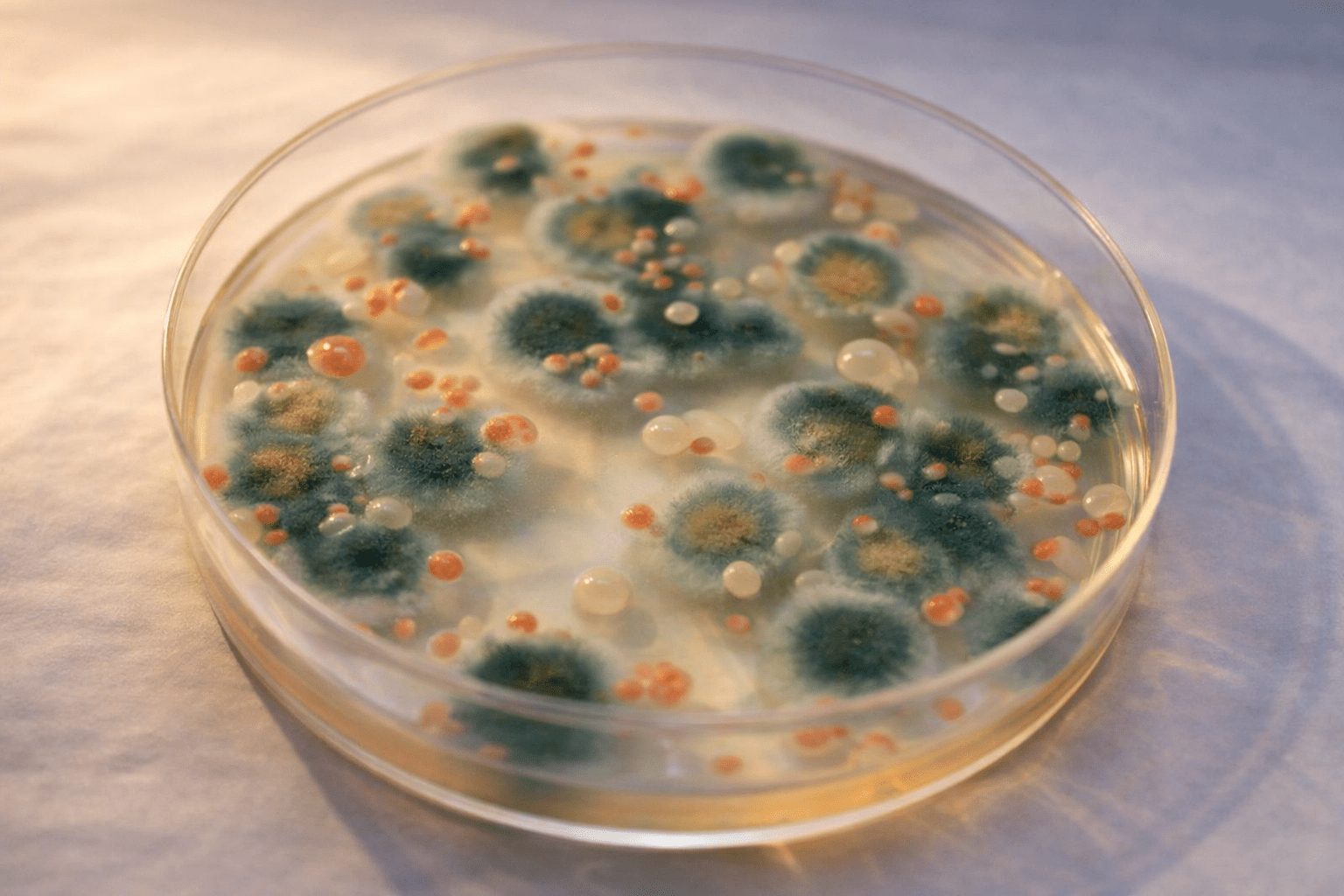
The ISS study keeps popping back up. In their findings, researchers reported that C. sphaerospermum could actually be grown in orbit. The fungus outperformed its earthbound controls and registered lower radiation readings beneath the living biomass compared to the control patch in the Petri dish. That points to some radiation-dampening effect in space. 6
The DARPA connection exists, though it’s not as tight as those fresh headlines make it sound. Back in February 2025, DARPA outlined a pivot for its NOM4D program—two separate orbital demos focusing on materials and assembly. The first payload is headed for SpaceX’s Transporter-16, shooting for launch on March 30, while a second is now slated for the ISS via Northrop Grumman’s NG-24, no earlier than April 8. “First step toward scaling up” to bigger structures, is how program manager Andrew Detor put it. 2
Back in February 2025, DARPA put out a call for proposals on “Large Bio-Mechanical Space Structures”—we’re talking space elevators, debris-grabbing grids, and other orbit-built systems using biological manufacturing. That’s the angle 19FortyFive wove into their Chernobyl fungus coverage this week. 7
The Pentagon’s detection claim needs some clarification. The 2020 University of Saskatchewan research 19FortyFive referenced wasn’t a new look at C. sphaerospermum; instead, it focused on radio-adapted black fungi—specifically, Wangiella dermatitidis. That project, funded by the Defense Threat Reduction Agency, aimed to develop “cost-effective and highly sensitive biological detectors of nuclear fallout,” Dadachova said at the time. 8
The difference isn’t trivial: dark fungi aren’t a monolith, and even C. sphaerospermum brings its own wrinkles, with the space paper cautioning against oversimplifying the results. The authors note they couldn’t isolate radiation’s impact from the effects of microgravity, and they draw lines between growth toward radiation, surviving it, and actually capturing energy from it—separate issues, not to be lumped together. 6
Bottom line: reports confirm the fungus can withstand radiation, sometimes even thriving in its presence, and there’s some evidence it can block limited amounts. But so far, there’s nothing in the research showing it actually feeds on radiation or supports the more sweeping claims making the rounds lately. 4