
WASHINGTON, March 11, 2026, 10:06 EDT
- According to CBS News, the U.S. Space Force now expects re-entry at 12:03 a.m. ET Wednesday—pushing back NASA’s previous projection, which pegged it at 7:45 p.m. Tuesday.
- NASA expects nearly all of the 1,323-pound craft to disintegrate during reentry, estimating the odds of it causing harm to anyone on Earth at roughly 1 in 4,200.
- Stronger solar activity ramped up atmospheric drag, causing the probe to drop years ahead of schedule.
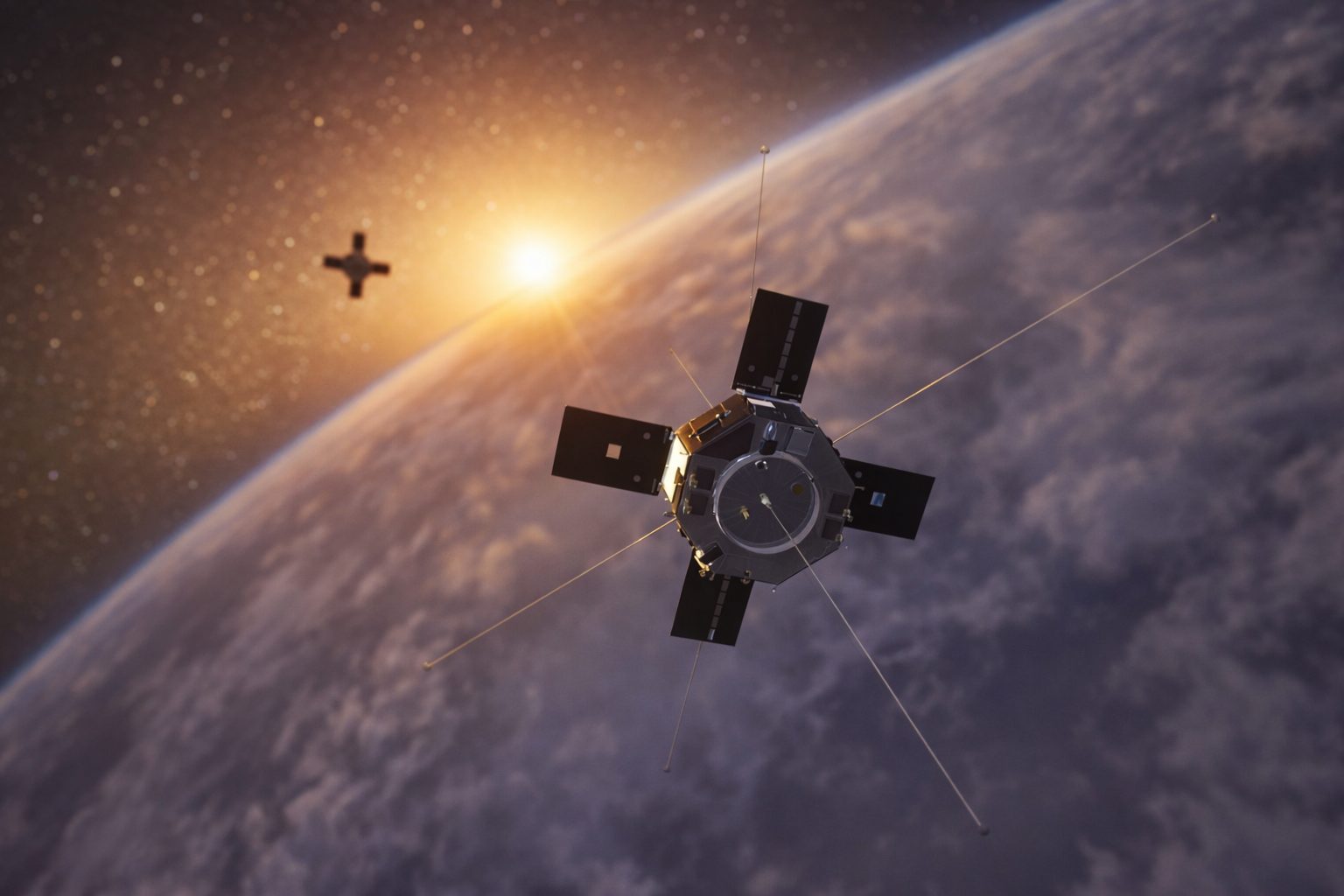
NASA’s most recent tracking for the retired Van Allen Probe A indicated re-entry wouldn’t happen until after midnight U.S. Eastern time on Wednesday, throwing last-minute uncertainty over when the spacecraft might finally come down. Most of the 1,323-pound probe is expected to incinerate in the atmosphere, according to NASA, but there’s a chance some parts could make it through.
The re-entry window has drifted from NASA’s original Tuesday night estimate, and it’s still broad—a reminder of the challenges tracking the descent of an old satellite during an active solar cycle. This wraps up a mission whose data is still in use, helping researchers analyze space weather—NASA’s catchall for solar phenomena that affect satellites, astronauts, communications, navigation, and even Earth’s power grids.
Late Tuesday, CBS News cited a new U.S. Space Force estimate, moving the most probable re-entry time to 12:03 a.m. Eastern on Wednesday. Previously, NASA’s official update—originally posted March 9, then revised March 10—gave a window around 7:45 p.m. Eastern on Tuesday, with an uncertainty range of 24 hours in either direction.
Probe A and its twin, Probe B, lifted off together on Aug. 30, 2012, kicking off what was supposed to be a two-year run. Both spacecraft navigated the Van Allen belts—those bands of charged particles caught in Earth’s magnetic field—collecting data on how particles move in and out of the area.
NASA describes this as the first mission designed for multi-year operations within the belts—a zone usually avoided, since the radiation is hazardous to both equipment and crew. The probes, managed by Johns Hopkins University Applied Physics Laboratory, also delivered a first: data revealing that a third, temporary radiation belt can appear when solar activity spikes.
The mission wrapped up in 2019. At the time, project scientist Sasha Ukhorskiy said the probes had “rewritten the textbook on radiation belt physics.” In that same NASA summary, David Sibeck, serving as mission scientist, mentioned the data had already led to upwards of 600 peer-reviewed papers and more than 55 Ph.D. theses. NASA
Timing continues to elude forecasters. Jonathan McDowell, an astrophysicist who specializes in satellite tracking, spoke with Scientific American on Tuesday, saying the re-entry window is “still very uncertain.” That uncertainty, he said, highlights just how volatile drag calculations can get for objects traveling in a highly elliptical orbit. Scientific American
The chief risk is clear enough: only the most durable fragments endure, and those could end up crashing onto land instead of ocean. NASA, speaking to Scientific American, confirmed there’s no specific target for any surviving debris. Still, analysts point to water making up about 70% of the planet, stacking probabilities in favor of an ocean landing.
Probe A is heading for reentry much sooner than NASA engineers had in mind, as the solar cycle turned out hotter than anyone predicted. When scientists identified solar maximum for 2024, it meant more intense space weather—enough to puff up the upper atmosphere and add drag to the old spacecraft. That extra resistance dragged Probe A lower, beating earlier models’ estimates.
Uncontrolled re-entries aren’t unusual; what stands out this time is the particular spacecraft involved. Only one person on record—a woman in Oklahoma back in 1997—has ever been hit by falling manmade space debris, according to The Guardian. She walked away unharmed.
NASA doesn’t anticipate Probe B’s return before 2030. As for Probe A, the agency says the danger to the public is likely minimal, but its demise underscores a point: while tracking helps trim down the re-entry timeframe, it can’t eliminate the unpredictability.