WASHINGTON, Jan 26, 2026, 12:14 (EST)
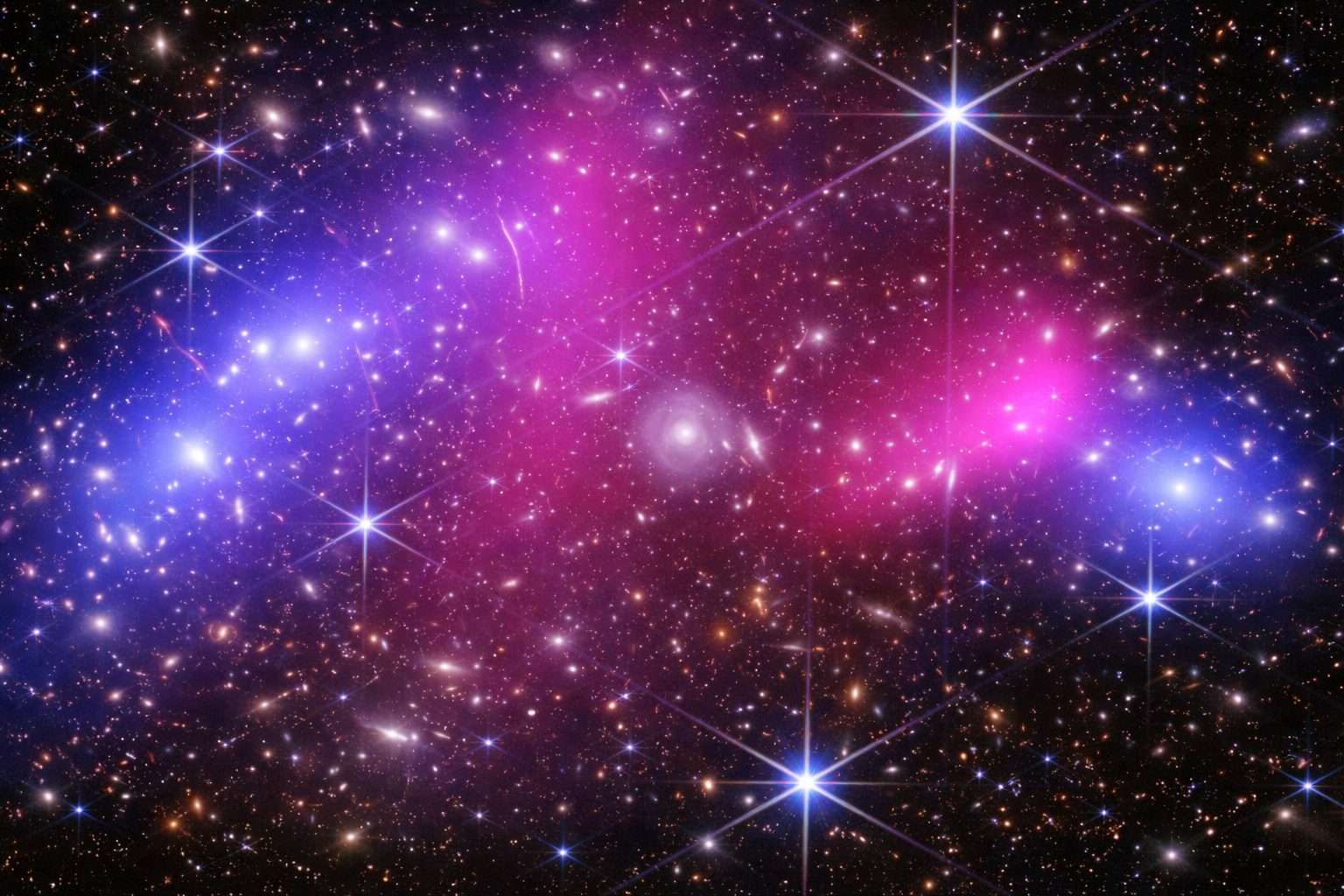
- Using NASA’s James Webb Space Telescope, scientists have created a high-resolution dark matter map of the COSMOS field
- The map uses weak gravitational lensing, detecting subtle shape changes in distant galaxies to reveal unseen mass
- Researchers say it tightens constraints on galaxy formation models and establishes a standard for upcoming larger surveys
Astronomers using NASA’s James Webb Space Telescope have created the most detailed map yet of dark matter in the COSMOS field, tracing the invisible substance that makes up roughly 85% of the universe’s matter. The data aligns with the leading Lambda-CDM model — which stands for dark energy (Lambda) and cold dark matter. Diana Scognamiglio described Webb as “a new pair of glasses for the universe,” while co-author Jacqueline McCleary called dark matter halos the “nurseries of galaxies.” 1
The improved map is crucial because researchers rely on it to study galaxy growth and the way matter clusters across cosmic time—key to understanding everything from galaxy clusters to the Milky Way. Scognamiglio noted that the Webb-based map is “twice as sharp” as previous dark matter maps, allowing scientists to observe the universe’s “invisible scaffolding” in greater detail. 2
Since dark matter neither emits nor absorbs light, researchers track it by observing gravity’s effects—specifically, how it warps light from distant galaxies in a process called gravitational lensing. Scognamiglio noted this fresh perspective allows scientists to “see everything more clearly.” Harvard-Smithsonian astrophysicist Rutuparna Das, who wasn’t part of the study, told AP, “Our home is the universe.” 3
The map spans an area roughly 2.5 times the size of the full Moon, located in the Sextans constellation—a patch monitored for years by the Cosmic Evolution Survey, or COSMOS. Webb clocked about 255 hours on this field, cataloging close to 800,000 galaxies. Researchers then tapped into the weak-lensing effect—subtle, consistent distortions in galaxy shapes—to pinpoint the distribution of dark matter. 4
McCleary explained that Webb’s camera enables the team to study distant galaxies, which appear tiny and grainy, and “map those shapes very carefully.” She called the output “a snapshot” of the universe when it was roughly half as old as it is today. 5
Previously, researchers used Hubble Space Telescope images of the COSMOS field, but now they’re layering Webb’s deeper shots over those to confirm past findings and uncover fresh structures. “This is stunning,” said Scognamiglio. National Geographic pointed out that Webb’s results arrive just as NASA’s Roman Space Telescope and Europe’s Euclid telescope prepare to expand dark-matter mapping across far larger regions. 6
NASA estimates the universe is about 5% ordinary matter, roughly 27% dark matter, and around 68% dark energy—a mysterious force linked to the accelerating expansion of the cosmos. This breakdown is precisely why cosmologists focus on mapping dark matter’s distribution, not just spotting its presence. 7
A report led by Durham University explained the Webb map reveals how dark matter’s gravity drew ordinary matter into the universe’s first structures—dense clumps connected by filaments that astronomers call the cosmic web. Richard Massey remarked, “They grew up together,” highlighting how dark matter and normal matter evolved together in the same regions. 8
NASA labels the force behind the universe’s speeding expansion simply as “dark energy.” If upcoming maps reveal that dark matter’s clustering doesn’t fit the predicted patterns, it might either clarify or disrupt current theories about dark energy’s role through cosmic time. 9
But the latest image remains an indirect glimpse: scientists detect dark matter through its gravitational effects, relying on tiny weak-lensing distortions that require precise measurements of galaxy shapes and distances. NASA points out that “no one knows exactly” what dark matter is, so while the map narrows the search, it stops short of identifying the target. 10
NASA describes the Roman Space Telescope as designed for speed and scale — snapping 300-megapixel images and scanning the sky much faster than Hubble, all while maintaining comparable resolution. Webb, on the other hand, focuses narrowly but deeply, providing detailed views that help anchor lensing maps and enable astronomers to study the rarest, faintest objects these wide surveys reveal. 11
NASA’s timeline notes Webb took off on Dec. 25, 2021, capping decades of preparation and testing — that kind of extended groundwork often leads to breakthroughs, like this week’s dark matter map. 12