CAMBRIDGE, Mass., Jan 16, 2026, 05:23 (EST)
- A recent research note predicts that 3I/ATLAS will align unusually closely with the Earth-Sun axis on January 22
- Another analysis estimates the comet’s rotation period after perihelion to be roughly 7.1 hours
- NASA has confirmed that the interstellar comet is not a threat to Earth
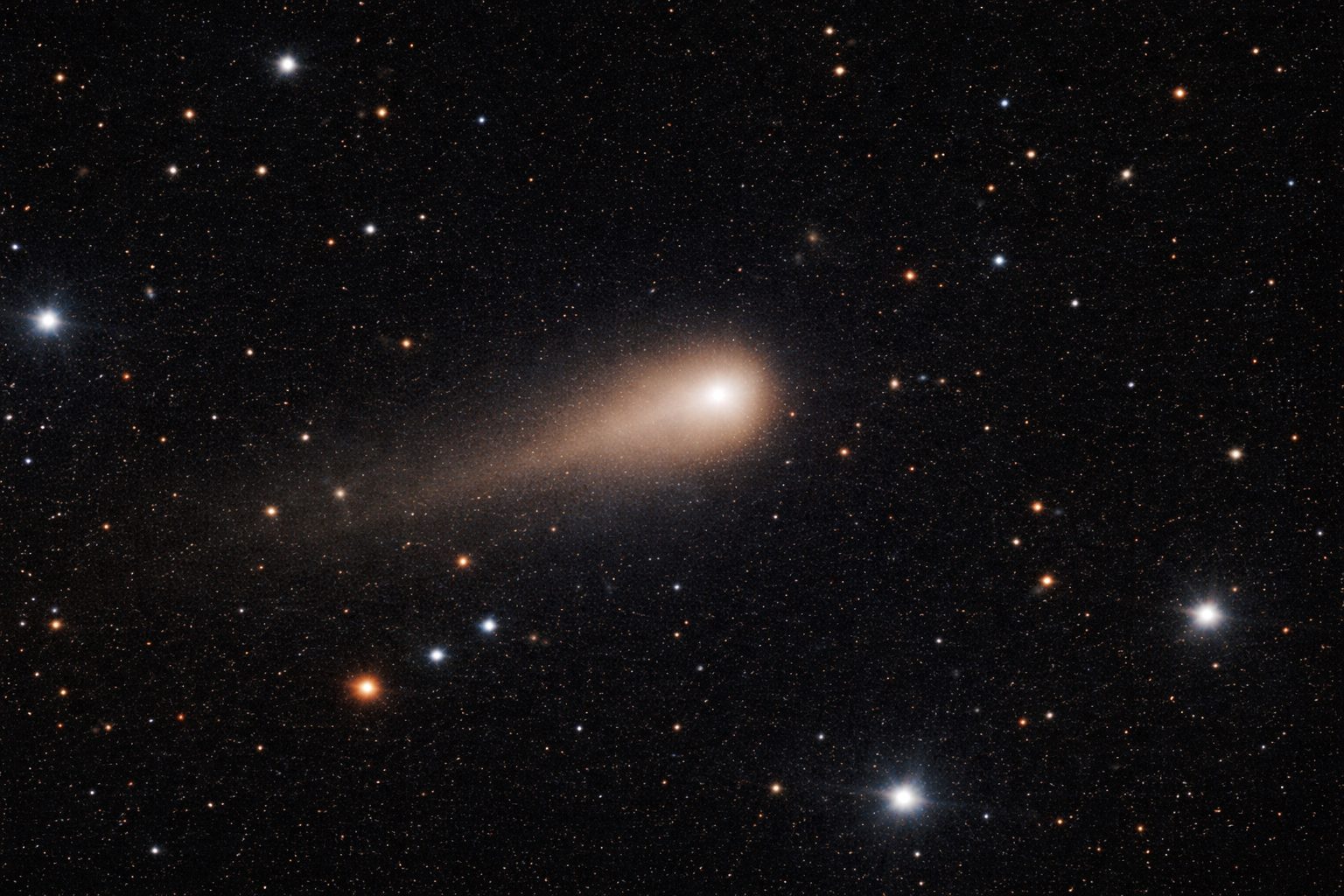
Astronomers report that on Jan. 22, interstellar comet 3I/ATLAS will align closely with the Sun and Earth, creating a rare viewing angle. This positioning offers a brief opportunity for scientists to study the dust the comet releases.
The timing is crucial since the geometry can boost faint light-scattering effects that are difficult to detect from other angles, and because 3I/ATLAS is already moving away and fading. The plan is to exploit this alignment to extract key dust properties — its reflectivity and how densely it’s packed — using ground-based observations.
Another fresh analysis, published independently, puts the comet’s rotation period at about seven hours. This finding might assist observers in distinguishing changes due to the comet’s spin from those resulting from variations in the viewing angle.
Harvard astronomer Abraham Loeb and co-author Mauro Barbieri noted online that 3I/ATLAS will reach a near-opposition alignment—where Earth nearly sits directly between the Sun and the object—around 13:00 UTC on Jan. 22. The phase angle, which gauges that alignment, will dip to about 0.69 degrees and remain under 2 degrees for roughly a week, they explained. Loeb described it as “a narrow but well-defined observational window,” although the object is expected to be faint, hovering near magnitude 16.7. 1
Loeb also shared findings from a separate paper he co-wrote with Italian observer Toni Scarmato, which determined the comet’s rotation period after perihelion to be roughly 7.1 hours. They based this on shifts in jet orientation and brightness. “The combined data supports a post-perihelion rotation period of about 7.1 hours,” Loeb stated. 2
NASA identifies 3I/ATLAS as only the third object confirmed to originate from beyond our solar system, following 1I/‘Oumuamua in 2017 and 2I/Borisov in 2019. According to the agency, the comet poses no danger to Earth, passing no closer than about 1.8 astronomical units — around 170 million miles (270 million km) — as it speeds away on a hyperbolic trajectory. 3
Scientists are drawn to interstellar comets because they contain material created around other stars. Dust grains, especially, offer insights into chemistry and planetary formation across various cosmic settings.
The Jan. 22 geometry might prove useful since objects close to opposition often exhibit an “opposition surge”—a sharp increase in brightness when the Sun sits nearly directly behind the observer. Plus, polarimetry, which gauges the alignment of light waves, can reveal details about grain size and structure. Typically, these signals get mixed up with shifting activity and varying viewing angles.
But there are challenges with the window. The object is faint, the surge itself subtle, and bad weather or spotty coverage can wreck time-series measurements. In their draft paper, Scarmato and Loeb highlight that “future dense and contemporaneous monitoring is required to reduce systematic uncertainties,” pointing out the risk of aliasing — false periods arising from data gaps.
Observers need to track shifts in brightness and polarization near the alignment, then contrast those with the comet’s behavior on nearby nights when the phase angle grows larger. This approach is the only straightforward way to distinguish the geometry-driven spike from typical fluctuations in comet activity.
If the measurements hold up, they’d provide another solid data point for a type of object astronomers have only recently begun to detect — and only fleetingly, before these objects vanish back into the darkness.