WASHINGTON, Jan 20, 2026, 09:52 EST
- NOAA said severe (G4) geomagnetic storm levels were reached again early Tuesday after a coronal mass ejection swept past Earth.
- A severe (S4) solar radiation storm was also in progress, NOAA said, flagging added risk for polar flights, satellites and astronauts.
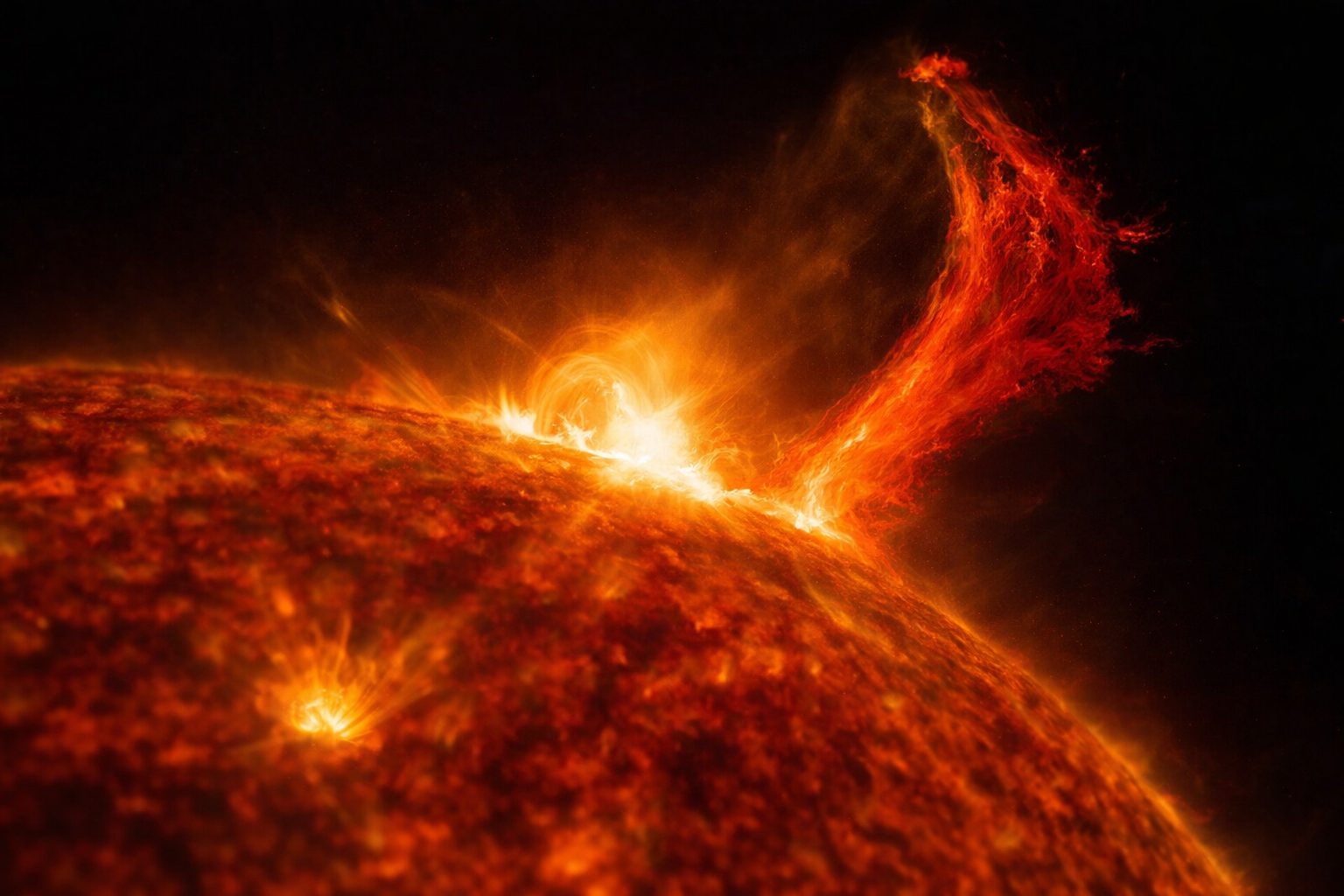
- NASA’s space-weather modelers traced the event to an X-class solar flare and a fast-moving halo CME that erupted on Jan. 18.
The National Oceanic and Atmospheric Administration’s Space Weather Prediction Center said a severe geomagnetic storm hit the agency’s G4 level early Tuesday, with storm conditions logged at 3:23 a.m. and again at 5:21 a.m. Eastern time. 1
Why it matters now: NOAA said a severe S4 solar radiation storm was also under way, a rare category that can raise radiation exposure risk for astronauts and for flights that use polar routes. It also cited higher risk for satellites and space launch systems and potential loss of over-the-horizon high-frequency (HF) radio links in polar regions. 2
In a separate alert, NOAA put a severe G4 watch in place for the Jan. 20 UTC day and linked the storm to a coronal mass ejection, or CME — a cloud of charged particles and magnetic field — launched on Jan. 18 with an R3 “strong” solar flare. It said storm levels could vary from minor to severe, and were likely to weaken later Tuesday, with residual effects possible into Wednesday. 3
The geomagnetic storm first reached G4 on Monday afternoon, hitting that threshold at 2:38 p.m. Eastern time when the CME shock arrived, NOAA said, and warned G4 conditions could recur as the CME moved through. 4
NASA’s Community Coordinated Modeling Center cataloged the solar eruption as a halo CME tied to a long-duration X1.9 flare from Active Region 14341, peaking at 18:09 UTC on Jan. 18. NASA noted gaps in imagery from the SOHO spacecraft during the eruption but said other instruments, including NASA’s STEREO-A coronagraph and a GOES coronagraph, captured the event. 5
A NASA-run WSA-ENLIL model run estimated an Earth shock arrival around 01:22 UTC on Jan. 20, plus or minus about seven hours, and projected a disturbance that could last roughly 10 hours. NASA cautioned that its DONKI products are experimental research information and pointed users seeking official U.S. space-weather forecasts to NOAA. 6
Forecasts also pointed to brighter auroras, or northern lights, across Canada and much of the northern United States, and possibly farther south, according to a NOAA forecast cited by The Guardian. Shawn Dahl, a service coordinator at the center, said the intensity had “not been seen in more than two decades.” 7
The alert put airlines that fly polar routes, satellite operators and space agencies on notice, as forecasters watched how the storm’s radiation and magnetic effects evolve over the next day.
But the worst effects are hard to pin down. Space weather can swing fast, and small changes in the CME’s magnetic field can blunt or sharpen impacts on the ground and in orbit, sometimes in short bursts.
NOAA said severe radiation storms of this level have not been observed since 2003, a benchmark year for modern space-weather planning.