
London, July 9, 2026, 16:25 BST
- Standard Chartered traded up about 3.5%, reversing much of Wednesday’s 4.23% fall.
- The move came as the FTSE 100 slipped, held back by AstraZeneca and renewed Middle East risk.
- Investors are looking toward Standard Chartered’s July 29 half-year results and its longer-term return targets.
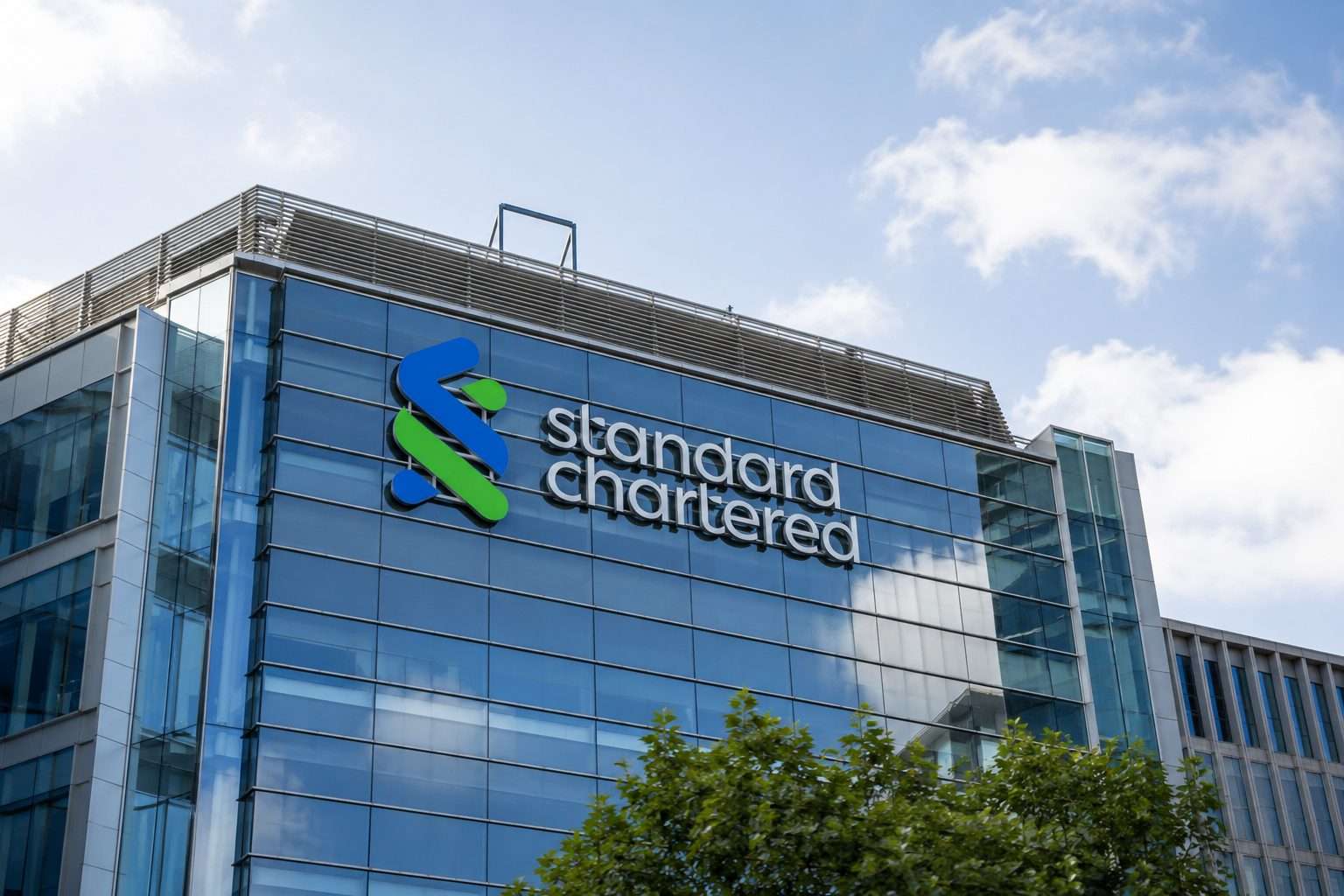
Standard Chartered PLC shares rose more than 3% in London on Thursday, outpacing HSBC and Barclays, as investors bought back into the Asia-focused lender a day after a sharp selloff.
Hargreaves Lansdown showed Standard Chartered at 2,107p to sell and 2,108p to buy, up 71p, or 3.49%, on delayed prices. The move put the stock ahead of HSBC and Barclays on the day, though all three large UK-listed banks gained.
| London bank share move | Latest shown quote | Day move | Volume shown | Market value shown |
|---|---|---|---|---|
| Standard Chartered | 2,107p/2,108p | +71p / +3.49% | 5.34 mln | £45.82 bln |
| HSBC | 1,458.4p/1,458.8p | +36.6p / +2.57% | 6.15 mln | £250.12 bln |
| Barclays | 508.9p/509.0p | +11.9p / +2.39% | 8.70 mln | £68.65 bln |
The rebound mattered because it came against a soft UK market tape. Reuters reported earlier Thursday that the FTSE 100 was down 0.6% at 10,417.63 by 1045 GMT, pressured by AstraZeneca’s late-stage trial setback and renewed Middle East concerns.
Standard Chartered had fallen 4.23% on Wednesday to £20.36, underperforming a 1.66% drop in the FTSE 100, MarketWatch data showed. The stock then stood 10.62% below its June 24 52-week high of £22.78.
| Market backdrop | July 9 latest/close shown | July 8 close | One-day change |
|---|---|---|---|
| FTSE 100 | 10,467.38 | 10,489.04 | -0.21% |
| FTSE 100 intraday Reuters snapshot | 10,417.63 | — | -0.6% |
| Standard Chartered previous session | £20.36 | — | -4.23% |
Investors also had company-specific dates in view. Standard Chartered says it will release second-quarter and half-year 2026 results at 05:00 UK time on Wednesday, July 29, followed by a virtual presentation at 08:00 UK time.
The bank has spent the past two months trying to give investors a longer road map. In May, it set a target for return on tangible equity — profit measured against shareholders’ tangible capital — of more than 15% in 2028 and about 18% in 2030. It also targeted high-teens earnings-per-share growth and a 5%-7% income compound annual growth rate from 2025 to 2028.
That is the bull case behind the stock’s recent strength: more wealth income, more cross-border corporate banking and tighter costs. Reuters reported in May that Standard Chartered also planned to cut more than 7,000 corporate function roles by 2030, helped by automation and artificial intelligence.
But the risk side has not gone away. Ed Firth, an analyst at Keefe, Bruyette & Woods, told Reuters that “performance may prove more challenging further out,” citing the lift banks have had from high rates and strong wealth flows. Standard Chartered also set aside $190 million in first-quarter precautionary provisions linked to the Middle East conflict, Reuters reported. Reuters
The bank’s recent announcements show where management wants growth to come from. On July 7, Standard Chartered said it had completed seven gold transactions through Hong Kong’s gold central clearing and settlement system; Chief Executive Bill Winters said “Gold is becoming increasingly important” as investors and central banks seek diversification. Standard Chartered Bank
A day earlier, the bank said it had partnered with BlackRock on an Asia-Pacific multi-asset fund for wealth clients. Sumeet Bhambri, Standard Chartered’s global head of advisory and managed investments, called it a “well-diversified, institutional-quality solution,” while BlackRock’s Andrew Landman said the firms saw “compelling opportunities for active investing.” Standard Chartered Bank
Standard Chartered has also pushed further into digital assets. On July 2, it said it had launched, with Circle, bank-led access for institutional clients to minting and redemption of USDC, a dollar-linked stablecoin; Roberto Hoornweg, chief executive of corporate and investment banking, said digital assets were an “increasingly important component” of global financial infrastructure. Standard Chartered Bank
The stock move, then, was less a single-news reaction than a reset after Wednesday’s selloff. The next harder test is July 29, when investors will look for evidence that wealth inflows, capital discipline and credit risk are still moving in the same direction.